Interview With ‘Loki’ and ‘Rick and Morty’ Writer Eric Martin Part Two: Dealing With Criticism From Studios and Fans
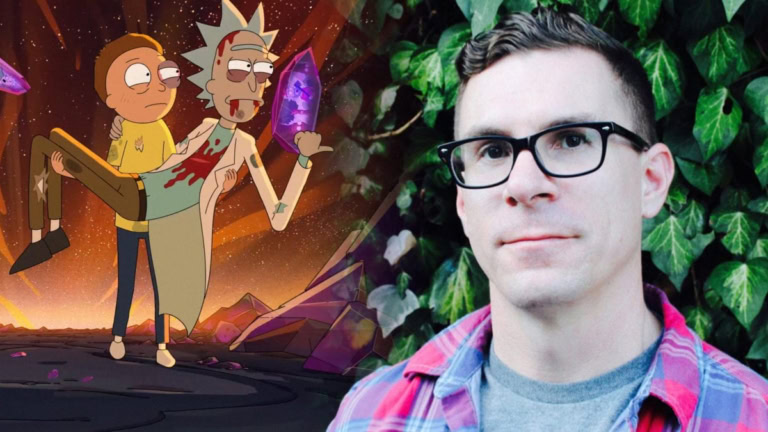
We’re back for the second part of our interview with Rick and Morty and Loki writer Eric Martin! Read on for more on his personal writing process and advice to those looking to break into the industry!
Have you received feedback or criticism in terms of how you’ve handled writing certain characters and themes that you can’t personally relate to in certain ways (ex. Sexual orientation) and how do you “take it in”? Are you able to separate those kinds of critiques from “petty” attacks (ex. trolling)?
EM: I want to listen to it all and take it all in, and really try to internalize any kind of criticism; especially if you see it repeated [you want to] find the validity, I want to try to find the validity. And then also [with] something like Loki, I am just one of many voices in there, and certainly did not have the kind of control to, like, dictate certain things. And so with that, it’s like I’m looking at it from a little bit afar, so that’s not quite as personal [as opposed to a situation where] I was the sole author; I was not the sole author of [Loki].
I’m always trying to see if I have a blind spot on something, right? And I don’t think it’s always so clear [at] the time; I think I try to not make a judgment on something that’s unfinished. If something’s not done and people don’t know the full context, people are making lots of assumptions and everything. So I want to always give it time and, you know, step back, but I’m listening; I listen to everything because I do want to know. Because to me, writing is just a constant evolution of self and just trying to put more experience into myself so I start to understand the world better and understand every individual a little bit better.
So I’m just looking to take it all in, hear it, react to it, but not spin out over it. I want to just understand it […] I’m always looking for an opportunity to grow as a person, right? And I just look at it in the same way.
Can you recall a time your outlook was changed after receiving this sort of feedback on your work?
EM: I’ve had a lot of scripts where people have thought they were written by a woman and they had a different response to them based on that. I think if you write [even] just with a female lead people will assume that you’re a woman because your lead is female, and a lot of times people will just write along the lines of “male”, “female”, “non-binary”, whatever they themselves are. And because that is so common people just automatically assume that, but also being able to write multi-faceted people characters, people just assume that men can’t do that.
But that’s the thing, people might see a white man but they wouldn’t know that I was raised by three women and they wouldn’t understand that I might actually have a certain understanding of American women of a certain age because of my life experiences, and I’ve definitely had some of those where people were surprised that certain things were written by me because I’m not what they saw what is in their head already as to who the person would be to write something like I’ve written.
Speaking of feedback, how do you deal with notes from a studio you’re working with that a script needs changes? How does that differ from audience criticism?
EM: I’ve definitely had to deal with that in both features and TV where it’s like all of a sudden something has to just change completely. [I] give myself time to mourn and be like, “ugh no that was terrible, that was good! They don’t understand! Blah blah blah,” and then wake up the next day and try to find an opportunity in it, and there’s always an opportunity. Every note that you hate is actually an opportunity to make the thing better, because you’re gonna rethink what you had, and now you’re gonna put some more work into it and elevate it up. That’s how I always try to look at it, like, “alright, how do we let this make it better?”
But I just mourn it first, and then just jump in and do the work. It sucks you have to toss a lot of things out, but if I can just sit there dwell on it for just a little bit but then just try to control the situation by working on it, I can come to terms with it and just keep moving on.
What is your “mourning process” like?
EM: By the next morning, I have to be over it. I run a lot and I’ll usually just go for a run and just think on it and by the time I’m done running I will have gotten somewhere where I’ve worked through those feelings and just that panic and just awfulness of, like, “no, all is lost!” And then the moment that first new idea comes in, and it’s like, “okay, alright, alright, there is a way. This isn’t hopeless,” and as long as I have that little bit of hope, I’m okay.
Do you normally have a feeling that your work is going to get criticism from studio executives before it does? Do you ever have backup ideas ready to go just in case?
EM: It depends; there have been times when I knew something was never gonna make it, and there were other times when I thought something wouldn’t and it sailed right through. You can’t always predict it, but yeah, there have definitely been times when something will just feel like, “this is never gonna make it,” and it might be because I don’t think it’s very good as is, or it might just be too ambitious. And I haven’t always been able to predict on either of those.
Sometimes I will not have thought about things from a certain perspective, and when somebody calls it out it’s like, “ohhhh. Thank you!” Like, that hurts, because now I have to do all this other work, but nobody’s perfect the first time out [of] the gate, right? We’re all on this journey to be better, and that goes along with the writing too. You can’t just expect everything to be perfect the first time, and it’s okay if it isn’t. I put a lot of pressure on myself to make something perfect, and so there’s always that little bit of a sting, like, “oh yeah, it’s not perfect,” when somebody reminds you of that, but, “thank you for pointing out that it’s not perfect; I had reached the point where I couldn’t see what was good or what wasn’t in that area, and now I have a chance to actually make this better, and learn a little something.”
Do you normally look at audience feedback on your projects right away, or do you let things simmer for a bit?
EM: [On] every social media platform, the people are in a bit of an echo chamber that’s very big and very real to them […] Reading what’s on Twitter, you might get a totally different response than something that might come in when you’re just talking to people in everyday life. And we all have an echo chamber, right? We all have some sort of thing around us where we’re surrounded by people [who] think similarly to us, and so they’re [probably going to respond] more favorably to something that you do than the average person, and so you have to get out of that.
And so I listen everywhere to everything as much as I can […] I think all the online stuff is completely valid, but it’s not more valid than just talking to people out on the street and hearing people face-to-face, their response to things. Because I’m always fascinated to hear when people just start talking about something, and they might not know I’ve worked on [that thing]. That’s always really interesting.
How much do you take fan feedback into account when working on the next installment of a project?
EM: I think everybody’s listening to everything, but you have to pick and choose what you allow to drive things and what you don’t. I think it’s just [a matter of] constantly weighing things, just having that innate feeling; everybody in those rooms, they’re all very sensitive people; that’s why you can do that work and wear the skin of another person and many other people, it’s because you’re very sensitive by your nature.
And I think with that you are consuming everything, you’re internalizing everything that’s coming at you, so there’s going to be the conscious and the unconscious version of that, right? Some of it you won’t even realize [is] altering the path of what you’re doing, and then there are things that are very much talked about. But for the most part, I’m a believer in [not giving] people exactly what they say they want because they don’t actually want that.
There are a lot of different versions of that, and I think it’s like, I’m always listening for the emotion, the emotion people want. [I’m less interested in] specifics, like people say, “I want this person to do that!” […] I step back and am like, “but why do you want it?” Because we work in the feelings business; I want to know what the emotion is that they want out of that, that’s what I’m trying to understand. And it’s like, okay, let’s get to that emotion; that’s the important thing.
Do you have any advice for aspiring sci-fi writers about setting up a good framework for the “rules” of their fictional universe?
EM: I think you just have to put the time in. You have to have a lot of conversations, a lot of arguments, and you just put all of that in there and it’s just going to be time-consuming and that’s okay. I think in general for people that want to write, cut yourself some slack, and know that it’s hard, and that’s okay. […] It’ll never not be hard, you’ll just get a little bit better at it.
But for the world-building stuff, just do a little bit at a time. Give yourself an anchor, and just keep building from there, because when you’re looking at that blank page [and] you know you have to build this whole world, it can be really intimidating. But if you just give yourself some little things that you can anchor, and just keep building from there, and know that you might even change the very first thing you anchored on later on [and] that’s fine. Just keep building, just keep moving forward, keep working, and you’ll get there.
You’ve also been a producer; what has your experience in that role been like?
EM: For me […] being on set is a very specific job. You’re there to make sure the story continues as it was written, and make sure if a line is changed – like somebody improv’d something – the important information still gets out, and that there is somebody there protecting that continuity.
A lot of it’s just being that person [who’s] there to “put out a fire”, right? “This line isn’t working, there are 200 people sitting around waiting – write something new!” Sometimes you have to do that. And that can be a pretty exciting [and a] pretty nerve-wracking thing.
There have definitely been situations where, like, maybe a major actor was doing something with a day player, and the day player was having maybe a little stage fright working with this major actor, and it’s like, “okay, how can we make this section of dialogue more digestible [and] easier to read [and] still get this same information out?” And then you have to do that, whereas, like, in the safety of your house when you’re on your laptop you might be able to sit there and work on that for half an hour to get the right thing, but when you’re on set it’s like, “I’ve got 30 seconds to write this!” [And then it’s like,] “okay, here, try this.” That’s how that will function a lot.
And then there’s also, like, working with the actors, working with the director, working with the producer on a myriad of different things, any kind of different problem that pops up. I look at production kind of like going to war; it’s wildly inefficient and it’s something where a lot of people just had to come together real quick to achieve an objective, and you’re all just thrown into this thing and you just have to try to help the best you can to get it down the line.
It’s a lot of responsibility, it’s an honor, you know, a lot of people will have worked really hard to get those words on those pages and you just want to see it through in the best way possible. You just hope that everybody feels proud of what ends up on there, and just fight to make the best thing possible. I really respect the work that everybody does, and I respect the whole process, and I enjoy the collaboration so much, and so it feels like a real honor to be able to see that through.
What are your goals moving forward in your career?
EM: I just want to tell emotional stories, complicated human emotions portrayed in a way we can all expand our humanity and find the ways that we kind of interconnect and just explore the human condition. I mean, I know that all sounds pretty ridiculous, but that’s what’s so interesting to me about it all, just exploring humanity and people.
For me it’s just all about emotion, that’s what I love exploring, especially complicated stuff where it isn’t just so, like, clearly down the middle of what somebody’s supposed to be feeling, like loggerheads where it’s like: somebody feels one way, somebody feels another way, and they can’t find that alignment and that kind of conflict in there. I like feeling that gutting version and then finding the positive that can come from that as well. And it’s just like a dirty mess to somehow get through life, but you feel all the big stuff, all the small stuff, and then you get there at the end and it was all worth the ride. [I like] just getting in there and not being afraid to make things a little sad, because you can’t get that happy without that dark sadness, right? Like the happy’s just not worth much [without it].
I love those really old Disney movies where like, they’re a little scary and sad and dark. Bambi? That made me cry as a kid but still, I loved to watch it, and that’s the thing, it’s okay to feel a lot of different emotions, and it’s good to feel sad sometimes, it makes the happy really pop and be so much better!
That’s it for my two-part interview with Eric Martin! If you missed the first part, it’s available to read here.
The first season of Loki is currently available to stream on Disney+, and Rick and Morty episodes are available on Hulu and HBOmax.