‘Disclosure Day’ Review: Spielberg Takes a Thrilling Sci-Fi Swing
Back in the early 2000s, Roger Ebert dubbed Minority Report a “triumph” during a time, as he called it, “when movies think they have to choose between action and ideas.” And this was during a creative era for Spielberg, when the iconic director felt emboldened to explore new territory. UFOs may not be fresh material for the E.T. filmmaker, but Disclosure Day feels very reminiscent of this time period for Steven Spielberg. The film has all the window dressing of an espionage thriller, as two unlikely protagonists race to expose a government cover-up. But it’s the fascinating sci-fi concepts carefully interwoven that make Disclosure Day something truly special. And it’s a bonkers premise that only Spielberg could make work.
What is Disclosure Day about?
Written by Spielberg’s longtime screenwriter, David Koepp, with Spielberg sharing a story credit, the film focuses on two moving narratives that slowly come to the verge of colliding over two hours. The first is Dr. Daniel Kellner (Josh O’Connor) and his girlfriend Jane (Eve Hewson), who, right from the start of the film, are on the run from a powerful government official named Scanlon (Colin Firth). Kellner’s subplot bears a strong resemblance to the real-life situation involving Edward Snowden. Kellner used to work for Scanlon’s shadowy agency, Wardex, before deciding that the agency’s secrets deserved to be shared with the world.
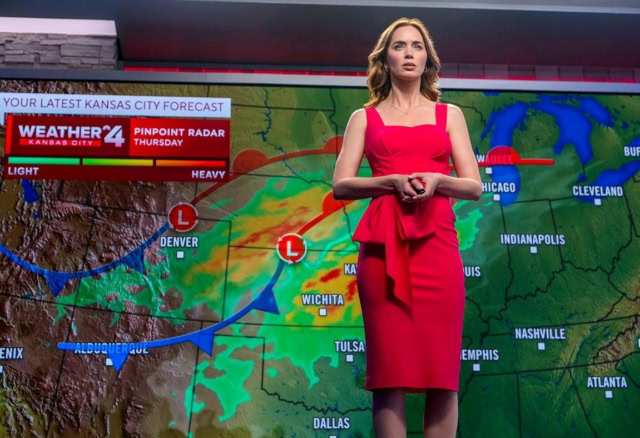
Simultaneously, we focus on the weather personality for a news station named Margaret Fairchild (Emily Blunt). She leads a mostly mundane life with her boyfriend, Jackson (Wyatt Russell), but she suggests she feels unsettled in both her personal life and her career. And at the introductions to their dynamic, we sense that they have moved around a lot.
After a small relational exchange between them, a red cardinal flies through the window and stares at Margaret intensely. From here, Koepp’s screenplay cleverly strings together a series of situational comedic moments. Margaret begins exhibiting odd abilities, such as reading minds, speaking fluent languages, and more. And no one knows how to react to her. Then she goes live on air, speaking in that strange manner as seen from the trailer. The event places Margaret directly in the crosshairs of Scanlon and his team at Wardex.
Steven Spielberg’s eye for thrilling setpieces
From the moment Margaret speaks that strange language on the broadcast, the film jolts into a nonstop chase over the course of ninety or so minutes as both Kellner and Margaret run from the questionable agency chasing them. It’s in this section that the experience feels most like Minority Report, as Spielberg creatively finds new ways to keep the chase fresh moment to moment. For example, there is a sequence with Colin Firth involving a piece of alien technology that felt as inventive as the robot spider bathtub sequence in Minority Report.
The same can be said for Spielberg’s incredible cinematic prose for composing adventurous action. The setpieces in Disclosure Day are thrilling and orchestrated with robust personality. One sequence, involving a train, might be one of the most intense of the summer and is masterfully realized as a thrilling setpiece. It’s one of the fresh reminders about why Spielberg is one of the best in the game. He is one of the few filmmakers who can inject so much personality and heart into these high-octane moments.
Not to mention, every frame is lush with that Spielberg flavor thanks to his longtime cinematographer, Janusz Kaminski. He does not incorporate the bleach-bypass effect from Minority Report, but the signature overexposed light remains, framing the action coherently for the viewer to devour.
What will be difficult to surmise is how audiences will react to some narrative choices in between these thrilling setpieces. There is one subplot featuring a character named Hugo (Colman Domingo) and a house that comes across as a headscratcher upon first viewing. Without giving away too many details, Hugo and his team are in the process of bringing something into existence to help someone reach their potential. But upon first viewing, it feels like the screenplay lacks clarity about how Hugo knows to do this or why it is the only path to achieving the character’s growth.
Spielberg and David Koepp make bold choices for Disclosure Day

Additionally, similar to Minority Report and other works like A.I., Spielberg takes a heavy risk in the third act and leans into divisive territory. The finale will either be a massive success for some viewers or extremely far-fetched for others. Personally, the closing number left me with a mixture of both. I found the ending audacious and surprisingly emotional, yet teetering on the edge of silly. Yet, I’m unsure how the movie could end any differently.
The finale aside, the film also explores the religious ramifications of revealing the existence of UFOs or UAPs. Kellner’s girlfriend, Jane, has a religious background, having served in a nunnery. She wrestles with whether exposure would be good for a religiously fragile human race. The topic sparks an interesting dialogue between Jane and a character named Sister Maura (Elizabeth Marvel). However, I’m uncertain how accurate the conversational details are in scripture. It will be interesting to see how the more extreme Christian population reacts to these story elements.
Overall, Disclosure Day is another exciting entry for the acclaimed filmmaker. It’s not as great as E.T., but it feels like Spielberg in his Minority Report era. It keeps the audience enthralled in an intriguing chase with amazing character work. But similar to his early 2000s archive, such as A.I., the final act is going to be divisive. Despite some questionable creative risks, I enjoyed every adventurous minute.
Also check out: Masters of the Universe is a Bowl of Sugary Spectacle