Emerald Fennell’s ‘Wuthering Heights’: An Immersive, Sensual Ghost Story
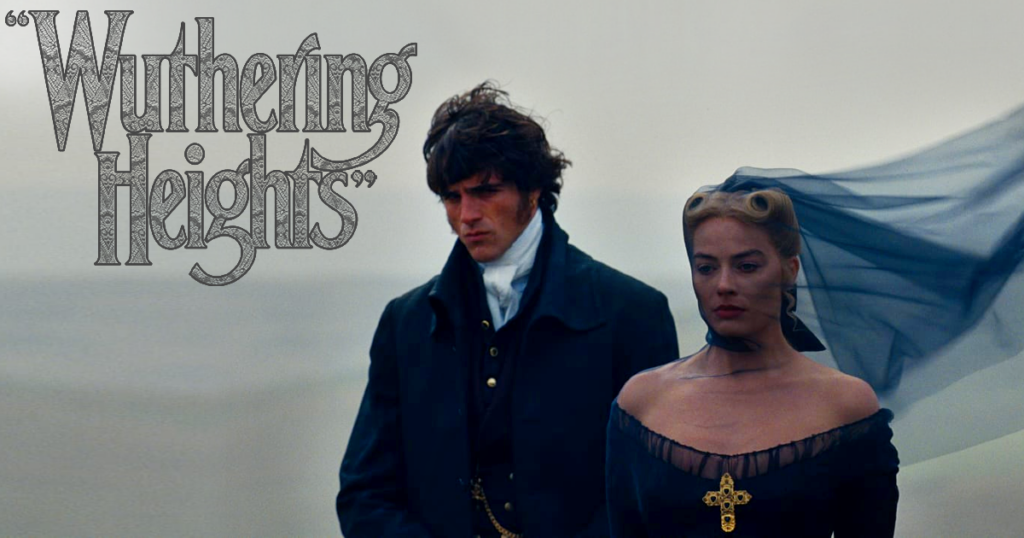
Emerald Fennell’s Wuthering Heights is a sensory fever dream that feels less like a traditional period piece and more like the Nosferatu (2024) of romantic tragedies. Starring Margot Robbie and Jacob Elordi, with music by Charli XCX, this is the latest adaptation of Emily Brontë’s only novel, which has been brought to screen nearly 40 times across film and television.
The story presents Fennell’s original re-interpretation of Catherine and Heathcliff, a toxic tragedy she compares to Romeo & Juliet. While the film is likely to be divisive among audiences, especially purists, it’s undeniably an audacious artistic statement that sets it apart from so many other adaptations of the same book.
The immersive atmosphere of Wuthering Heights
With jaw-dropping sets and cinematography accented with bold colors, the most striking element of the film is its sheer aesthetic power. The production design, color palette, and costumes create a world that feels entirely immersive, moving beyond historical accuracy into something gothic and haunting, almost in conversation with Guillermo del Toro’s Frankenstein and Robert Egger’s Nosferatu.
Every frame by cinematographer Linus Sandgren is stunning, utilizing 35mm film to provide a timeless texture that is equal parts decadent and decayed. While not a perfect movie, it would be a worthy experience in IMAX for the full scale of the visuals alone.
Emerald Fennell’s writing and direction fixate on the more unsettling aspects of the story. She magnificently evokes visceral emotions to intentionally trigger emotional bodily responses from the audience, eschewing the polite restraint usually found in classic literature adaptations. Blood flows from a body like a river, bread is kneaded with sexual fervor, and empty green gin bottles pile up around an alcoholic like a Christmas tree.
Color plays an essential part of the visual storytelling. The cinematography is loaded with immaculate shots accented by blacks, whites, and reds and contrasted with murky grays.
The sound design and musical direction guide the experience less explicitly but just as meaningfully. There is no nudity, yet the soundscape of Wuthering Heights is intensely sensual, cleverly using mundane sounds to tease the audience’s emotions without crossing boundaries. The effect creates a state of “craving” more than anything fully satisfying, a hunger that is never fully fed.
The music combines Anthony Willis’ classical score with more modern music by Charli XCX. This creates a combination that is both elegant and brutal, powerfully accompanying Fennell’s vision for the film.
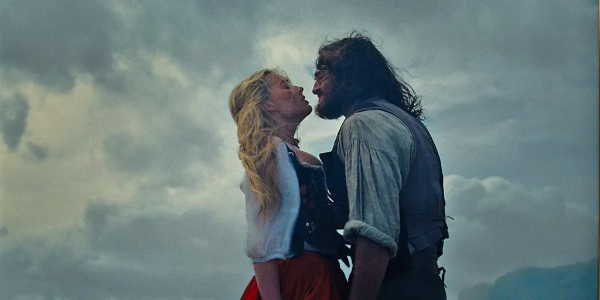
Adapting Emily Brontë’s transgressive, toxic tragedy
Wuthering Heights plays out like an erotic ghost story. Questioning the very nature of love, revenge, safety, and identity, the movie is a tour de force of how toxic behaviors fundamentally transform who we are.
The primary story is an emotionally immature cat-and-mouse rollercoaster between Catherine (Margot Robbie) and Heathcliff (Jacob Elordi) which evolves into delusional obsession. Both actors bring sincere performances that fluctuate wildly between warm and cold as their characters suffer the consequences of their own design. Catherine and Heathcliff consistently make bad decisions, and the audience is invited to watch those mistakes spiral into disaster.
This ultimate confidence comes from the fact that Fennell is hardly interested in the audience actually liking the characters. Instead, she focuses on creating a cinematic experience, letting the atmosphere and emotion of the messy drama carry the viewer through the film.
Fennell’s tone is sure to be one of the most controversial aspects of the movie. From mourning to eroticism to misplaced humor, the tenor of the film often shifts in ways that are unclear or jarring. However, the lack of clarity is arguably the script’s greatest strength. The bold vision leaves the experience open to interpretation, allowing different audience members to have radically different reactions.
Even the story itself is unclear at times, presenting a form of heightened reality: Fennell is clearly more interested in creating a surreally visceral experience rather than filling in all the details or adhering to book authenticity, but the result is a film that’s fully engrossing from start to finish.
Final thoughts on Emerald Fennell’s Wuthering Heights
Emerald Fennell has created an unapologetic maximalist take on a classic. This new version of Wuthering Heights is breathtaking, erotic, confusing, and immersive. Elegant yet brutal, this is a romantic extremity with high-quality filmmaking that deserves to be seen on the big screen. While not designed for everyone, this is a challenging work with a unique point of view that elevates what literary film reinventions can be.
Also check out: The Moment Review: Charli XCX’s Witty, Incomplete Brat Summer