‘Enola Holmes 3’ Review: A Major Disappointment

Why so gloomy, Enola? Why so drab? Why so dull? These are questions I asked myself while watching Philip Barantini’s Enola Holmes 3, a sequel that made sense, considering how great Harry Bradbeer’s 2022 second entry to one of Netflix’s most popular films was. Millie Bobby Brown was born to play the titular character at the center of Nancy Springer’s book series of the same name. She’s given the most compelling performances of her career, constantly involving the audience in her mysteries by breaking the fourth wall and allowing them inside her mind palace.
While we still get access to Enola’s intuitive mind inside a story that consistently flows between her past adventures and her current case, what’s on screen is staged with such lethargic energy that it begins to lose our attention. It’s a real shame that Bradbeer was likely busy with Spider-Noir and couldn’t return to finish off what could’ve been a great trilogy. Barantini has no clue how to treat characters that were once interesting to watch on screen, now devoid of the wit and charm that made their respective filmic iterations of Sir Arthur Conan Doyle’s large universe stand out.
The plot of Enola Holmes 3
The core problem that plagues Enola Holmes 3 is how self-serious it is, compared to the last two installments, starting with the kidnapping of Enola’s brother, Sherlock (Henry Cavill), the day of her planned wedding to Tewkesbury (Louis Partridge).
Of course, this is a personal case for Enola, as her brother means everything to her, and his behavior felt suspicious before her nuptials. But the one defining trait that has characterized this franchise is fun, and that word is sadly absent from a sequel with no discernible identity of its own.
A sequel film that dulls the impact of its predecessors
Barantini is primarily known for his continuous one-take films and television series, including Boiling Point (which was followed by a limited series) and the Emmy-award-winning Adolescence, which could’ve given this third entry in the Enola Holmes franchise a particular flair. However, you’d never know that he was behind the camera for this one.
He tries desperately to create fast-paced montages, à la Guy Ritchie, as Enola’s mind picks up some clues from her past to apply to her current case, but they never feel purposeful. In fact, they complicate the film’s admittedly simple plot and create a rather dizzying sense of motion as it moves from one setpiece to the next.
Speaking of, there isn’t a single memorable setpiece in the movie. While Bradbeer’s second installment had a bevy of playful and kinetic action, what’s staged in Enola Holmes 3 is devoid of any propulsion or the same excitement found in the last go-around with the character.
Even the climactic action fight between the various characters and Moriarty (Sharon Duncan-Brewster) makes little visual sense. The action is lazily shot and choreographed, and the editing is indifferently handled. It’s almost as if this sequel was made to fill Netflix’s quota for “movies to watch while folding laundry” rather than something with actual cinematic substance.
When Enola reunites with Moriarty for the first time in this film, the resulting confrontation is so nauseating that one has no idea where the characters are in any given moment. It almost feels like the Superman IV: The Quest for Peace of the Enola Holmes franchise. The studio was somehow able to get all the original players from the last few movies (minus Adeel Akhtar’s memorable presence as Lestrade), but doesn’t put the same effort into staging sequences with the same sense of grandeur as we’ve come to expect.
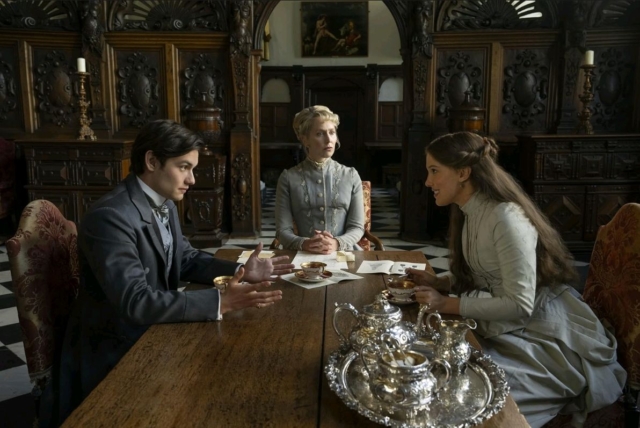
The case isn’t at all interesting, either. It attempts to tie so many loose threads together rather conveniently, rather than making all the puzzle pieces feel urgent. We never understand Moriarty’s motivations apart from a personal vendetta against Enola and Sherlock or the lengths she takes for her plan to be foolproof and make the world’s greatest detectives stumble as they try to uncover her sinister plot.
The final nail in the coffin occurs in the movie’s very last shot, an image so laughable that one could treat it as a deus ex machina and be entirely correct. In any event, Jack Thorne’s screenplay is such a far cry from his previous one that one can’t believe he didn’t take another pass and further flesh out what was most essential in this sequel.
Thankfully, none of the actors has lost a step. Millie Bobby Brown is still excellent as Enola Holmes, although her relationship with Louis Partridge’s Tewkesbury takes a bit of a backseat here. Their sequences together don’t have the same emotional potency as the last film.
Henry Cavill is once again wasted, in a role he could’ve probably done in his sleep, and doesn’t even get a few heart-to-heart conversations with Enola as he had in the previous two outings. He’s confined to a jail cell for most of the runtime and has nothing to do.
The casting of Sharon Duncan Brewster as Moriarty is particularly inspired, and the way she was set up in the second film made us believe she’d had a significant role to play here. Unfortunately, the character is nowhere near as psychologically riveting as some recent portrayals of the antagonist in previous movies. This Moriarty is reduced to a mustache-twirling villain with very little concrete motivation that would make her pop off the screen. The climax feels stunted because we don’t understand the villain beyond her sheer hatred of Sherlock and Enola, and yet in the various source materials, it’s far more nuanced than that.
Final thoughts on Enola Holmes 3

It’s sad that the Enola Holmes franchise will likely end on such a whimper, as there is doubt whether it will continue beyond the third film. What could’ve been one of Netflix’s most prized assets has turned out to once again be just another cog in the streaming algorithm.
If there’s going to be a changing of the directorial guard, allow them to infuse their own sensibilities in the material they’re treating. Barantini doesn’t look like he cares much, despite the rock-solid work from all of his cast members. If it weren’t for them, I probably would’ve turned this movie off long ago. Life is too short to waste my time on direct-to-streaming “content” that offers little to no value to me or anyone watching.
Also check out: The Invite Review: A Rare Remake that Surpasses the Original