‘The Invite’ Review: A Rare Remake that Surpasses the Original
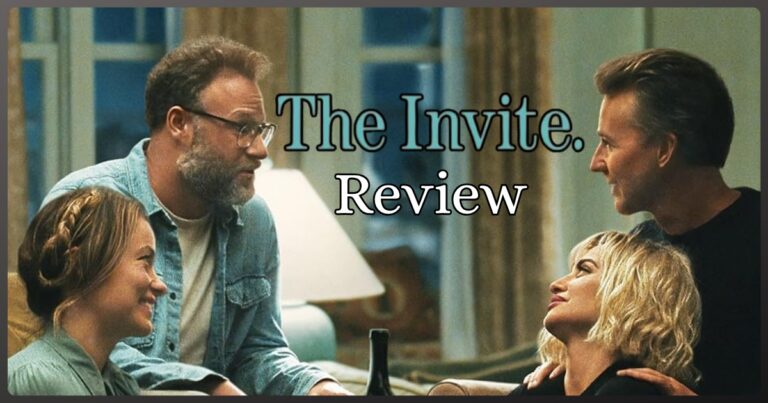
It’s rare to find a remake of an international film that’s better than its original text, but this is what Olivia Wilde does with The Invite. The film adapts Cesc Gay’s The People Upstairs for an American audience, which was also remade in Italy, Switzerland, France, and South Korea. Wilde, along with screenwriters Will McCormack and Rashida Jones, elevates the original film’s paper-thin characters and screenplay by making efficient choices that smartly add up once it reaches a sobering conclusion that you might not even see coming.
The plot of The Invite (2026)
The film’s conceit takes a rather unexpected turn early on as the married couple, Joe (Seth Rogen) and Angela (Olivia Wilde), hosts their neighbors, Pina (Penélope Cruz) and Hawk (Edward Norton), for dinner. Joe and Angela have problems of their own, but the two can’t stand the lovemaking noises Pina and Hawk make and want to take the opportunity to get to know them away from their individual apartments.
However, their neighbors have plans and want to invite both Joe and Angela to one of their sex nights. That’s where the movie opens up in ways I didn’t register, even though it’s painfully obvious from the get-go.
Joe is a music teacher who wishes to do so much more with his life, while Angela wants more affection out of her husband. His back pain is a constant reminder that his life isn’t panning out the way he wants to, while Angela carries the metaphorical weight that’s put on his back.
It’s a relationship that’s destined to peter out, but the two don’t want to confront this inextricable fact. That said, Joe believes there’s a bigger problem at play when his wife tells him she’s invited the neighbors, finally giving him the opportunity to tell Pina and Hawk how he really feels about them.
Olivia Wilde proves her directing talent once again
With a propulsive, effervescent comedic style worthy of Mike Nichols, Wilde reinterprets The People Upstairs to fit her own sensibilities as a director still searching for a voice. If Booksmart was the first step to being revered as a trailblazing voice in modern cinema, Don’t Worry Darling certainly wasn’t a follow-up that was deserving of her talents.
The Invite proves to us that her sophomore effort was only a fluke, because Wilde is in complete control of every single aspect of this production; from its razor-sharp editing that punctuates McCormack and Jones’ rhythmic script as if it’s a high-energy thriller, to a visual style that owes a lot to the great comedies of the 1960s.
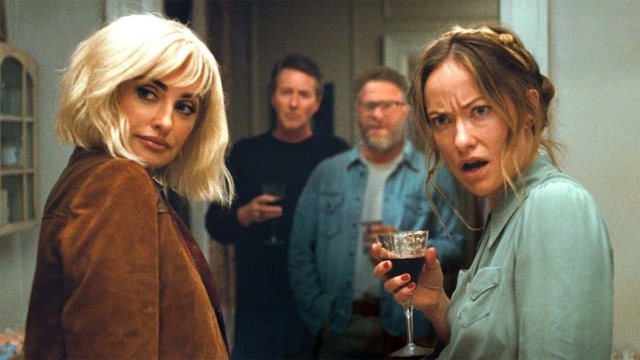
Perhaps the Bernard Hermann-esque music from Devonté Hynes is a bit too overbearing, but the resulting tension from its pitch-perfect performances could’ve only been accomplished by a director who knows exactly what she wants out of her star-studded cast.
In fact, I’d argue that directing The Invite is a far more daunting task than doing something like Don’t Worry Darling. Because in that movie, you have the luxury of working in various environments, whereas this remake of Gay’s Spanish-language film is entirely set in one location.
Because of this, you have to make the dialogues feel natural enough to pull you into the story and create a flow between the various conversations that populate the film’s 107-minute runtime. Especially as you build upon the unspoken tension between Joe wanting to tell the neighbors about their sex and Angela attempting to keep their discussions civil.
The Invite overcomes its chamber piece challenges

The characters have to feel believable (or attachable) enough for you to want to learn more about them and their perceived vulnerabilities. You want Wilde to open them up, but there needs to be a pact between the audience and the characters, and that starts with making the dialogue exchanges palpable and full of humanity.
Of course, the actors have to be up for the task. Luckily, Olivia Wilde has assembled a killer cast of elite actors who know exactly how to let the protagonists’ unspoken exchanges resonate louder than their words, ensuring that the tension builds to a certain point before everything is laid bare.
Seth Rogen, in particular, gives one of the best performances of his career, this close to beating his magisterial turn in Steven Spielberg’s The Fabelmans. His traditional sense of humor is well-exploited, sure, but it’s when we get away from his house-style of comedy and try to figure out what makes Joe experience chronic pain that Rogen shines the most.
Edward Norton is the most classically trained actor of the bunch, but there’s a scene where he accomplishes something with his face that will stick with me for a long time. I’ve simply never seen him in this position before, and that’s where you know you’re in the mark of a director who knows what they’re doing.
You also shouldn’t make the chamber piece feel stylistically muddled. Sadly, The People Upstairs has no sense of aesthetics nor a visual language of its own. Wilde corrects this by shooting The Invite on film, creating an emulsifying language that’s always alluring to look at. She consistently moves her camera and offers thoughtful perspectives as she divides the couples through the space and even deftly employs mirrors to represent the fractures among the characters.
There probably isn’t a more personal touch than her hand-drawn tribute to the late Diane Keaton, to whom the film is dedicated. If there isn’t a more devastating final image than the one found in The Invite, the one-two punch of following it with a “For Diane” title card was too much for me to bear.
Wilde even explained why this gesture was necessary, stating that “no one would have felt it more deeply than her.” After watching this generational comeback, which proves that Olivia Wilde will be making more masterpieces than disasters, I couldn’t agree more. If only she were still here with us to witness such thought-provoking entertainment that would become a major turning point in Wilde’s acting and directorial career and pave the way for more artists to follow in her footsteps.