‘Fallout’ Season 2: A Great Expansion on the First Season
Prime’s Fallout season 2 has a lot to prove after the success of the first season. In some ways, it’s more modest than the first season, but with even more dangerous enemies than before. The new episodes delve deeper into moments of self-discovery, exploring the power dynamics of a post-apocalyptic world and examining the remnants of morality and what it means to be a good person, while still delivering the dark humor and violence that Fallout is known for.
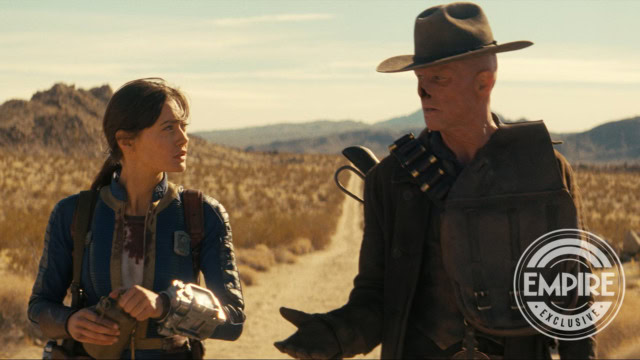
What becomes clear quickly is that this season is all about consequences. The world has always been broken, but now the characters are broken in more precise, personal ways. Lucy (Ella Purnell) is no longer naïve, but she is actively choosing and learning how to exist in this wasteland.
The Ghoul (Walton Goggins) is no longer just a mystery character. Instead, he is a man haunted by his past and the questions he may decide later in the story that he didn’t want to know the answers to.
Maximus (Aaron Moten) is not punished by the Brotherhood due to his past and recent choices, but he tries to overcome every obstacle and live with himself while being a part of them.
The story in Fallout season 2
After the events of season 1, Lucy’s pursuit of her father Hank (Kyle MacLachlan) became something more than a rescue mission. What she wants now is accountability for every bad thing he did. The man who raised her with an optimistic look at life and good values became a symbol of everything Vault-Tec represents at its worst.
Now Lucy is forced to confront the uncomfortable truth. No matter how good her father’s intentions were, from the perspective of others, he is an evil man who turned his wife into a ghoul by bombarding one city. Even though Lucy still believes in justice, she is beginning to understand how fragile that concept is in a world built on lies and the effects of capitalism.
This time, Lucy isn’t alone. Traveling with her is The Ghoul, whose partnership is creating one of the best parts of the show, thanks to their dynamics and battle of morale. It’s thanks to him that Lucy is starting to see things for what they really are.
His approach to justice is brutal, efficient, and deeply personal, all thanks to the betrayal on a global scale, which is revealed this season. Their relationship is also still one of different points of view. Where Lucy, most of the time, sees people whose systems failed, The Ghoul sees people who deserve punishment.
Maximus’s storyline also becomes one of the most crucial in the show. He is now a knight in the Brotherhood. Maximus must still understand what it is that he desires. Is it to belong with what the Brotherhood actually stands for or to understand the harsh truth and risk everything to learn it?
A great addition to the show is showing the known characters from the Fallout games. One of those is Robert House (Justin Theroux). He was most commonly known from Fallout: New Vegas. He is a technocrat who believes he is the only one qualified enough to guide humanity’s future and decide what’s best for them.
House serves as the embodiment of the show. Each time he appears, there is a question raised, like who gets to decide what “saving the world” actually means, or “is it better to kill millions so you can rule a few thousand?”
Justin Theroux’s take on the character, both in the digital version and in the flashback scenes, immediately makes House feel unsettling. He never needs to raise his voice; he never has to act like he displeases someone or hates someone. His power lies in preparation, anticipation, and the belief that human lives are just numbers and variables in a grand scheme mathematical equation.
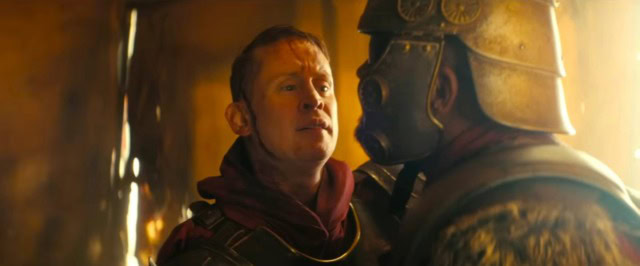
Another great introduction to the show is that of Caesar’s Legion and Macaulay Culkin as part of it. They are a horrifying group because their worldview is consistent, disciplined, and utterly inhuman. They model and describe themselves as a society that is meant to be expanded on a distorted vision of ancient Rome, even though they prove that they are creating a lot of danger by simply romanticizing the past ideals without understanding them.
Their brutality is not just chaotic. In the Fallout universe, their ideals lead to the understanding that the order can be just as terrifying as anarchy, but Caesar’s Legion embodies and spreads that truth.
Nods to New Vegas and other games
Fallout season two is deeply respectful of the games, particularly Fallout: New Vegas, from which it borrows and adapts some elements. The creative team understood that nostalgia works best when it has a believable context behind it that makes sense and is not overwhelming for viewers. Locations like Novac, Freeside, and the Mojave wasteland are instantly recognizable. These places feel alive, scarred in their own way, and not safe. In a way, they reflect the truth about the people who live there.
New Vegas city itself in a show is both a promise to the fans that creators respect the source material and a warning to the characters of the show. It is a city built on the illusion of control, a monument to human arrogance preserved through technology and careful strategic planning.
The show smartly explores the reasons that made the game’s world so beloved, and it refuses to declare which story from the games is canon and which one is not. Which is a good thing. Instead, the show explores the aftermath of the choices of the game without telling the audience which choices were “right.”
Perhaps what’s most important is that the show captures the games’ essence and soul once again. There are no real victories here, no good moral choices, no factions that are they will win whatever battle will come. Democracy, autocracy, technocracy, tribalism, and all of that are presented and shown as flawed ideals that may end sooner than later.
Final thoughts on Fallout season 2
Season two of Fallout really does is expand what was established in the first season and uses it to create an even better story. Characters are no longer typical representatives of hero archetypes exploring a strange, dangerous, or unknown world.
The second season also feels more set in the game tone. The humor has improved, and the violence serves a bigger purpose. Of course, there is still spectacle, absurdity, and retro futuristic nonsense that somehow feels grounded, but it all serves a larger purpose in the story.
Ella Purnell, Walton Goggins, and Aaron Moten are still the highlights of the series, with performances that bring a lot of quality and love for the characters. The introduction of Robert House and Caesar’s Legion, with Macaulay Culkin as part of it, makes this season even better than the first one.
Everything in this show has its purpose. Either it’s to explore what happens when humanity’s worst instincts are the only thing left, why some people don’t deserve love, or what’s the true reason behind every single catastrophe that’s happening both in the show and currently in the real world. It’s a great meta commentary that gets really dark and serious when you really think about it.
With a third season already on the horizon, Fallout still feels like a series that has found its true purpose in adapting a great series of games and influencing this world. It was also recently confirmed that events of the show will influence some parts of the Fallout 5 game, which is still in development.
Now that’s what I call a connected universe. This is just another reason for you to watch the show and even to start the playthrough of the games once again or for the first time.
Also check out Fallout Review: A Post-Apocalyptic Story Worth the Wait