‘Star Wars: Visions Presents – The Ninth Jedi’ Thoughtfully Expands the World of ‘Visions’
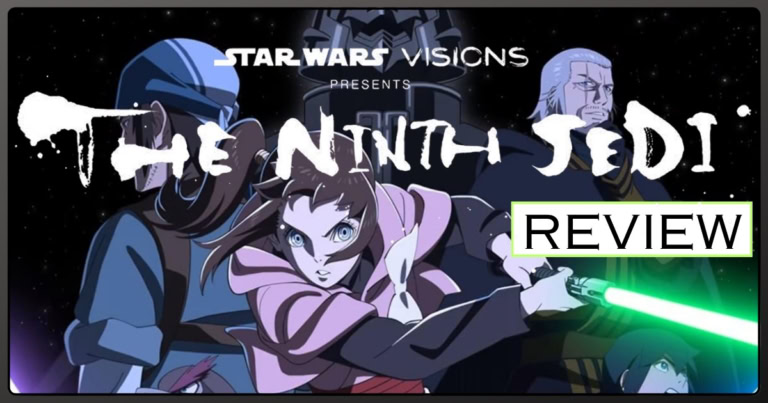
As unnecessary as spinoffs can get, Star Wars: Visions Presents – The Ninth Jedi might present itself as a series devoid of interest. I mean, the spinoff of two short films presented in the first and third seasons of Star Wars’ anime compendium Visions seems like one hell of a stretch to do an entire eight-episode series over. That said, The Ninth Jedi were the shorts with the most promise to expand upon the story of Lah Kara (Chinatsu Akasaki) and her journey of self-actualization as a Jedi in a world where few Force-wielders want to make themselves known.
It is, however, an extremely niche offshoot of shorts that few audience members outside the hardcore fanbase actively watched, which initially makes this allegedly first installment in the Vision Presents series (no other shows in that anthological collection have been announced yet) seem inaccessible. I’ve watched all three seasons, and even I had to remember what’s at the core of the first two shorts. Such as how creator Kenji Kamiyama and director Shunsuke Tada attempt to reinterpret our conception of the Force and lightsabers in a frequently visually dazzling but at times emotionally hollow affair.
The Ninth Jedi presents a reconception of the Force that yields some surprising texture
Whenever The Ninth Jedi (by this point, I am referring to the show, not the short films) focuses on Lah’s story and her perceived rivalry with antagonist Nawaam (Nao Ōmori), the series functions so well it almost feels like a miracle.
What’s most impressive about this particular arc is how Kamiyama and Tada always integrate its animation as an intrinsic part of its storytelling. The lightsabers, in particular, fluctuate between various colors to represent the characters’ states. In most cases, it’s green/blue and red, but Nawaam is obsessed with achieving a state of pure emptiness, which transforms the traditional lightsaber colors to a neutral grey.
Kara’s father, Lah Zhima (Shin-ichiro Miki), is one of the few Jedis (if not the only one) who was able to achieve this. The person wielding a lightsaber floats between the light and dark sides and reaches a state of clarity that Force-wielders who are clouded with love (or hate) cannot perceive. This is the type of stuff I want to see from Star Wars: a total remythologization of what we think we know about the Force, as Kamiyama and Tada add another layer to our conception of what can be achieved as Jedi (or Sith Lords) learn to hone their powers.
Nawaam isn’t a Sith Lord, nor is he a Jedi. He lives in a morally grey area, though his lightsaber color speaks otherwise, as Lah Kara says to him during the final episode, “Your blade is showing you what the color of your heart is now.” That makes him a fascinating and deeply human antagonist, because he wasn’t always like who he is today.
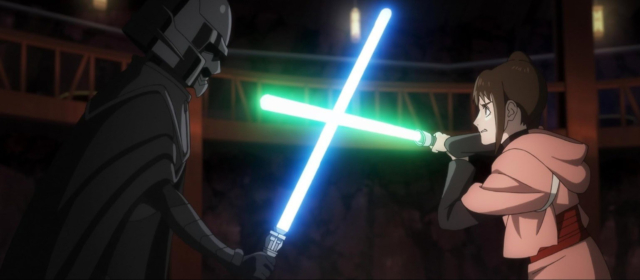
His thirst for power is driven by a single goal, but he cannot see the pain and suffering he’s causing because his emotions have become completely cold. The show attempts to interiorize the villain in ways that no one, not even George Lucas, has tried to do, at least not in the way Kamiyama and Tada achieve it.
That’s probably the strongest element in anime storytelling, which introduces a broader context in its first episode but begins to pull back the curtain as we learn more about what’s ruminating inside the characters’ minds. It’s an often fascinating and emotive series. Especially when action sequences of genuine artistry are laid out in front of us and repurpose the grand spectacles of Star Wars into more intimate battles between characters who aren’t at peace with themselves.
However, one would rather see the entire galaxy burn to ashes than resolve his lack of emotions. There are numerous visual cues in the series that are quite simply jaw-dropping and respond to the narrative (mostly thematic) arcs laid out in it. Kamiyama is a smart enough filmmaker to understand what drives a show like this (the push-pull between Lah Kara and Nawaam), but less so when it comes to pacing.
Comparisons to Kamiyama’s previous work
Although less lethargic than his previous work, The Lord of the Rings: The War of the Rohirrim, The Ninth Jedi does have difficulty maintaining momentum when its structure begins to repeat itself and refuses to add meaningful layers to the character until the last few episodes.
Some of the character designs are also repeated from Kamiyama’s Lord of the Rings film, which wouldn’t be bad if it weren’t so obvious. But that’s a minor complaint given how he’ll desperately try to pull at your heartstrings in methods that feel painfully manipulative and repeat narrative beats we’ve seen before in this sandbox. At this point, they don’t feel original anymore, even if its artistic presentation certainly beats the “quest for realism” animation of The Clone Wars and its offshoots.
Final thoughts on Star Wars: Visions Presents – The Ninth Jedi

That said, this is a more thoughtful expansion of the Star Wars universe that we’ve seen on Disney+ this side of Andor. If the streamer wants to continue making animated shows on the platform, they should invest their money in more Visions-like stories and less work that repeats what we’ve seen before. Both can obviously coexist, but risks need to be taken if we want this franchise to continue for another fifty years, as it will reach this milestone in 2027.
Also check out: Maul – Shadow Lord Takes Star Wars Animation to New Heights