‘Street Fighter’ Review: Kitao Sakurai’s Uneven Love Letter Explodes the Screen
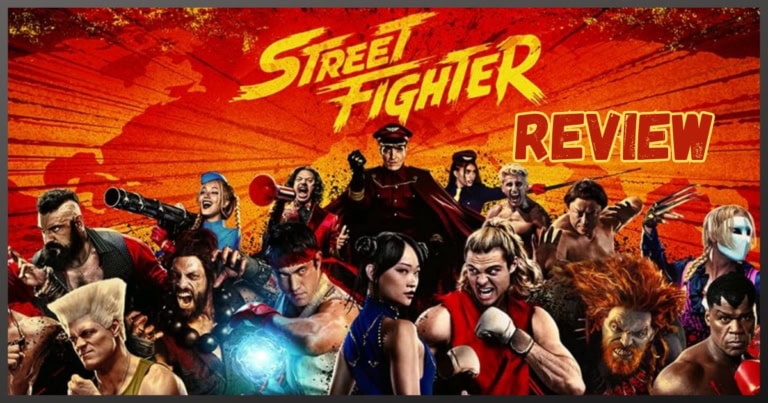
It feels great to not only see a major blockbuster that looks and feels like a movie—with heightened colors, expressive camerawork, baroque lighting compositions, A-list actors giving boisterous, theatrical performances—but also to see great reverence expressed for the source material it’s adapting. In fact, Kitao Sakurai’s transposition of CAPCOM’s Street Fighter might be the first live-action film entry in a franchise that has desperately tried (and failed) to act as a love letter to the games and nail that particular aspect. The characters are thinly developed, but they weren’t necessarily polished in the video games either.
The world Sakurai and cinematographer Ken Seng bring to life on screen feels so alive and is primarily inspired by Joel Schumacher’s living comic books. One could even say Street Fighter acts as a living video game, meaning the filmmaker incorporates the game’s fighting mechanics into the language of cinema to create an exhilarating, almost maximalist theatrical experience worth seeing on the biggest IMAX screens.
Theoretically, such an approach works and will yield better and more invigorating results than Simon McQuoid’s terrible Mortal Kombat II. So why is it so disappointing?
The plot of Street Fighter (2026)
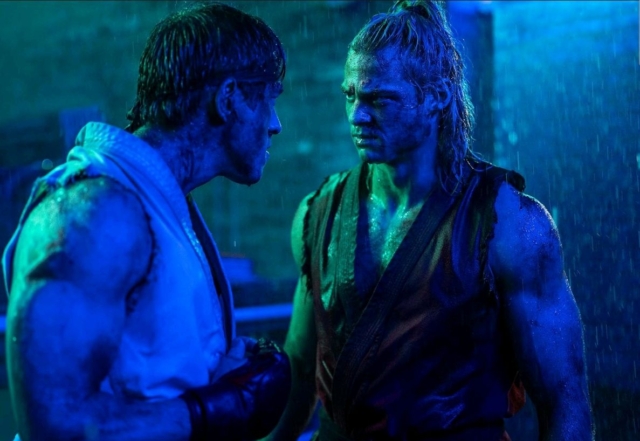
This movie does start out with a strong statement, contextualizing the strong friendship and eventual falling out of fighters Ken Masters (Noah Centineo) and Ryu (Andrew Koji) as the two train to master their respective martial arts at the hands of their mentor, Gouken (Ma Dong-seok). The IMAX-captured animation is detailed and impeccably realized, translating the fighting mechanics of the Street Fighter games into genuinely thrilling action on the big screen.
One wonders why the movie couldn’t have simply been a large-scale anime adaptation of Street Fighter, because as soon as Sakurai shifts into live-action, the movie takes the biggest of all nosedives. There are far too many characters, too many plotlines, and unimpressive action sequences to sustain a two-hour movie, especially when nothing is fully developed.
Some will say that we’re not here for compelling characters or thought-provoking drama, which is absolutely true. After all, we’re here to see people kick ass and use their Hadou to topple enemies and the evil dictator M. Bison (David Dastmalchian). The thing is, if we’re going to spend almost two hours watching Street Fighter, we have to care about the people on screen.
Kitao Sakurai’s film does too much all the time
I will give Sakurai credit for one thing: his reverence for the game and its characters ensures we will spend some considerable time with each of the core members who have defined CAPCOM’s games. Unlike Mortal Kombat II, which wastes the talents of Joe Taslim and Hiroyuki Sanada again, Street Fighter knows that if one casts Andrew Koji in a pivotal role, he needs to be on screen for a solid amount of time.
All the wrestler stunt casting should make sense, too. I never imagined seeing Cody Rhodes as Guile or Roman Reigns as Akuma, but the two make the most of their on-screen appearances and seem to have fun portraying figures who need their almost operatic, theatrical presences to shine.
Koji is undoubtedly the best part of Street Fighter, especially when the film explores his internal conflict as Bison forces him to extract his Hadou so he can use it for nefarious, world-dominating ends. There’s great emotional depth in a character who probably doesn’t need it, but it’s a testament to how strong Seng’s visual language is.
Whenever we’re in Ryu’s headspace, the movie comes alive thoughtfully as the frame expands and allows us to peer into his most conflicted emotions. And when Ryu reaches a level of darkness he perhaps shouldn’t attain, Leo Birenberg and Zach Robinson’s note-perfect musical score gives the audience a sense of how to read that shift.
What’s particularly thrilling about Birenberg and Robinson’s music (following in the footsteps of their work on Cobra Kai) is how their love of Street Fighter allows them to experiment creatively with wholly modernized renditions and completely original compositions to fit in with Sakurai’s baroque visual approach. His images certainly explode with bright tableaux and expressive characters on an IMAX screen, so it’s a shame that the action choreography is so lacking.
Perhaps it’s solid, but you wouldn’t know given how weirdly blocked and edited most of the action is. It only locks in whenever Sakurai diverts his focus to Chun-Li (Callina Liang), whose choreography recalls Michelle Yeoh’s collaborations with Johnnie To in The Heroic Trio and Executioners.
Liang is incredible in the role, giving as much as she can to a sadly poorly written character. At least she has a bit more to chew on than in the way Chun-Li was depicted in Andrzej Bartkowiak’s unwatchable Street Fighter: The Legend of Chun-Li.
David Dastmalchian makes a meal out of his M. Bison, too, but one can’t help but be reminded of Raul Julia’s ultimate performance in Steven E. DeSouza’s 1994 original adaptation. That movie didn’t feel much like a Street Fighter transposition, but it had legible fight scenes, characters the audience could relate to, and a corker of a finale that saw Jean-Claude Van Damme kick M. Bison to oblivion.
Compared to Sakurai’s movie, which translates the game’s world to the screen with accuracy, it’s a masterpiece. It’s genuinely bewildering how much this 2026 film doesn’t work, but it mostly boils down to its hypermaximalist approach, which never allows any raw engagement with the viewer.
An overabundance of commercial references significantly hampers some of the film’s biggest action beats, such as 50 Cent’s “Many Men” dropping as Balrog (played by Curtis Jackson himself) punches Ken to oblivion. I assume it wasn’t a hard right to clear, given that 50 Cent is in the film, but did we need that on-the-nose needle-drop?
Or how about all the flopsweat bits involving Dan Hibiki (Andrew Schulz), who has more screen time than any of the core Street Fighter characters, excluding Ken and Ryu, combined? Schulz is painfully unfunny, yet he’s plastered in almost every frame of this film. Something’s not clicking when this happens, but at least one of Sakurai’s closest collaborators, Eric André, can compensate with his brand of anarchic comedy in an actively hilarious turn as Don Sauvage.
With every solid performance, there’s an equally bad one, and none is more illustrative than the contrast between Koji’s emotional turn as Ryu and Centineo’s career-worst (miscast) Ken. Everything he says is clumsily delivered with little to no aplomb and sinks the character much further than anyone else on screen, even Jason Momoa, who embarrasses himself once more on screen this year by portraying the motion-captured Blanka.
Having only a few players do solid work in one of the year’s poorest screenplays is a feat unto itself. Having some of the biggest stars in that film deliver some of their worst performances is an even bigger accomplishment.
Street Fighter film rating and final thoughts

It’s a true shame that Street Fighter doesn’t fully function, because Sakurai seems to deeply love the games. You can feel it in every ounce of his neon-soaked frames, in anime interludes so aesthetically daring that reverting to live-action seems almost criminal, and in the boisterous performances that ensure the cast is at least having a good time. Couldn’t the audience join in on the fun, too?