‘Coward’ (‘Les Braves’) Review: An Intriguing and Unconventional Wartime Film | BFI London Film Festival 2026

Being called a coward, or “lâche,” as the French equivalent, is probably one of the greatest insults that one soldier could volley towards another during a World War I setting. Within Lukas Dhont’s third film, Coward, this slur carries added significance by equally describing those men who risked everything during a failed escape attempt in a bid to avoid the horrors of war, crossing over battle fields to reunite with loved ones.
These terrors are tackled upfront in Coward with a first-person, close-up perspective accompanying rookie Pierre, played by newcomer Emmanuel Macchia. The result is a terrifying, first-hand depiction of the gruelling, mental toll exacted upon the soldiers in its full, gory details as Pierre strives to impress his seniors by perfecting his tasks. This includes maintaining an unflinching composure to complete clean-up exercises amongst corpses.
Coward (2026) differentiates itself from other wartime films
Yet Dhont achieves the impossible by presenting a tender and compassionate wartime drama of friendship combined with musicality. Coward intersperses the shock and awe imagery with these additional elements, thereby delivering an unconventional war-based tale that draws audiences in and keeps them close to all the action and emotions. As such, Coward is an engrossing personal, wartime tale that is unafraid to expose the brutal reality but bathes the narrative within a warm saturation of beautiful cinematography.
Candlelit scenes and an omnipresent warm glow set Coward apart from other grim period dramas depicting war. Whilst the location may be historical, there is a modern-day lens protruding as contemporary questions about masculinity and the critique of conscription take centre stage.
Pierre and others within his cohort have been drafted without context regarding the conflict, the dangers, and the consequences. For many of them, their socialisation as to how to be a man, a father, or a son may be received from and shaped by their experiences with their comrades. This is tinged with the ever-present violence from the battle field. Their social encounters may therefore be lacking as they look to each other to forge their identity and provide that solidarity as a team in the face of violence. But they may never have that opportunity to develop their own identity outside of intense, traumatic scenarios.
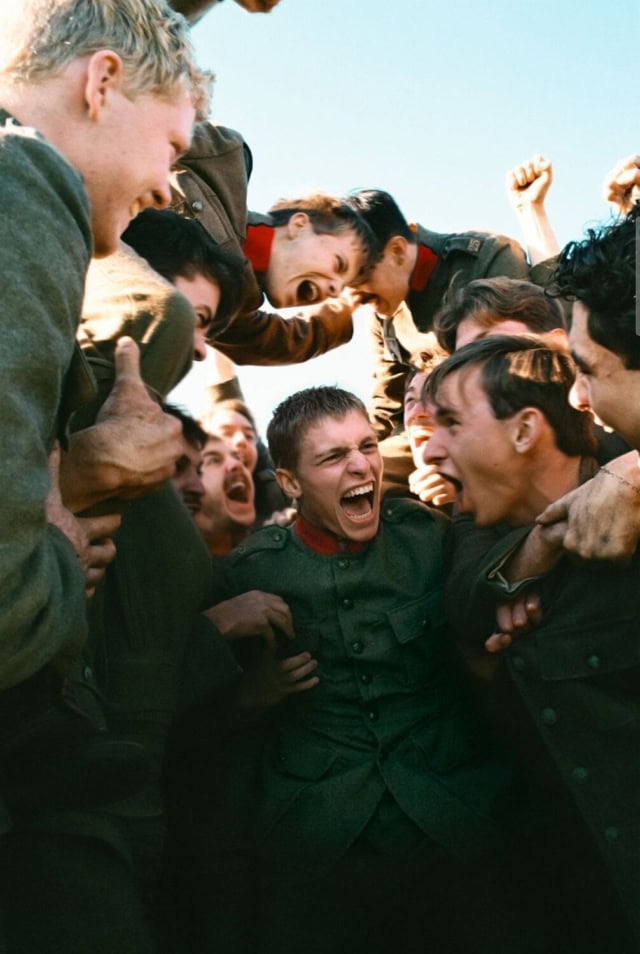
A personal perspective within Lukas Dhont’s film
With Dhont’s direction, we live vicariously through Pierre’s eyes as he wanders along battlefields in response to a starter pistol shot. It is a triggering sound and is fully absorbed by the audience via the deliberate choices for the sound design. There are loud, squelching sounds as Pierre traipses through the mud in response and loud cries of anguish and pain from injured comrades.
The violence may be secondary and off screen, but its impact reverberates throughout all the scenes, reminding us constantly of the precarious nature of the set-up. Dhont’s preference for resting the camera on his actor’s facial expressions ensures that audiences are never truly protected from these horrors from both a visual and psychological perspective.
Indeed, as Dhont’s preference is not to focus on the killings, the psychological aftermath and audiences’ own interpretations of the messiness and ugliness of war may be a more sombre perspective with which to contend. Therefore, there are no limits to the human imagination regarding the terrifying extremities suffered on the frontlines without such on-screen assistance.
Coward may present a more horrifying prospect than other war films, in that sense, with issues of depravity within the human condition left unanswered. Yet, in so doing, Dhont has created an ideal space for recreation. When Pierre meets Francis, there is the appearance of an alternative option allowing him to explore his creativity, which showcases the power of the arts to be transformative. Valentin Campagne portrays Francis as a mesmerising soldier recruiting members to join his “band of rejects” to provide an outlet for other soldiers and a degree of positivity by performing within revues.
Coward questions the gender status quo within period films
In an all-masculine space, Dhont has cleverly laid the groundwork to question established perspectives. Being inspired by a 1914 black and white photograph of a Belgian soldier in costume as a woman, Dhont introduces these elements to the musicality and theatricality of the revues that Francis leads.
The boys create feminine costumes designed from disused parachutes and, similar to modern-day pantomimes, perform all the roles. Their limited experiences with women manifest themselves in caricatures of the female roles, which was also evident in their earlier locker room pack mentality antics of re-enacting a pregnancy delivery!
The rehearsals for the theatre performances create an optimistic parallel permitting aspects of humanity to shine through and new friendship bonds to emerge with sensitivity and humanity at the forefront. However, Pierre does not escape being deemed a “coward” for focusing on the theatre rehearsals as opposed to his trench duties, and thus an additional conflict emerges.
Dhont has created an intriguing, immersive tale with a personal emphasis on the relationships developed whilst being on the front line. Yet, there is constant tension and duality also explored, providing that sense of hope and beauty. The beautiful cinematography assists in this regard with its subtle glow lending romantic hues to contrast the harsh realities.
This encourages a sentiment of distancing to permit both Francis and Pierre to exist in a vacuum and allow their hopes and dreams to exist in such microcosm. Both Macchia and Campagne, as the leads, carry this air of sensitivity, naivety, and hopefulness that makes them endearing to audiences despite the tragic settings. Given their commitment to their roles, it is unsurprising that both actors won the Best Actor award at the 2026 Cannes Film Festival.
Coward film rating and overall impressions

Coward is unparalleled in its ability to reflect the raw, emotional state of soldiers on the frontline alongside demonstrating a degree of beauty simultaneously. Reminiscent of Beau Travail (1999) due to some of its military-focused beach set scenes and impressive choreography and musicality, this is another impressive feature from Dhont.
Despite having a final scene that feels tacked on, Coward is a captivating film that will create that feeling of being awestruck long after the credits have rolled.
Coward (2026) will have a limited release in the U.S. on December 25, 2026, with a limited theatrical release in international markets beginning October 21, 2026.
For more coverage from the BFI London Film Festival, visit the archive!