‘Paradise Lost’ Review: Another Disappointment from Yeon Sang-ho
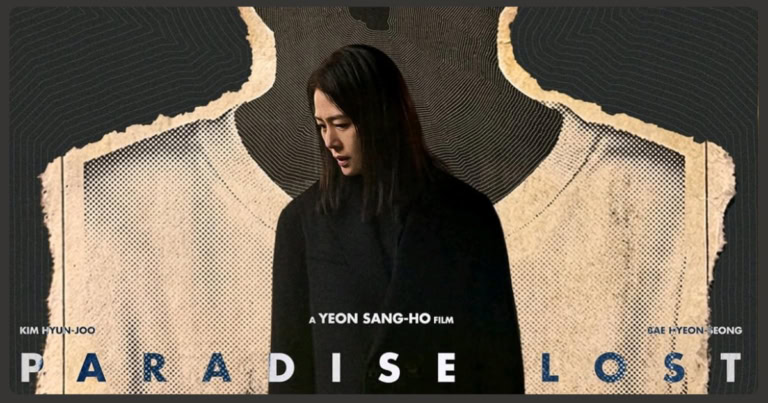
By now, it’s tradition: whenever Yeon Sang-ho does something truly great, he immediately follows it with something so unwatchable you might question why you appreciated the filmmaker in the first place. This was the case between Revelations and The Ugly, and we’re seeing the same pattern again a year later, from Colony to Paradise Lost. While not as egregious as The Ugly, Yeon’s more minimalist and character-driven offerings don’t seem to land with the same potency as his more unwieldy (or esoteric) efforts. Colony had an aesthetic and a device to truly keep us hooked. Paradise Lost has a conceit but quickly fumbles the bag.
What is Paradise Lost (2026) about?
Yeon blends far too many genres instead of focusing on a select few elements to elevate his psychological thriller. Paradise Lost is centered on grief-stricken mother Ryu So-young (Kim Hyun-joo), who agrees to become a part of an AI program dubbed “Children of Paradise” after her son, Ryu Sun-woo (Yu Ji-wan), alongside other children, was kidnapped and killed.
So-young has been living the better part of nine years with an artificial version of her child, whom she has grown to make part of her everyday life. Exchanges between So-young and her “son” are devastating because they show the mother’s inability to move on and her refusal to accept that the Sun-woo she knew and loved is gone.
She’ll have to reckon with this inextricable fact even more when, after receiving a call from the police, she is informed that her son is actually alive. He has surrendered himself at a police station in an attempt to find his identity. So-young wants to care for her child and help him reintegrate into society, but it looks like Sun-woo has plans (and motivations) of his own, and that’s when Paradise Lost spectacularly derails.
Rarely do I see a movie begin with benevolent intentions and shoot itself in the foot like that, but that’s what happens when Sun-woo comes back and starts doing stuff that didn’t really make much narrative (or legible) sense. Shrouding the character in mystery is one thing, but making him the complete antithesis to what So-young held onto is another, especially when his heel turn feels shockingly derivative.
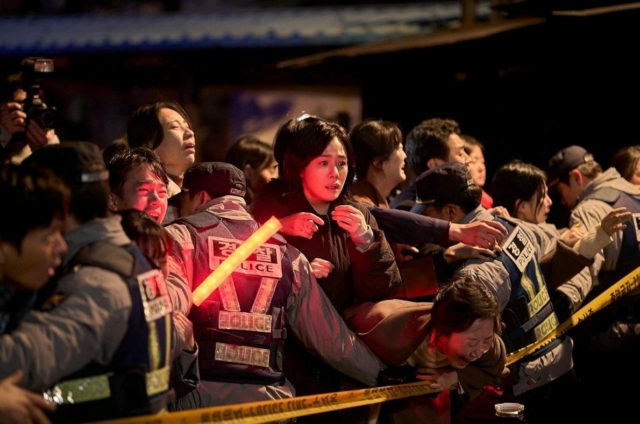
Yeon has always pushed his characters (and images) into complex, almost morally dubious territory (see Revelations for a movie that challenges both the audience and the protagonist). It’s no surprise he would want to do the same here. However, the various threads are stitched together with little cohesion.
Paradise Lost is a film that loudly warns its audience about the dangers of AI without taking a firm stance on what it wants to say. It then becomes a psychological thriller about a son who manipulates her mother, but that goes nowhere when Sun-woo makes a decision so irredeemable that it almost comes out of left field.
This film is also a journalistic thriller where Sun-woo’s “disappearance” is being heavily investigated and perhaps even linked to some terrible events, but that part also goes nowhere. No, actually, this one has a ridiculous conclusion. But it’s difficult to discuss any of them without spoiling a thing.
Questionable decisions from Yeon Sang-ho drag down the film and story
What I can say is that each decision Sang-ho makes for Paradise Lost is always the wrong one. He elicits zero sympathy from the audience, as a mother whose delusion that her son is the same way he has always been leads her to make one bad decision after another.
He also won’t elicit any connection with her once she devises a plan to “beat” Sun-woo’s schemes that is so ridiculous it might be even more laughable than the conclusion of his 2016 breakout hit Train to Busan. The film’s spiderweb storytelling might have worked on paper, but the way Yeon links them falls flat on its face.
Paradise Lost shows very little formal daring, too, which makes it especially disappointing. Yeon has been at the forefront of a visual revolution in Korean cinema since he made the jaw-dropping Psychokinesis and continues to explore the visual potential of moviemaking in both film and television, but nothing particularly exciting happens on screen. The images are flatly composed and give the proceedings little heft, even during supposedly thrilling confrontations between the mother and the son.
The problem is, we’re always three steps ahead of the picture. Elements that are introduced and inferred will inevitably return during its climax, and it’s quite easy to figure out where the story will be heading. However, I bet you won’t be able to guess where Paradise Lost is going during its confounding final moments, which throw all sense of goodwill out the window. Its anti-AI commentary turns into a relatively centrist stance, just like in Timur Bekmambetov’s terrible Mercy.
Paradise Lost (2026) film rating and final thoughts

Unlike Mercy, Paradise Lost at least has a solid turn from Kim Hyun-joo, whose emotionally vulnerable notes hit like a ton of bricks. If only the film around that performance was, y’know, actually good? Because I have no idea what Yeon wanted to accomplish in Paradise Lost.
Yeon’s films always critique something about contemporary society, but you’ll quickly realize that whatever he is critiquing here falls much flatter than his last attempt at minimalism. Here’s hoping he picks himself back up with his next one, as he’s done in the past, but without fumbling the bag after a really great movie.
Also check out: Tenzing Movie Review: A Biopic of Immense Grandeur