‘Wicker’ Review: A Wonderfully Weird and Witty Romance

Wicker isn’t exactly one of those films that’s easy to pin down or theorize what it may be like after your first glance at the logline. Is it more absurdist comedy or does it lean more towards the dramedy realm of things? Is it straight zingers surrounding its central concept, or does there exist an inner earnestness to it all? The ultimate answer, like most things in life, is a mix of everything.
Directors/writers Eleanor Wilson and Alex Huston Fischer interweave their own peculiar sensibilities to the framework of fables and fairytales that it’s being adapted from. The result is a consistently sharp romance that’s hysterical and deeply romantic in equal measure.
This film fully embraces the off-kilter nature of its premise while still retaining a genuine proficiency to the meaning of expressing your love towards someone; finding happiness within the best version of yourself regardless of what the relationship looks like to others while maintaining a cozy warmth to the palpable love at its center. The charms can start to wear thin at a few points, but Wicker is a delightful, strange, and quirky winner that delves into just as many boner jokes as it does patriarchal structures and marital gender dynamics.
What is the movie Wicker about?
Adapted from the 2008 short story by Ursula Wills-Jones entitled The Wicker Husband, Wicker opens with the regular day in the life of Fisherwoman (Olivia Colman). Fisherwoman leads an unfortunately lonely life where she’s sneered at by the townspeople for her apparent fish stench. She’s viewed as an outcast of sorts for being one of the only women in her medieval village not bound to marriage or what she sees as the silly traditions like pulling woven eggs from a basket.
With the Tailor’s wife (Elizabeth Debicki) acting as a particular thorn in her side in her daily routine and the insults and ridiculing continuing to pile up, Fisherwoman decides to find a romance of her own. She enlists the services of the local poem-speaking Basket Weaver (Peter Dinklage) to make (or weave) her a husband to marry.
One month later, in a miraculous fashion, the weaver succeeds in making Fisherwoman a fully autonomous Wicker Husband (Alexander Skarsgård). The two’s unconventional romance blossoms right away, sparking gossip and chaos of all sorts across the village.
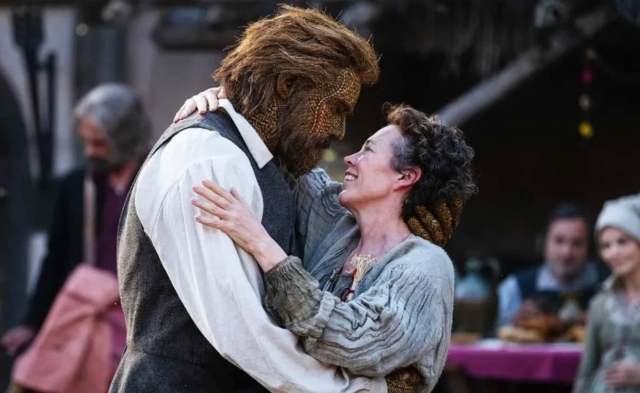
A film balances its oddities with surprising sweetness
Within Wicker, there’s always a glimmer of magic to its many heightened and cozier sensibilities. This adds a dreamy fairytale-like quality to its inner themes of longing for romance and being content with one’s inherent nature. It’s difficult to not be empathetic towards Fisherwoman from the character’s first introduction, a woman shunned by society for not fitting in yet still finds solace in being able to live as her true self.
This is only exemplified throughout the many scenes we see Fisherwoman and The Wicker Husband share together as Colman and Skarsgård bring such warmth to their relationship. There’s never a moment where you don’t believe the genuine palpable reactions Colman has within her happiness or sadness surrounding the insecurities she has about herself and her growing relationship.
Skarsgård has an equally difficult task having to bring a gentle quality within every action of a character that is covered in immaculate makeup work for the entire runtime, but he excels at it. The Wicker Husband is a man in a society where the other men around him see the basic idea of doing things to make your partner happy as alien. He’s a beacon of warmth acting out of pure love that exposes the deficiencies these men have been so oblivious towards.
The two performers are truly great here, with acting that captures the strengths of what they’ve excelled at in the past (Colman in pure likability and Skarsgård with imposing but soft tenderness). Amidst all the absurd raunchiness, Wicker has a heartfelt core of finding true devotion in love, no matter the societal conventions women are put under within present-day expectations of marriage. Other elements, like Anna Meredith’s flute-heavy score or Lol Crawley’s luscious cinematography, further bolster that.
As for the raunchy humor itself, there are dick quips, innuendos, and vulgar jokes aplenty to be found within Wicker’s screenplay. Wilson and Fischer do an impressive job providing a proper tonal balance between the softer and unhinged moments.
Gag highlights include Fisherwoman and The Wicker Husband always destroying their bedpost, their insanely loud intercourse that has many nearby wonder if murder is taking place, and the continual Shakespeare-soliloquies we see Dinklage yap about in his brief appearances. The humor can occasionally wear thin, but it’s a good example of intertwining both what an audience expects from most romances or fable tales whilst bringing its own spice to the table.
Wicker (2026) movie rating and final thoughts

There’s no doubt that Wicker is a peculiar picture, but one that has its own sense of palpable warmth amidst its delightful oddities. It’s a heartfelt surprise that’s as bitingly smart in its exploration of gender norms as it is genuine about finding your happiness and yearning for love, making for an all-around hilarious, lovely time.
Also check out: Smile… the Worse is Yet to Come Film Review