‘ATMOSFAR’ [Early Access] Game Review: Survival in a World of Islands Floating in the Sky
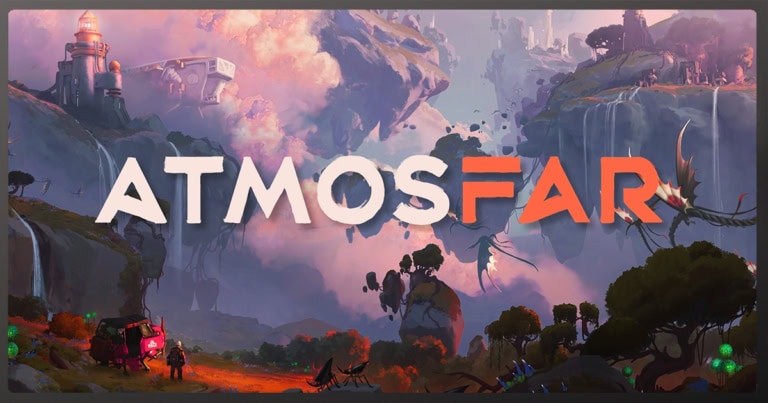
Most survival games propose a standardized approach to players by telling them to build a shelter, collect resources, explore dangerous areas, and slowly upgrade their gear. ATMOSFAR has a different approach by taking the traditional survival formula and moving into the skies to create an adventure where the ability to fly is a must-have skill if players want to survive. It is a science-fiction survival game set on the mysterious planet Tycos, which is a world dominated by floating islands, various ecosystems, unpredictable weather, and an enormous open sky.
The idea of the game is focused on combining exploration by flying with resource management, crafting, survival, and base-building. It is a really fresh concept for survival games, as most of them are on solid land with exploration that is restricted and gets slightly larger with time. However, ATMOSFAR mixes familiar mechanics into an adventure with new and unique ideas.
The story in ATMOSFAR [Early Access]
ATMOSFAR‘s story is built around the premise that humanity has created an outpost on a distant alien planet, but something has gone terribly wrong. We arrive in the aftermath of a desolate colony to find out what happened and what the true fate of humanity’s final settlement is.
Players can slowly reconstruct the history of Tycos through exploration, finding data, and upgrading their base. Abandoned facilities, rotten infrastructures, scattered remnants of human activity, and mysterious locations are clues that help players find out what happened to the people who tried to create a new home in a mysterious environment.
It is an approach that fits the game’s idea that discovering something new is supposed to feel like a personal achievement rather than simply completing another objective just to get to the final mission. The planet itself is a vital part of the story, as its unusual geography and strange ecosystems reveal that humanity has visited an environment that is beyond them.
The floating islands might look beautiful and peaceful from a distance, but their ecosystems contain dangerous creatures, unpredictable, constantly changing conditions, and abandoned structures that help players discover a much larger story.
The Early Access version of ATMOSFAR provides only limited access to this journey, and it doesn’t deliver the complete story. I was able to access two of the three major regions, with the final region to be released in the upcoming months.
This is one of the biggest limitations. Nevertheless, what we have so far works. Finding the truth about humanity’s final outpost is a meaningful objective for an adventure built around the freedom to travel wherever we want. The most important thing going forward is making sure that the narrative evolves alongside the gameplay.
Players get to fly, explore, build, and explore, but a lot of what’s supposed to be there is missing
Gameplay of ATMOSFAR showcases exploration, flying, and surviving. The most important vehicle is the Wasp, a compact flying ship that serves as our primary method of traveling between islands. Rather than using it as a simple vehicle, the Wasp is an essential part of the overall survival experience. It requires maintenance, fuel, upgrades, and careful preparation before longer expeditions.
There are also different forms of the Wasp. The Utility Wasp supports portable camp deployment, the Cargo Wasp is used to transport heavier materials, and the Striker Wasp provides defensive methods through equipment that we can use to fight hostile targets.
This division creates an interesting layer of preparation because choosing the appropriate vehicle becomes part of the expedition itself. Players cannot simply assume that one configuration will solve every problem, particularly when exploring unfamiliar locations with limited resources.
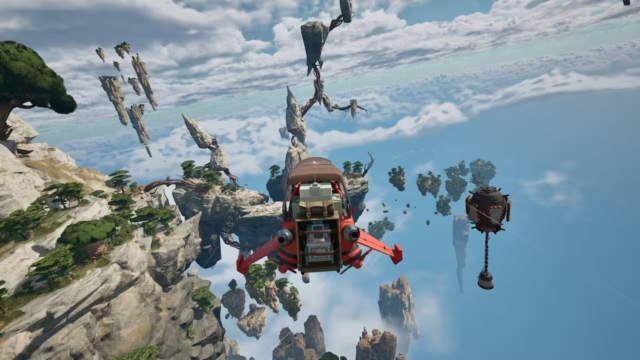
The experience of traveling between floating islands is arguably the game’s most attractive element. Tycos is designed around verticality and open spaces, with environmental conditions that can influence how players approach their journeys.
Strong winds, dangerous weather, constantly changing weather conditions, and the transition between day and night are all part of the feeling that traveling through the sky is something more than just picking an island and going there without any preparation.
The game made me appreciate the difficult surroundings and potential dangers. Exploration is an important process of identifying potential destinations, planning how to gather resources, and dealing with unexpected complications along the way. The flying mechanics also provide a conventional movement system.
Crafting systems follow a familiar progression structure. Players collect resources that are converted into equipment, modules, consumables, and improvements that upgrade our abilities and inventory. The ability to modify engines, hover components, hulls, and other vehicle parts also gives the experience of customization.
The same philosophy applies to the Cloud Cruiser, which can be upgraded into a more effective mobile headquarters. However, ATMOSFAR’s survival systems are not particularly revolutionary. Resource collection, crafting, equipment maintenance, and technology upgrades are known mechanics. The difference is the way these mechanics are connected to aerial exploration and surviving in those conditions. Instead of treating the flying vehicles as optional transportation, they are important to progression.
The freedom of an open world is valuable, but freedom alone cannot sustain an experience if the destinations do not offer enough variety, unique encounters, or discovery. Some creatures are simply part of the ecosystem, while others are potential threats that require preparation and appropriate equipment. But ultimately, those mechanics really need improvement and maybe even a rebuild to work better.
Also check out: The Legend of Zelda: Ocarina of Time Game Review: A Remake Done Right
ATMOSFAR [Early Access] game score and final thoughts
ATMOSFAR is an interesting project in the filled-with-repetitive-schemes survival genre. It creates new settings and rules for the players to become much more meaningful, unique, fresh, and useful.
The idea of exploring an alien planet through a collection of specialized flying vehicles and tools while maintaining airborne headquarters is a refreshing alternative to traditional survival adventures. The mystery surrounding humanity’s collapsed colony is also a great reason to continue exploring, just to learn more about the lore.
Unfortunately, some of ATMOSFAR‘s survival mechanics remain much too familiar. The constantly repeating mechanics of resource gathering gets boring after longer sessions, and the technical condition in Early Access still needs a lot of improvement.
The incomplete story and missing region also mean that it’s better to wait for the final version before starting with this one, as it is one and done. Then players have to wait a long time to return to the game.
For now, it is a really ambitious game in Early Access. The skies are beautiful, the original concept is interesting, and the mobile-based mechanics offer a refreshing look at the survival genre. However, potential alone cannot carry an entire project.

- Game Title: ATMOSFAR
- Developer/Publisher: Apog Labs/SHUEISHA GAMES
- Genre(s): Action/Survival/Exploration/Indie
- Version Being Reviewed: PC [Early Access]
- Also Available to Play on: PC only
- Release Date/Year: October 29, 2026
- Reviewer’s Score: 3.5/5