‘Blade Runner 2099’ Review: Adapting Philip K. Dick’s Novel Now Feels Complete
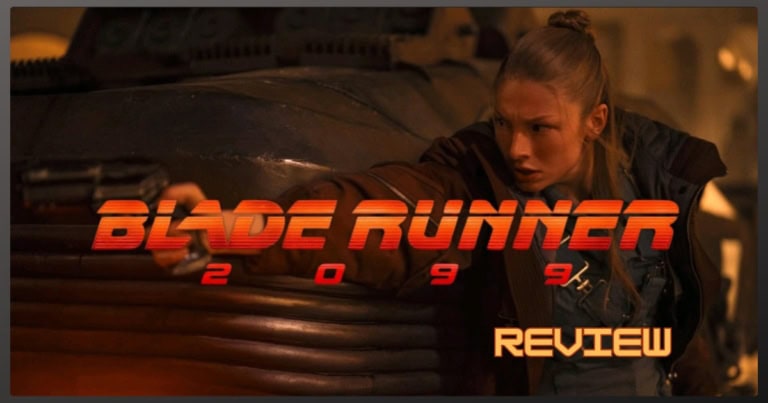
Silka Luisa‘s Prime Video science fiction limited series, Blade Runner 2099, is the newest addition to the film franchise. It serves as a sequel to both executive producer Ridley Scott, Hampton Fancher, and David Peoples‘ Blade Runner as well as Denis Villeneuve, Fancher, and executive producer Michael Green‘s Blade Runner 2049.
It is also the second television program for the franchise, after Kenji Kamiyama and Shinji Aramaki‘s Blade Runner: Black Lotus.
Extrapolated as an adaptation of Philip K. Dick‘s 1968 novel, Do Androids Dream of Electric Sheep?, the series will leave fans floored. The Dominican-American executive producer, series creator, screenwriter, and showrunner has done quite a tremendous job of bringing more of Dick‘s intellectual property (IP) to life.
Blade Runner 2099 spans eight episodes and follows a human woman infiltrating the futuristic Los Angeles Police Department (LAPD). There, she works alongside android bounty hunters. In the franchise, they are known as Replicant Blade Runners.
[Warning: Spoilers for Silka Luisa‘s Prime Video series, Blade Runner 2099, below.]
Blade Runner 2099 takes place 80 years after the original film and fifty years after its sequel, 2049
Returning to this franchise again feels akin to the continuation of the live-action Star Wars series. That is, fans know how the worldbuilding is established and how that further develops.
Towards the end of Blade Runner 2049, Replicants overthrow the Wallace Corporation in refusal of slave labor. Now, what comes next is a new generation of storytelling. Luisa and her team confine so much within several episodes. Yet, the exciting part is their navigation from points A to Z. It makes sense that another IP by Philip K. Dick is housed at Prime Video.
After Frank Spotnitz‘s four-season series, The Man in the High Castle, getting the tonal approach right is appropriate. Like supervising producer C.K. Kiechel and screenwriter Tom Spezialy‘s work on Damon Lindelof‘s Watchmen, Blade Runner 2099 is a reflection of current events.
The writers’ room accomplished a feat so grand, and it shows even in the line readings of dialogue. Replicant Olwen’s (Michelle Yeoh) manner of speaking with others about dying is impactful.
Blade Runner 2099 episode breakdown
Blade Runner 2099‘s first two episodes, “Hades” and “Birther of Worlds,” from executive producers Jonathan Van Tulleken and Luisa, are brilliant introductions to this new chapter of the franchise. These episodes tell viewers who the key characters are and what each is personally after.
The series never really clarifies what the “war” being mentioned was for. That is, unless it alludes to the Replicant uprising. I would assume it’s like the novel’s World War Terminus, in which people forget who exactly won.
The third episode, “Ho, Ho, Folks,” demonstrates the tyrannical authoritarian state that Replicants have established for themselves. Co-executive producer Kirsa Rein, co-writer Monika Revilla, and director Marcela Said expound on an idea that we get a glimpse of in “Hades”.
Turning point for a parallel universe America
As the series enters its third and fourth episodes, it becomes clear what the new era depicts. For the series, the foundation of blade-running and policing is an allegory for Nazi Germany and other nation-states upholding racial prejudice. For one thing, Replicant Blade Runners keep Los Angeles in check. One of them, Yahya (Matthew Needham), searches for a human runaway fugitive in an apartment complex.
A closet space in one apartment hides a doorway to protagonist Cora’s (Hunter Schafer) younger brother, Elias (Lewis Gribben). He is kept safe from officers of the law by a city registration employee, Bebeto (Dimitri Abold), after having killed a Blade Runner with a Molotov.
To add, the fourth episode, “Memory, Hither Come,” pivots the narrative in a whole other direction. In a deserted Mexico City palace-like residence, two married memory collectors turn asylum-seekers into patrols. This couple, Ruiz (Juan Pablo Shuk) and Sol Valle (Silvia Sabate), is an example of the sort of political betrayal occurring in compliance with Replicant authority.
Blade Runner 2099 is quite layered when it pertains to the different ideas and themes that it aims to present. Olwen’s blade-running partner, Marek (Johnny Harris), is a pawn in a much larger conspiracy.
This leads to a conflict mirroring the novel/original film. Marek’s newfound rogue Replicants, led by Nexus-1 Replicant Julius (Tom Burke) and his companion Clotilde (Amy Lennox), function similarly to fugitive androids Roy Baty, his wife Irmgard Baty, and their companion, Pris Stratton.
Tensions rise toward the end of the series
In the fifth episode, “My Lord,” Olwen’s suspicions of Cora are confirmed after putting two and two together. The following episode, “Kill the Killers,” takes a Treasure Island-like detour. Cora and Olwen unfold the mystery behind Marek’s disappearance, his connection to Tyrell Corporation, and what this has to do with the murder of Cora’s adoptive mother, Helena (Sheila Atim).
As it turns out by the end of the sixth episode, Helena is one of Tyrell’s two original Replicants of the Nexus-1 model. This would be more groundbreaking if only the series could give the character more screen time.
The penultimate episode, “One More Kiss, Dear,” is one of the series’ more narratively creative episodes. Olwen changes her mind about humans, while Cora has changed how she sees Replicants. The former understands what it is like to feel pain, whereas the latter learns what it means to inflict pain.
The Blade Runner franchise and its Prime Video series have done a good number on empathy up to this point. “Share the Fantasy,” the series finale, cements Cora as the new generation’s version of Rick Deckard. She gets her hand crushed by a Replicant while holding her gun.
The closing scenes are up to interpretation. Cora isn’t herself, and it could be because of rebirth as a Replicant. Olwen evades LAPD capture by fleeing Earth to outer space, never suggesting her fate.
The relevance of this Blade Runner story today
Blade Runner 2099 benefits profoundly by keeping the Dick spirit alive, as the franchise had before. At the same time, this isn’t necessarily a “jingling keys” franchise since everything stems from just one book. That isn’t counting the follow-up novels not written by Dick, but by others. The series maintains the brilliance of its predecessors by offering what Scott, Villeneuve, and others missed.
One key theme is the concept of empathy. At a time when certain men running social media platforms call empathy a weakness, this is a vital reminder. For Dick, empathy is what separates human beings from androids. Yet, for the Blade Runner franchise, empathy allows us to see ourselves in those who are different.
Explicitly, Blade Runner 2099 taps into empathy in the back half of the series. In “My Lord,” Luisa, Kiechel, and director Karena Evans develop L.A.P.D.’s Voight-Kampff index tester, Greta (Katelyn Rose Downey). Defining this trait is a calculated storytelling move that I appreciate a lot. They combat the contention that empathy opens the door to “a risk of emotional contagion.” Anyone who thinks that way is abnormal and absurd.
On that note, gaslighting is a crucial tactic to utilize. In Do Androids Dream of Electric Sheep?, androids try to convince bounty hunter Rick Deckard that he is an android, too. In Blade Runner 2099, Cora does everything in her power to convince the Los Angeles Police Department that she is a Replicant.
Once Olwen grows suspicious of Cora’s intentions, Cora shuts this down with a reminder of her failure to locate Marek. I think that’s the very point in how empathy works in the series. People believe that they simply understand others’ interests and intentions. However, the human psyche is so much more rhetorically complex than that.
Casting Blade Runner 2099
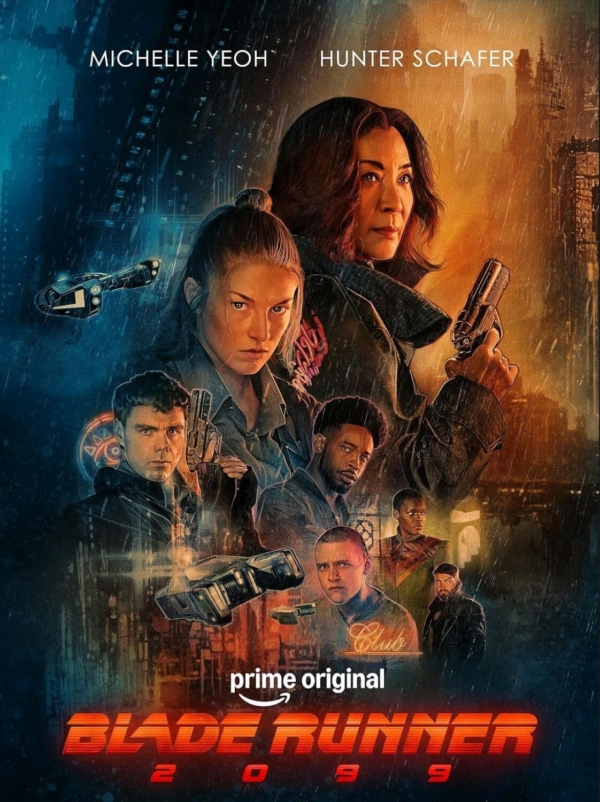
This isn’t the 1980s anymore. The series doesn’t have that same atmosphere as having the likes of Harrison Ford or Arnold Schwarzenegger lead a project. Instead, lead actors Michelle Yeoh and Hunter Schafer take charge of the overarching narrative. I’m so happy about the characterizations, specifically that these two actors are not typecast.
Blade Runner Olwen is days away from dying as a result of being an aged Replicant. The actor is known for her action and martial arts roles. However, the character is restricted to only so much when the fingers in her hand close up. This is akin to Rutger Hauer‘s Roy Batty in the original film.
Looking back at Shakespearean times, women were not allowed to be thespians on the stage. Even in the film industry, the depiction and portrayal of women are often challenged by both those who pull the strings and viewers. Cora is born a cisgender girl, and there is no issue with Hunter Schafer taking on such a role.
Casting directors Julie Harkin and Nathan Toth, Czech casting director Maya Kvetny, and their team assembled some of the most diverse rosters I have ever seen. It also comes down to roles that don’t provide as much weight.
In “Memory, Hither Come,” Colombian actor Juan Pablo Shuk delivers a mighty fine monologue as Ruiz Valle. Here, the character weaponizes empathy, citing family and devotion as something very human that he would sacrifice others for.
Likewise, a security guard at City Birth, formerly Tyrell Corporation, named Bertie (Gloria Obianyo), delivers surprisingly skillful lines. Her little monologue about fate and the inevitability of death is written superbly by Luisa, Kiechel, and staff writer Ryan Willison.
Just like other actors portraying Replicants, Matthew Needham is usually straight-faced and serious as Blade Runner, Yahya. Though there are a couple of rare moments where he has comedic timing, e.g., his search for a current-day Elias while holding a Polaroid of him as a child.
The soundtrack and aesthetics of Blade Runner 2099
Music composer Leopold Ross‘s score heavily involves saxophones in a manner that takes viewers back to the noir era. Funnily enough, I love how the score consistently plays into the rising tension in the drama. The saxophone stays loud here.
For example, the score plays magnificently, and I mean otherworldly, in the first episode when Cora gets a serial number carved into her hips. In the mise-en-scène of it all, the series plays it off as if taking a page from John Woo, Mike Werb, and Michael Colleary‘s Face/Off.
The technology presented in Blade Runner 2049 is so meticulously austere that it surpasses at least the original film. The Tyrell Corporation’s pyramid headquarters are reintroduced as gorgeous. The hovercars resemble the fantastical look of Back to the Future‘s DeLorean but are more detailed for modernity.
I absolutely love the action sequences, thanks to supervising stunt coordinator Jan Petřina and storyboard artists Jan Blažíček and Mark Simon. Unfortunately, the display of choreography does go down the drain at times during the show’s editing stage.
Visual effects supervisors Viktor Müller and Aleks Pejic and VFX producers Karen Murphy-Mundell and Barbara Genicoff craft stunning imagery. Although some visuals could be refined a bit more, they truly match what we see in Blade Runner 2049.
Easter Eggs and References from Philip K. Dick’s Do Androids Dream of Electric Sheep? and the Blade Runner films
Blade Runner 2099 is chockful of details for fans of the franchise and devout readers of its source material.
Buster Friendly is a minor character from Dick‘s novel. He hosts the television and radio talk show, Buster Friendly and His Friendly Friends, which runs at twenty-three hours per day. The character makes small appearances throughout the Prime Video miniseries, portrayed by Hugo Hamlet. Notably, Elias sits around at Bebeto’s apartment and watches Friendly’s show on television.
In the third episode, he is even seen and heard speaking to a guest, Amanda Werner (Pia Laborde-Noguez), much like in the novel. Friendly’s show plays in the background, where he spreads propaganda about Mexico City being a safe haven. Buster Friendly’s role as a synecdoche of the media is important in its influence on swaying public interest.
Some pieces of technology from the films and the novel thrive in 2099. A device akin to what Rick Deckard’s daughter, Dr. Ana Stelline, uses in Blade Runner 2049 is found in the second episode. The DNA database machine appears at the beginning of the following episod. Then, as it is, there is the vidphone, an invention that precedes FaceTime and video calls.
Best of all the Easter Eggs, empathy boxes and the cult of Mercerism have finally entered the chat. These two vital plot elements have been left out in the film adaptation and its sequel. In Silka Luisa‘s Prime Video series, one worshipper of Wilbur Mercer (Tomas Rydval) encounters Olwen and Cora at Helena’s secret residence.
Mercer is a Sisyphus-like figure who climbs a hill, only to be hit with rocks. Witnessing his pain from this perspective via “box” machine, humans in the novel practice empathy in an odd fashion.
Namedrops thrown into the Prime Video series’ dialogue
The artificial intelligence (AI), Joi, makes a cameo appearance in the third episode by an uncredited actor. It’s less likely that Ana de Armas reprises her lead role from Blade Runner 2049. However, it would be a sweet surprise.
Rachael Tyrell and her falsified childhood memory of a spider web are shown in the fourth episode. This is a reference to a scene from Do Androids Dream of Electric Sheep? involving an antagonist, Pris Stratton, an android who resembles Rachael Rosen. Towards the end of the novel, she and two other androids find pleasure in torturing a spider found in the dust of a dilapidated apartment complex.
In a flashback, a young Cora is met by her soon-to-be caretaker, Helena. Having crashed ashore with her younger brother on a flight off-world, Cora follows Helena’s horned black goat named Isidore to a lighthouse up on a cliff.
Isidore refers to a secondary character, John R. Isidore, a human special from the novel. In his subplot, Isidore offers refuge to rogue androids in his dilapidated apartment complex.
A Sloat Loan advertisement voice (Michael Miranda) is named during the end credits of the fifth episode. This possibly refers to Hannibal Sloat, the owner of Van Ness Pet Hospital, a repair firm for false, electric animals. Isidore is employed there as a truck driver.
Then again, I am sure the name is coincidental, like the name Luba (Klara Palivcova) being credited in the final episode. Luba refers to a rogue android named Luba Luft, whom Rick Deckard hunts at an opera house.

Character developments and performances
You see Hunter Schafer and almost forget that she’s worked with some of the best in the industry. There are some sequences in the first episode alone that look like she’s taken a page from Zendaya‘s book in Euphoria. Her experience in dramatic acting alone has prepared her for the role of Cora.
She outdoes herself in scenes where she is a fighter, proving she has what it takes to be a Blade Runner. Her exchange with Sol Valle in “Memory, Hither Come” generates anger. Schafer is stunning, thanks to costume designer Helen Huang et al., along with hair, makeup, and prosthetics designer Natalie MacGowan-Spencer Kudo, and the hairstyling department.
Simultaneously, the actor’s screams of pain are effective. Tilman Singer‘s horror movie, Cuckoo, is not enough to convince fans of that.
As it should be, Michelle Yeoh‘s role as a Replicant consists of robotic mannerisms. That may not suggest a terrific performance. Then again, keeping a straight face has got to count for something. Due to her Replicant nature or personality, Olwen impresses as an anti-hero archetype.
She has remarkable emotional exchanges with her former LAPD partner, Marek. Meanwhile, in the office, her apathetic exchanges with Greta are well-acted. Olwen begins the series with a fearlessness of death, knowing that she could track down Marek, who could accompany her before she goes. Yet, when this fails, she gradually comprehends that loss is a vital component of the human soul.
Bebeto and Elias have such tough chemistry. The former is up to no good, while the latter hides from the police after killing a Replicant searching the siblings’ apartment.
Namely, Lewis Gribben has grown on me as Elias over the course of five sizeable episodes. Elias’s disability starts off as a crutch, but he learns self-worth despite the system being rigged. The character’s monologue, broadcast from Helena’s home, at the series’ conclusion feels like poetic justice. Like his sister, he’s got guts.
Tom Burke as the antagonist, Julius, is his fiercest role since Praetorian Jack in George Miller and Nico Lathouris‘ Furiosa: A Mad Max Saga. While I don’t believe he’s as memorable a menace as Roy Batty, his means of accomplishing his personal mission are vaster. He is a straight-up villain due to his conceitedness.
Blade Runner 2099 series rating and final thoughts
Silka Luisa‘s Blade Runner 2099 may not match the big-screen quality that Villeneuve, Fancher, and Green‘s Blade Runner 2049 achieve, but the larger purpose of the television format is that it offers greater opportunities for storytelling. Eight episodes, at around an hour of runtime apiece, allow for even more room to breathe.
All the leftover details from the novel that haven’t yet been adapted are now incorporated into the series. Consequently, the franchise feels complete in doing Philip K. Dick some justice. It’s the best sci-fi thriller sequel project since, say, The Force Awakens, The Last Jedi, and Watchmen.
I cannot imagine there being a second season of this series, considering this is a strong conclusion to the franchise. On the other hand, I would love to see Alcon, Scott Free, and the other production companies try their hand. This is the best thing of substance to come from the works of Philip K. Dick in a long while.
The writing must be commended for being the glue that binds the other narrative elements together. One of my favorite lines that I’ve noted comes from Cora in the seventh episode: “I don’t think it matters whatever any of us are… If we couldn’t tell the difference, then there isn’t one.”
All 8 episodes of Blade Runner 2099 are now streaming on Prime Video.

- Series/Show Title: Blade Runner 2099
- Season: 1
- Number of Episodes in the Season: 8
- Season Premiere Date: November 24, 2026
- Where to Watch: Prime Video
- Based on the novel Do Androids Dream of Electric Sheep? by Philip K. Dick
- Cast: Hunter Schafer, Michelle Yeoh, Sheila Atim, Dimitri Abold, Lewis Gribben
- Genre(s): Sci-fi, Action, Drama, Mystery, Thriller
- Reviewer’s Score: 5 out of 5 stars