‘REKA’ Game Review: A Peaceful Folklore Tale
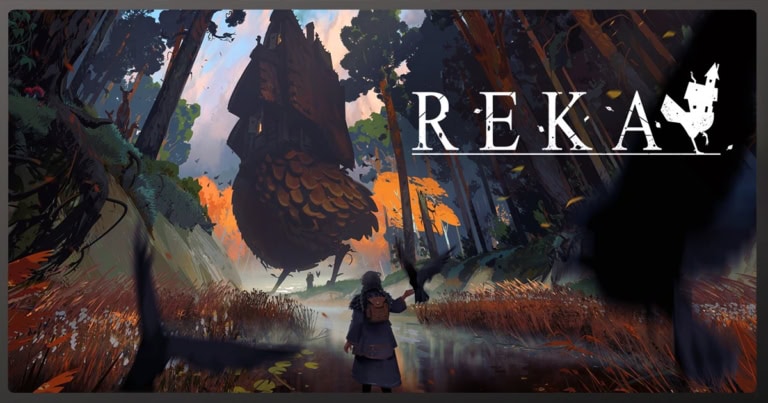
Stories about witches, mysterious creatures, enchanted forests, and strange little villages have always presented players with an opportunity to experience beautiful, yet terrifying environments. Yet, despite the popularity of fantasy adventures, relatively few games attempt to set their stories in Eastern European folklore. REKA is taking inspiration from Slavic mythology and tells the story of a young witch beginning her journey under the guidance of one of folklore’s most recognizable figures, Baba Yaga.
REKA might look like another relaxing exploration and survival game, but it is something more. The game builds its focus on story, experience, travelling through beautiful landscapes, learning witchcraft, helping villagers, and constructing a home that literally walks on chicken legs.
REKA is a story about a witch, her apprentice, and the secrets of the forest
The story focuses on Reka, a young girl whose journey leads her to a mysterious old witch who lives deep within the woods. The woman is, of course, Baba Yaga, one of the most recognizable figures in Slavic folklore.
Rather than presenting her as a villain from the start, REKA uses Baba Yaga as a mysterious mentor whose intentions, knowledge, and relationship with the world are slowly revealed through Reka’s gained knowledge and experience.
Baba Yaga is not a monster hiding in a forest hut, but she is an experienced user of ancient magic who understands the natural world in ways ordinary people cannot.
For ordinary people, magic is something strange and potentially dangerous, often associated with superstition, fear, and stories passed down through generations. For Reka, however, it becomes a source to learn more about the world around her. Herbs, animals, forests, and insignificant objects all have importance once she begins looking at them through the perspective of a witch.
Nevertheless, Reka develops her own identity independent of her mentor. Her apprenticeship is not simply about collecting new spells or unlocking increasingly powerful abilities. It is also about understanding how she wants to interact with the people and creatures she encounters.
Helping someone, preparing a cure, or using magic to influence a situation can have consequences. The game also introduces various creatures and spirits inspired by Eastern European mythology, all of which have a significant influence on the story.
Unfortunately, REKA sometimes struggles to focus and develop these elements into a consistently coherent and focused on important things story.
Gameplay focuses on building a home and exploring a world of witchcraft
If there is one element that immediately gives REKA a unique identity, it is undoubtedly its mechanic focused on building the cozy house on a chicken leg. The idea of constructing a walking cottage supported by enormous chicken legs is inspired by the traditional image of Baba Yaga’s home.
It starts as a relatively modest wooden structure and slowly becomes a personalized traveling home that accompanies Reka throughout her journey. It is not simply a base where we return between missions or other tasks, but it is an essential part of the adventure itself. The cottage becomes a reflection of our creativity. It can be decorated and modified according to our preferences and what we need at the moment.
What makes the system particularly enjoyable and light is the balance between exploration and construction. Traveling through forests and other environments is comfortable and allows us to discover new locations without breaking a sweat. It creates opportunities to collect resources that can eventually be used to improve the cottage.
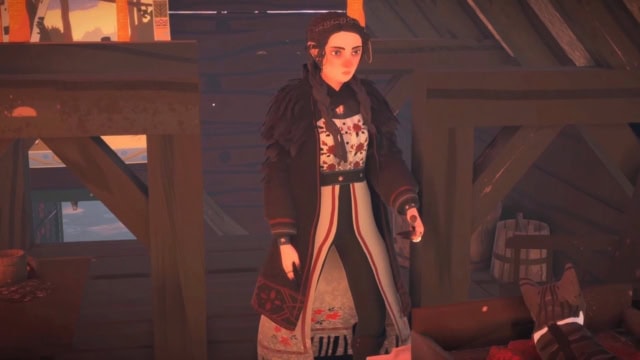
Different materials contribute to the appearance of the cottage, while furniture and decorative objects help establish an atmosphere inside. However, the building mechanics are not entirely easy. Their controls can take some time to understand, and positioning individual pieces does not always feel as intuitive as it should. Still, the overall concept is strong enough to overcome many of these inconveniences, especially once we become familiar with the available tools.
Outside the cottage, REKA offers a combination of exploration, resource gathering, crafting, cooking, and relatively simple questing. The world is divided into atmospheric environments featuring forests, villages, swamps, and other locations inspired by rural Eastern Europe.
These places are designed to encourage discovery, journeys, and traveling, rather than constantly facing danger, making it more of a peaceful activity rather than another PvE-style game.
Reka gathers herbs, discovers useful ingredients, interacts with wildlife, and searches for objects that contribute to her growing collection. Witchcraft is integrated into these activities through the preparation of potions, remedies, and other magical creations.
The absence of a traditional combat system and mechanics is another important decision that turns REKA into a unique experience. This is not an adventure where we are expected to fight increasingly dangerous enemies or constantly improve weapons to survive.
Gameplay is focused on observation, interaction with the environment, and using magic in more peaceful ways. Reka can encounter animals, establish bonds with certain creatures, and eventually bring companions back to her traveling home.
Cats, foxes, and other woodland inhabitants help make the cottage feel more alive while also maintaining the connection between Reka and the natural world. These interactions are particularly enjoyable because they contribute to the game’s central theme of creating a home and connecting to be one with nature.
The freedom to approach villagers and their requests in different ways also provides the opportunity to express this world’s interpretation of witchcraft. Magic can be helpful, but it can also be used to influence situations in less comfortable ways. Unfortunately, the activities themselves can become repetitive after spending enough time with them, especially during the longer sessions.
Gathering ingredients, completing additional requests, and returning to already discovered locations is enjoyable. However, the limited variety of objectives, encounters, and things to find means that the gameplay doesn’t evolve as much as one would expect in the later parts of the game.
But exploration is where REKA gets a lot of its charm, although it is important to understand that this is not an expansive open-world adventure built around constant discoveries. The environments are more used to creating a consistent atmosphere than delivering endless variety.
The forests are filled with fog, villages feel isolated from the wider world, and the presence of supernatural elements gives some locations a lot of needed character. The overall visuals of the game use a stylized aesthetic that may not immediately impress, but as the game progresses, the more sense it makes to be like this.
Also check out: The 10 Best Steam Next Fest Game Demos (October 2026)
REKA game score and final thoughts
REKA has a distinctive identity and lets players explore the unknown, interesting areas of folklore. The interpretation of Slavic folklore, the relationship between Reka and Baba Yaga, and the idea of a walking, chicken-legged cottage being our base is something that makes this adventure a unique experience filled with hours of fun.
What ultimately makes REKA a game worth experiencing is the way its different elements connect and influence each other. The house is more than just a gameplay feature because it is the emotional center of Reka’s adventure, representing the progress she makes throughout her strength, determination, and knowledge.
REKA is a deliberately slow adventure that focuses on atmosphere and creativity over being mechanically complicated. It offers a captivating look at Slavic mythology and is a comforting fantasy about finding your place in a weird world.

- Game Title: REKA
- Developer/Publisher: Emberstorm Entertainment/Fireshine Games/Shochiku
- Genre(s): Adventure, RPG, Simulation, Base-Building, Fantasy
- Version Being Reviewed: PC
- Also Available to Play on: PC only
- Release Date/Year: October 26th, 2026
- Reviewer’s Score: 4 out of 5 stars