Kristoffer Borgli Takes a Big Risk with ‘The Drama’
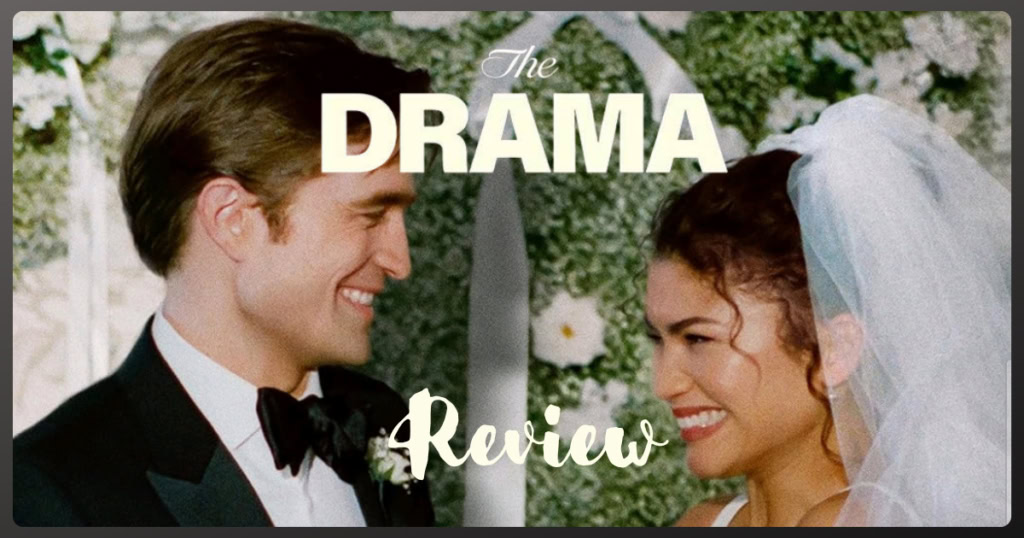
It is extremely difficult to talk about Kristoffer Borgli’s latest movie, The Drama, without mentioning the big twist that looms large regarding Charlie (Robert Pattinson) and Emma’s (Zendaya) union. What starts as a carefree, dynamic romantic comedy morphs into something else entirely… fifteen minutes after an opening montage that distills a picture-perfect marriage proposal between Charlie and Emma. The former is reading the speech he’ll give at his wedding to his best friend, Mike (Mamoudou Athie), while the latter has a job she loves with friends who are genuinely happy for her.
The twist will either intrigue you or make you want to walk out of the cinema violently. There is no in-between. On its surface, it’s tasteless, abject, and deserves all the criticism it’s likely to get. When such a bomb drops in front of the audience, the natural reaction one can have is “Oh, no. This isn’t going to be good, isn’t it?” Who can blame them? Such a reveal usually sinks films to irredeemable depths and quickly worsens a movie with seemingly benevolent intentions. The fact that Borgli does none of what you think will happen and runs with such a reveal makes The Drama somewhat intriguing, but I can’t be certain if all of it works.
Rest assured, dear reader, no mention of what that twist is will be found in this review. In fact, plot details will be kept to a minimum. However, it is very difficult to discuss such a movie without mentioning the elephant in the room, because it sets the entire story in motion and is the heart of the film’s titular drama.
Charlie looks at Emma differently, and vice versa. The two don’t know if they’re in love with each other anymore and attempt to find answers elsewhere. They’ll quickly realize that their search for “answers” is futile, because their conflict lies within themselves. If they want to move forward as a couple, both Charlie and Emma will have to resolve their differences together. It’s the only way they can move forward.
Robert Pattinson and Zendaya are excellent in The Drama
Will they? That’s a question for you to discover, but one thing is certain: both Robert Pattinson and Zendaya are incredible together (side note: the two will also be seen again in Christopher Nolan’s The Odyssey and Denis Villeneuve’s Dune: Part Three). Their versatility is on full display during sequences of immense (cringe) comedic tension.
In fact, Pattinson’s role as the bumbling idiot (also known as Charlie) is one of his most intricate and deeply engrossing performances. His subtle facial expressions, which simultaneously convey guilt, innocence, and embarrassment, recall the multiplex portrayals of Peter Sellers. It’s an absolute hoot to watch him ridicule himself like this and enjoy staying in cringeworthy zones we’ve, so far, not seen the actor play in.
One sequence in particular, featuring A24 actor-in-residence (I mean, Uncut Gems, Marty Supreme, The Moment, and now this), Hailey Benton Gates, is one of Pattinson’s most significant masterclasses. This may be hyperbole, but how he jarringly shifts from one broad display of histrionics after another is genuinely jaw-dropping, and further proof that he’s one of the best in the business. His sense of comedic timing is superb, although he’s far more maximalist in his approach than Zendaya’s, whose subdued turn as Emma is equally as captivating, though for entirely different reasons.
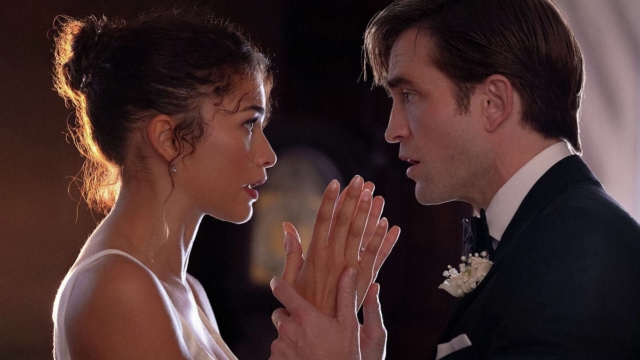
The Emmy-winning Euphoria actress seems to thrive on auteur-driven projects rather than blockbuster fare, especially a film like this, which examines Emma’s teenage mistakes and their impact on Charlie and their potential marriage. It’s a performance of the same caliber as the one she gave in Luca Guadagnino’s incredible Challengers, where her character was at the heart of the picture.
In The Drama, it’s also Zendaya’s show, but the protagonist she plays is extremely problematic, which can alienate viewers who might have mistakenly thought this was a romantic comedy. Whenever the movie bathes in this uncomfortable feeling and makes us sit with these two horrible egomaniacs, this is where The Drama shines the most. Because Borgli lingers in instances where both protagonists want to say how they really feel but are repressing so much emotional guilt to the point where their silence speaks louder than words.
The Drama has a confident visual style, but…
All of this deftly responds with Borgli’s hyperconfident and enrapturing visual style, which never handholds the audience and forces them to look at how the film is shaped. It gives the audience enough information to get a sense of who these people are, either through their present-day conversations or through fragments presented through the artifice of DV cameras or webcams about Emma’s past. We don’t need to know everything about them to get a sense of the couple’s true nature, but we know just enough to parse the inherent flaws they would have liked to keep to themselves.
However, the movie never evolves its characters beyond the big gamble he takes in the first fifteen minutes, which speaks to ongoing problems in America that no one seems ready to discuss. It keeps lingering in that same twist for a good portion of the runtime without meaningfully examining the protagonists beyond that reveal. What was once alluring has now become frustrating, especially as it begins to play this aspect for laughs, which is a very (very) risky bet.
By the time the movie reaches its final scene, The Drama has completely exhausted itself, because Borgli has made it clear he doesn’t have much to say about anything he presents. That being said, it’s still a film worth seeing on the simple basis that no one will feel indifferent towards it.
Most films released nowadays spell out their message to the audience, almost as if they’re afraid the audience will interpret the images differently. This one doesn’t. Cinema should spark conversation and debate. The Drama seems primed to do this, though in our era of Film Twitter hyperbole, and social media brainrot, our collective literacy crisis may regress even further from such a risk.
Also check out: How to Make a Killing Clumsily Reinterprets an Ealing Classic