‘The Hunger Games: On Stage’ Review: An Awkward, Interpretive Dance-Filled Mess
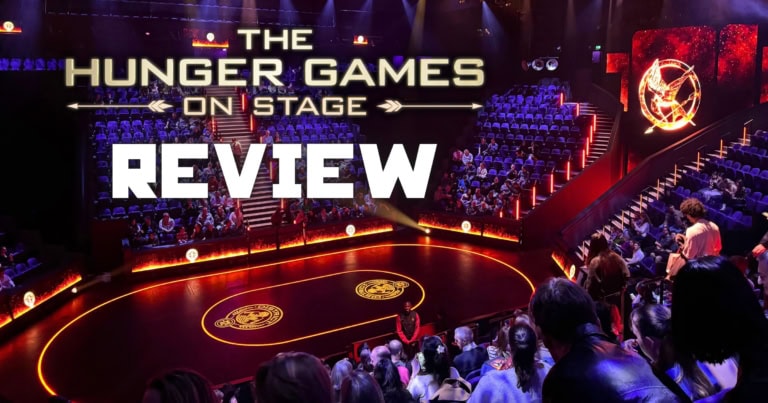
The Hunger Games is one of the most popular young adult franchises in the world, spanning five incredible books and six popular films. Naturally, some creative individuals thought the stage was the next frontier for Katniss to conquer. The Hunger Games: On Stage debuted in London earlier this year in a purpose-built theater in Canary Wharf. As a massive fan of the franchise, I had to get tickets for this show when I visited London in February and see it with my own eyes.
While The Hunger Games: On Stage was entertaining enough with some truly impressive set design, the show is plagued by bad acting and tonally dissonant interpretive dance sequences. The 74th Hunger Games could easily be brought to life in thrilling fashion for live theatre, but the producers of The Hunger Games: On Stage have made some truly baffling decisions that instead bring their production to the brink of parody.
[Warning: mild spoilers ahead.]
What The Hunger Games: On Stage gets right
Starting with the positive, I was pleasantly surprised at certain aspects of The Hunger Games: On Stage. I regard the Hunger Games films as near-perfect adaptations; while they change material from the books, in most cases the changes don’t compromise the author’s original vision or the intended themes of the narrative, which is more than can be said for some other book adaptations. The first film made some of the most significant changes from the novels, so I was happy to see more accuracy in some parts of the stage production.
In the novels, Katniss’ internal narration provides key insight into her complex thinking that’s relegated to Jennifer Lawrence’s facial expressions onscreen. On stage, Katniss narrates much of what she sees around her. It can be awkward at times (dialogue often cuts the narration off mid-sentence), but overall the narration gives an entirely different flavor to the production, lifting several lines directly from the first book.
Small things left out of the original film, like the wolf mutts representing the dead tributes, also help make the stage production a more faithful adaptation in some ways.
One key moment in Katniss and Peeta’s relationship is faithfully brought to life here when he says she’s a survivor and Katniss responds, “Only because somebody helped me.” This exchange is essential to both characters, and it was nice to see small, important moments from the original novel retained on stage. The line lacks its full impact because it’s delivered too quickly and sharply to hit the same emotions as the book, but at least it’s there.
The show’s production design is technically interesting, with a standout feature being the moving seats at either end of the oval-shaped stage. Moving the seats back and forth during a few key scenes really changed up the shape of the stage in an appealing way. The train interior was outstanding, featuring bold color choices like a teal carpet and orange and white highlights that were entirely unique to this version of Panem.
Katniss climbs a steel beam in place of a tree, and even though it’s not decorated at all, it’s easily believable as one. There was a cool Cornucopia set for the finale, but confusingly, it wasn’t used at all for earlier scenes. The costumes in the Capitol were also particularly impressive, perfectly nailing the strange vibe Katniss describes in the novel.
The best part of the show by far is how much it draws the audience into the story when you enter the Capitol. The show’s energy completely transforms during Capitol scenes as the staging turns you into a viewer of the Hunger Games, complete with teleprompter suggestions during the interviews.
Actors move up and down the stairs between seats, further drawing you into the world of Panem. These parts work so well that maybe the entire production should have been staged from a Capitol perspective. They are the most creative interpretations of the source material and stand in stark contrast to the rest of the show, which simply redoes the book on stage.
When the production dares to push the novel’s boundaries, it absolutely shines. It’s evident in the Capitol scenes and in an excellent moment during the Games when Peeta and Katniss are in the cave together, as he describes seeing her for the first time as children. The Hunger Games: On Stage pushes this scene to an incredible place as Katniss actually sings the Valley Song mentioned by Peeta.
This is a fantastic change to the source material that makes for an excellent scene thanks to some lovely singing. Unfortunately, while the singing is fantastic, the dancing isn’t.
What The Hunger Games: On Stage gets horribly wrong
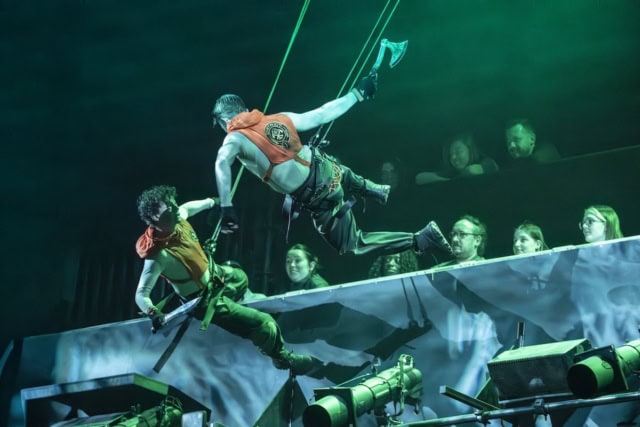
It’s the dancing. The random, awkward, and extremely out-of-place interpretive dance sequences are the worst part of this show. I’ll go on the record and state that I love musicals, in film and in live theatre. If The Hunger Games On Stage was a full-fledged musical, I would’ve been over the moon. It would be a strange change for the franchise, but I could picture it really working on stage. What we get instead doesn’t work at all.
I’d heard whispers of strange Capitol dance sequences before attending the show, which I was cautiously optimistic for. Capitol citizens are supposed to be weird, and I was entertained as they performed a synchronized electronic dance routine as the tribute train arrived. It’s a perfectly valid creative choice and seemed fun! However, the dancing after that sequence got weird.
Characters would strut around doing strange two-step choreography, from Katniss’ prep team doing a strange conga line around the stage to all the tributes randomly stepping in and out of a diagonal line in the middle of the bloodbath. The actors cut from violent fighting to weird dancing to violent fighting in a ridiculous fashion.
It feels entirely out of place in the story and adds nothing to the events playing out on stage. Dance could’ve been incorporated appropriately, such as by restricting the dancing to Capitol citizens reacting to the events playing out in the Games. Making dead tributes get up off the floor to hunch over, bounce up and down, and step to the left and right simply doesn’t work.
Rough acting and characterization in the London show
The acting also leaves quite a bit to be desired. Stage acting is naturally more exaggerated than film acting, but some actors seem like they’re performing for the first time. Katniss was played by an understudy in my show, Kiera Milward, and unfortunately she was one of the weakest performers on stage. Milward had no romantic chemistry with Peeta, no friendly chemistry with Gale, and delivered her lines forcefully, aggressively, and dispassionately.
Katniss’s aggression is actually a major problem with the show. Katniss is a biting, hard-edged character at times, more so in the Hunger Games books than the films. She can be quite mean and hurtful and has moments of aggression. However, she doesn’t walk through the world starting an argument with absolutely everyone. She may have some disdain for most people in Panem, but there are supposed to be key exceptions like Prim, Gale, and eventually Peeta.
Kiera Milward’s performance as Katniss is so harsh that every word out of her mouth sounds as if she’s trying to verbally stab someone, even when she speaks to her loved ones. Her first exchange with Prim is so condescending and aggressive that it feels like bullying instead of lighthearted teasing between siblings. It’s an awful choice that significantly harms the character.
The softer, kinder aspects of Katniss’s character are often hidden within her thoughts, but despite the constant narration, they rarely come across in this theatrical production. Although she does have a few nice moments with Rue (Aiya Agustin).
There’s a wide range in performance quality from the other actors. Lewis Easter’s performance of Caesar Flickerman was pretty natural since he was doing his own interpretation of the character, certainly not copying Stanley Tucci. Josh Lacey playing Haymitch, on the other hand, was essentially doing a loud Woody Harrelson impression. To be fair, he was actually pretty good because of it!
Peeta, played by Euan Garret, was good for the most part but also a little too aggressive. Gale’s role is increased for no good reason. His storyline adds nothing to the plot, and Tristan Waterson’s performance was unremarkable.
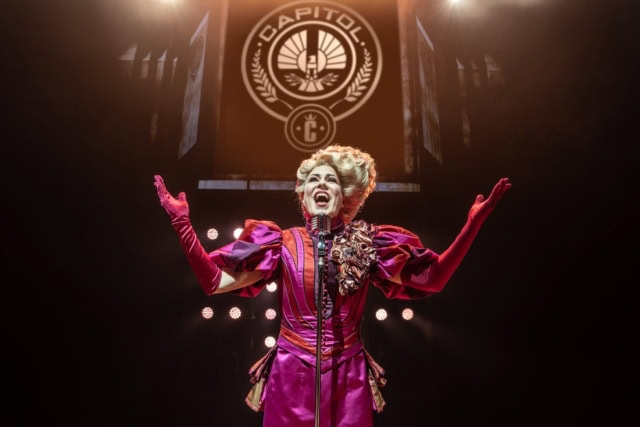
Cinna (Nathan Ives-Moiba) was entirely butchered. The entire point of the character is that he’s nothing like other Capitol people, from his demeanor to his look, but in this show he’s dressed as strangely and sounds as weird as any other Capitol citizen. His interactions with Katniss are as outlandish and overdramatic as Effie’s. Effie herself is well-realized thanks to great costume design and some nice line readings from Tamsin Carroll.
President Snow does not have nice line readings. Played by a giant recording of John Malkovich, Snow is another awful part of this production. His pre-recorded lines do not match up well with the live actors on stage at all. Malkovich’s performance lacks any kind of depth or emotion and is laser-focused on Katniss as she yells at him across the entire stage.
He speaks to other characters like Peeta and Caesar but never addresses them directly, putting up a wall that makes Snow’s presence not work at all. A stage production should have expanded Snow’s role and made it a meaty part for a talented actor, but what’s done here is the absolute opposite and ruins the key hero-villain dynamic of the series.
The Hunger Games: On Stage final thoughts
Overall, The Hunger Games: On Stage is an extremely mixed bag. It’s not completely awful and had some genuinely great moments, but at times it was barely watchable.
If you’re a diehard Hunger Games fan and find yourself in London anytime soon, it may be worth the roughly $60-80 ticket price for a weekday showing to see if you have a better experience than I did. If you’re not a fan already, this show isn’t worth your time or money. It’s simply a shame that such an inspired concept has been reduced to a muddied, inconsistent production.
Also check out Uday’s review of Sunrise on the Reaping by Suzanne Collins.