‘Vaewolf’ Game Review (Early Access): A Wild Premise Done Well
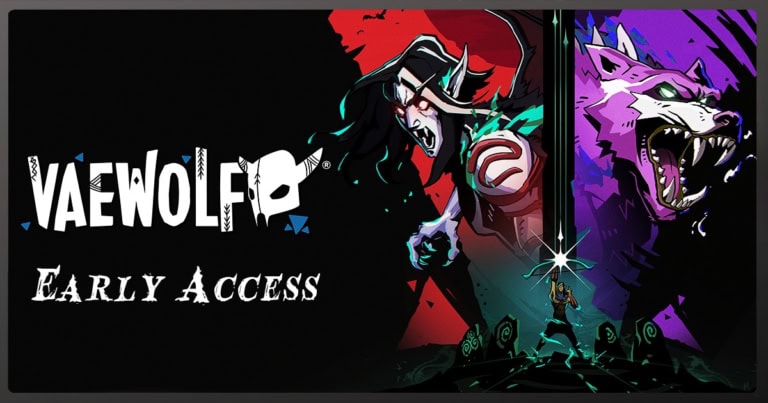
The concept of Vaewolf sounds ridiculous at first. A young elf survives the massacre of his people, becomes infected by a werewolf curse, is rescued by a vampire, and ultimately turns into a creature capable of switching between all three forms. Yet beneath that deliberately exaggerated idea is a surprisingly focused action roguelite. It is set in an alternate version of ninth-century northern England, and it combines Viking mythology, dark fantasy, comic-book aesthetics, and the familiar run-based games like Hades or Ravenswatch.
It is also important to clarify that Vaewolf is a roguelite focused on systems that evolve over dozens of runs, how much variety the later content offers, and whether progression remains satisfying after you die multiple times. Vaewolf does not appear to compete through scale or complexity. Instead, the simple act of changing forms feels so fluid and critical that the entire combat system revolves around it.
[Warning: Light spoilers from the Early Access version of Vaewolf are below. It is also worth noting that I played this game on PC.]
Vaewolf‘s game premise is fascinating for a roguelike
The story of Vaewolf is deliberately straightforward, and that may actually be the best decision for this kind of game. The protagonist begins as a young elf and a sole survivor of an attack on their village carried out by a dark Viking clan. During the massacre, the character is infected with a werewolf curse and is left to die. A vampire eventually intervenes, saving the protagonist and granting them a supernatural source of their powers.
From that moment on, the main character becomes something that should not exist. A part elf, part werewolf, and part vampire. The main objective of the game is not complicated. Find the Viking clan responsible, awaken the full extent of the powers, and take revenge.
The premise establishes the motivation almost immediately, giving the gameplay mechanics center stage. The world itself provides more depth than the central plot. Vaewolf takes place across a stylized interpretation of the ancient English North, with the environments inspired by the landscapes of Cumbria and the Lake District. Mountains, lakes, caves, ruins, and supernatural realms create a setting that combines recognizable British geography with dark fantasy.
The revenge narrative also fits naturally into the roguelite structure. The protagonist repeatedly ventures into dangerous areas, grows stronger, dies or retreats, and returns to try again with new abilities and knowledge. That means the story does not need to carry the entire experience. Instead, it acts as motivation to constantly repeat the missions, learn from your mistakes, and upgrade abilities.
Vaewolf is more an energetic revenge fantasy than an emotionally complicated character drama. But that is not its weakness. A protagonist hunting down the people responsible for destroying their home is a simple motivation, but it is also immediately understandable. If the finished game can use its characters, environments, and mythology to gradually add emotional weight to that foundation, it may be one of the titles that will shine.
The roguelike mix works really well for this game
Gameplay is where Vaewolf is at its strongest. The basic structure is familiar to anyone who has spent time with modern action roguelites. Runs take place across generated areas, enemies are parts of combat encounters, branching paths allow players to choose where to go, bosses appear at the end of major sections, and temporary upgrades shape the unique build during each run.
Permanent progression carries across attempts, giving us reasons to return after failure. On paper, that sounds extremely familiar. In practice, the three-form combat system is what gives Vaewolf its identity.
The elf form functions as the ranged specialist. The character uses a bow to attack enemies from a distance, allowing us to control encounters and eliminate weaker targets before they can get close and hurt us with melee attacks. The vampire occupies a very different role, focusing on supernatural abilities and attacks capable of affecting groups of enemies.
Then there is the werewolf, which abandons subtlety almost completely in favor of close-range aggression and brutal physical attacks. The important part is that these are not separate characters or abilities selected between stages. They can be switched during combat, and the transition is designed to happen almost instantly.
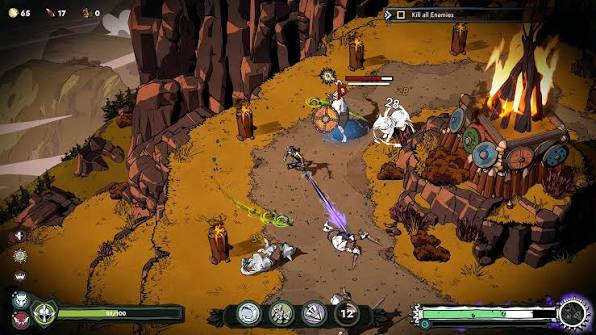
Changing forms is simply a convenient way of matching different enemy types. The system may eventually become predictable. A distant enemy means elf, a group means vampire, and a heavily armored target means werewolf. Once you understand those basic mechanics, combat will become a process of following instructions rather than making meaningful decisions.
The much more interesting possibility is that enemies, arenas, and combinations of threats force you to change forms constantly. In that situation, the three identities stop being three weapons and become parts of one combat mechanic.
Because there are no traditional cooldowns preventing constant transformation, the challenge comes from deciding what form is most useful at a particular moment rather than waiting for an ability to recharge. That makes Vaewolf feel faster and more reactive than many games built around the same roguelite foundation.
The combat is not necessarily about memorizing one optimal build. Ideally, it should be about recognizing a situation and immediately responding with the appropriate form. The final enemy and encounter design are crucial.
During runs, we can collect temporary upgrades, while permanent improvements remain available between attempts. Runes are part of this progression system, creating opportunities to develop different builds depending on how you want to approach combat.
The question is how dramatically these upgrades alter the three forms. A strong roguelite should make the player feel that each run is becoming its own experiment rather than simply adding bigger numbers to the same attacks. And they do.
Vaewolf overall thoughts on my early access experience
Vaewolf‘s structure is recognizably that of the modern action roguelite, and comparisons with Hades or Ravenswatch are unavoidable. But they don’t matter, as procedural areas, branching routes, temporary upgrades, persistent progression, and boss encounters are all familiar ingredients, yet they are used in different capacities.
That concept has genuine potential. The elf provides precision and distance, the vampire offers supernatural crowd control, and the werewolf delivers raw close-range power. You get forced to move between these forms rather than simply using them as convenient answers to different enemy types.
The story is similarly focused. A survivor seeking revenge against the Viking clan responsible for destroying their people is not an especially complicated premise, but it gives the game a clear emotional direction.
The setting gives that straightforward narrative a lot of personality. The ancient English North, inspired by the landscapes of Cumbria and filtered through comic-book fantasy, is an unusual setting for a roguelite and gives the game an immediately recognizable atmosphere. I can say that, as a roguelite, that setting is working particularly well.
Every transformation, every encounter, and potentially every build revolves around deciding which version of the protagonist should take control next. You make decisions, you pick builds, and you create your own run. All with the dark fantasy era, beautiful graphics, great sound, and all the technicalities that let you experience what the game could be, and have big expectations for the final release.
Vaewolf is expected to be released in early 2027 for PC, Nintendo Switch 2, PlayStation 5, and Xbox Series X|S.
Also check out: 1666: Amsterdam Game Review (Early Access)