‘The Odyssey’ Review: A Pure Visionary Achievement
The Odyssey is a fascinating follow-up to Christopher Nolan’s Oppenheimer. In fact, it might be the film I was hoping Oppenheimer might become. A movie about a man conflicted by his responsibilities in changing the world through destruction, but the key difference is that Nolan places Odysseus face-to-face with his sin, while Oppenheimer lost its way. Here, Odysseus is confronted with the devastation left by Troy. His Trojan Horse was his Hiroshima bomb drop. And the journey that follows is a beautiful allegory of one man’s struggle to crawl out of a hell of misery and regret.
Nolan makes it his own, weaving nonlinear threads among the past, present, and future as Odysseus forges an uneasy path to redemption towards Ithaca. And the experience is hypnotic, mesmerizing, and occasionally abrasive. And oftentimes, an overwhelming wall of sight and sound smashes the viewer like a vengeful Poseidon storm. But what remains in the afterglow is a wondrous series of thoughts about the theatrical achievement that occurred.
What happens in Christopher Nolan’s The Odyssey?
Written and directed by Christopher Nolan, the film juggles two distinct plotlines unfolding in the past and present. In the present day, Ithaca, Penelope (Anne Hathaway) and her son Telemachus (Tom Holland) desperately hold the kingdom together as suitors overtake the land, begging for the opportunity to replace Odysseus (Matt Damon), who has been missing for two decades.
Nolan’s narrative dances a shaky balance at first, showing the tension Telemachus feels while Penelope recounts the final days she had with his father. And each passing memory flashes back to their marriage before he left for Troy. The way Nolan interweaves the past and present narratively is reminiscent of the dance-like flow in The Prestige. How each historical marker informs the current dilemma, and vice versa.
The most dangerous suitor is Antinous (Robert Pattinson), who encourages the unfolding chaos in Ithaca, while consuming all the alcohol and food in the land. He also attempts to casually bully the family friend and swineherder Eumaeus (John Leguizamo) for serving as a resistance against their plight. And, as in the epic poem, Telemachus’s desperation to protect his family and kingdom motivates him to ask others what might have happened to Odysseus. The choice leads to the dazzling six-minute preview shown before Project Hail Mary, in which Jon Bernthal as Menelaus recounts the Trojan Horse ambush “from inside.”
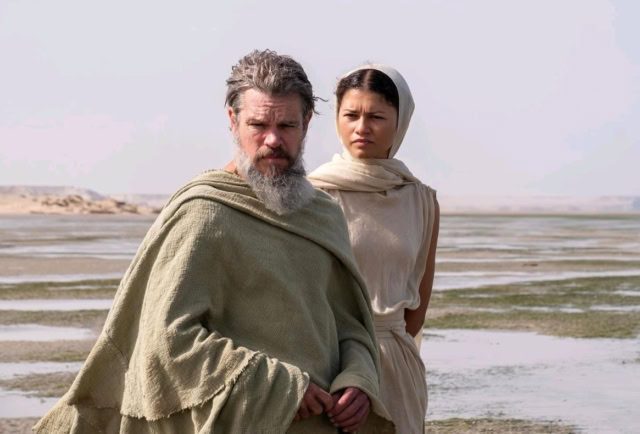
From here, we slowly begin to see Damon as Odysseus in the present day, an aged man lost on a beach with a woman named Calypso (Charlize Theron). She feeds him a white lotus in his delirium and beckons him to remember his past. And he recounts a nightmarish voyage that began after the fall of Troy and began on an island with a cyclops.
The ambitious practicality of Nolan’s Odyssey
Akin to Peter Jackson’s first three Lord of the Rings films, Nolan makes brilliant use of practical filmmaking techniques. When the Cyclops enters the cave, it feels authentically present and looks visually remarkable. The creature’s design is chilling, resembling one of the claymation nightmares from a Tool music video. And unlike other adaptations, Nolan treats the monster with a little more sympathy. The soldiers are the trespassers, not the creature.
But the cyclops encounter is far from the standout. The sequence involving armored giants is spectacular, as the battle feels almost like a modern war film. Each swing by the giant that misses and hits a tree ignites the tree branches like a C4 explosive, showcasing the power of their attack. And somehow, Nolan executes his own version of walking trees that assist in the combat against Odysseus’s men.
The middle section is full of inventive ideas that bring practical solutions for designing fantasy. The standout among them is a chilling sequence in which the men become pigs. We rarely see Nolan tackle the genre area of horror, much less body horror. And in The Odyssey, he presents one of the most stunningly horrific visions of someone molding a person like clay.
A beautiful symphony of sight, sound, and performances
While Odysseus fights his way through a labyrinth of inconveniences sent by the gods, we witness more unraveling in Ithaca. Telemachus begins to weigh options to keep his mother, Penelope, safe. And it’s in these desperate moments that Anne Hathaway might have secured her Oscar nomination. Hathaway plays the role with great sincerity and passion. But we also get a taste of how that passionate flame can form into anger when tested, especially by her son, who receives a verbal lashing from Penelope that made the audience stop breathing.
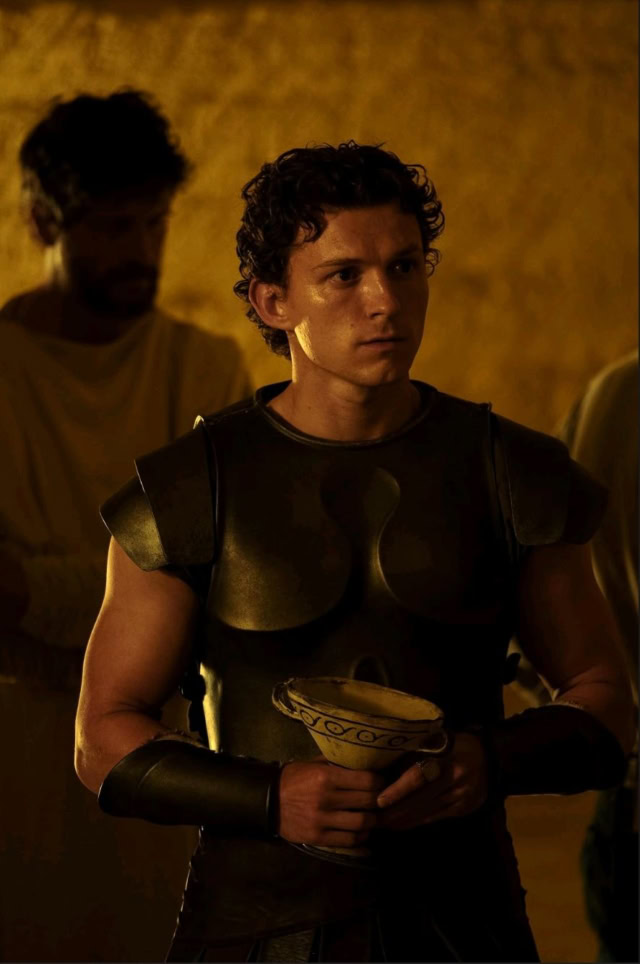
Tom Holland is nowhere near the same league as a performer as Hathaway, but with The Odyssey he genuinely surprised me, showing a subtler, more serious side than in his Spidey roles. He possesses the same required naivety, but with greater quiet nuance.
John Leguizamo is the biggest standout, delivering an earnest role that is against type for him as a performer, especially for a movie of this size. Himesh Patel as Eurylochus is also a low-key breakout, portraying a soldier trying to be the voice of reason as Odysseus continues to choose hubris over humility against the gods.
Hoyte van Hoytema’s cinematography continues to transcend the form, utilizing IMAX to its full advantage. The images are rich in scope, and even a sunrise over the waters of Ithaca feels divine. The canvas also enhances the enormity of both the story and the monsters within it, especially in a setting where a viewer needs to feel the full weight of a towering cyclops.
The score by Ludwig Göransson is more of a mixture than his work in Sinners, but he knows when to pull things back to a haunting minimum, such as when the soldiers cross Hades.
The Odyssey is a pure Nolan visionary achievement

The film comes into its own once we see the complete vision. Nolan takes the third act to the same familiar conclusion, but he also takes creative liberties to enrich it with new meaning. In his version of The Odyssey, the allegory adds a character study of the pain war brings. Odysseus was the victor in Troy, but like a soldier returning from the shores of Normandy, he faced greater destruction within himself, as well as the innocent lives caught in that warpath. And when the film pauses to meditate on those concepts, it becomes a spellbinding achievement.
I’m unsure where The Odyssey falls among Nolan’s best work. It’s not as overly complex as Inception or Memento, and it never becomes the sci-fi schmaltz of Interstellar. However, it’s a remarkable achievement in film that will push the form forward. It also confronts the demons of death and destruction in war more effectively than Oppenheimer does. And I find it incredible that an adaptation of Homer’s epic poem can find greater meaning within those themes.
Also check out: Review: Christopher Nolan’s Oppenheimer is Astonishing