‘Toy Story 5’ Review: The Animated Movie of Our Times
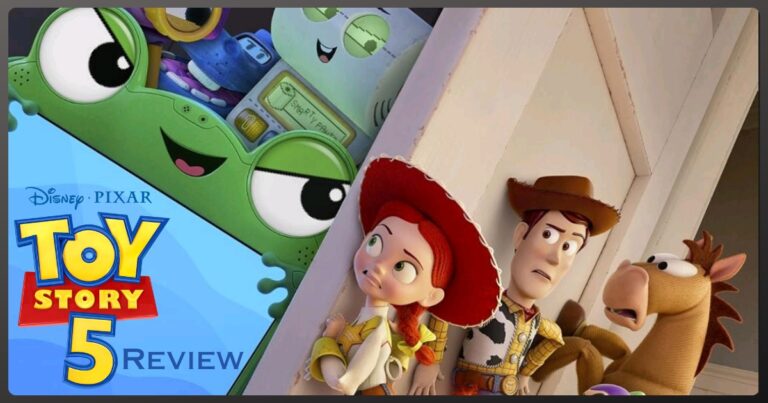
I know, another Toy Story sequel? Are they ever going to stop making these? This is a valid question, given how many agree that Toy Story 3 ended the franchise perfectly and offered thoughtful conclusions for the toys many of us grew up repeatedly watching on VHS until the tape wore out. Toy Story 4, while enjoyable, existed only to print money, and many might have entered Andrew Stanton’s Toy Story 5 with the same expectation. After all, Stanton’s last movie, In the Blink of an Eye, was poorly received by both critics and audiences, even if some of his live-action work (most notably, the episodes he directed for Legion and 3 Body Problem) shouldn’t be dismissed.
With Toy Story 5, Stanton returns to the language that has defined his best-ever works and draws a striking portrait of our isolated times. In a post-COVID world, such a movie feels like a refreshing wake-up call for parents (and adults) to reflect on how they perceive the world, ever since technology has proliferated and become an integral part of our everyday lives.
Many will likely argue that they can’t live without technology anymore, and they would be correct. Can you find a job without knowing the basic functionalities of a computer? Can you work without the internet? Can you meaningfully avoid traffic without AI-powered apps like Waze to guide you through your commute? Can you make connections without social media nowadays?
The plot of Toy Story 5
All of the above questions are thoughtfully explored in Toy Story 5, a movie that is much smarter than you think it is going to be and opens up unexpectedly, reminding everyone of the core essence of being human. Stanton and co-writer Kenna Harris reintroduce us to the iconic group of toys by putting them at the forefront of a contemporary crisis affecting the way humans—especially kids—look at one another through the multiplication of technological devices that hypnotize the young from the beginning.
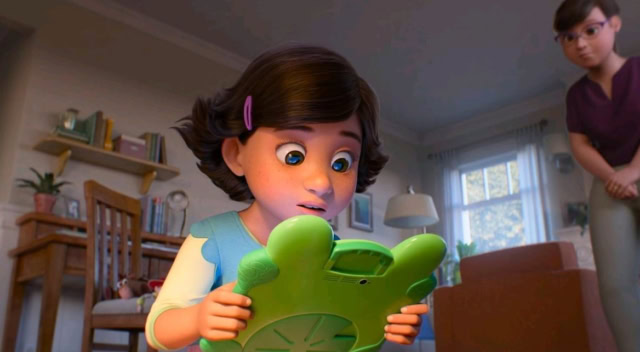
This is what happens with Bonnie (Scarlett Spears), who has been having great difficulty making friends because everyone is on a Lilypad (Greta Lee). Their parents think they are doing the right thing by offering Bonnie the same device, but it only makes her more isolated and vulnerable. Her entire life now depends on what she does in this entirely virtual world rather than outside it. Because of this, Bonnie no longer plays with her toys, and the imaginative scenarios she’s developed with figures such as Jessie (Joan Cusack) and Buzz Lightyear (Tim Allen) are no longer in her head.
With the aid of Woody (Tom Hanks), who returns to Bonnie’s room at Jessie’s request, the toys are determined to rid themselves of Lily and find Bonnie a real friend that she can play with. A series of misadventures ensues, which leads Jessie back to her previous owner, Emily’s ranch, where eight-year-old Blaze Manoukian (Mykal-Michelle Harris) now lives with her parents.
It won’t take long before she and her newfound friends, Smarty Pants (Conan O’Brien), Snappy (Shelby Rabara), and Atlas (Craig Robinson), find out that Blaze is perfect for Bonnie and come up with a plan to make sure they connect face-to-face.
The newest film in the franchise is smarter than you might expect
One can think Quentin Tarantino is right about how the Toy Story franchise should’ve ended at three, but there’s something so utterly moving about how Stanton depicts this urgent story. It’s difficult not to be swayed by what’s on screen. It’s a more scathing portrait of our technology-obsessed society that many give credit for. The way in which it depicts humanity’s relationship with their screens is far more subtle than the confrontations of Stanton and Harris’ script, especially when Bonnie is immediately entranced by the magnetic blue light of the Lilypad as soon as she turns it on.
Maybe Stanton cops out during the conclusion of the film, but it almost doesn’t matter, because he’s able to capture something out of his characters (and the audience) that few animated movies could convey. Even John Lasseter’s original installments don’t have the same emotional power as Stanton’s eye, who gives a more playful and stimulating style to the animation whenever we go into Bonnie or Blaze’s mind as they play with toys. Through more expressive camera movements and bright, heightened colors, Stanton argues that your mind is fully activated and immersed with whatever outlandish scenario you come up with, as your toys become the conduit for your imagination.
When I was growing up, I used to see everything—and I mean everything—through the prism of an action movie, because that’s how I played with toys. Bonnie and Blaze have different outlooks on the world, and we understand exactly what they are as soon as we observe them playing with their toys. Their minds see things that adults don’t, or have forgotten, because they’re so concerned about their day-to-day tasks that even imagining things is no longer a possibility for them.
By shifting the house animation style that has defined the Toy Story franchise for the better part of thirty years (and has revolutionized stereoscopic animation as a whole), Stanton taps into adult viewers’ most repressed memories. It makes them remember what it was like being a child and seeing the world through your bubble as you slowly began to understand what was unfolding in front of your eyes.
There’s a genuine earnestness in the way Stanton stages these scenes. He reminds all of us of who we once were before we began worrying about getting stable employment, communicating with the bank on our personal financial situations, or simply just getting by.
One of the main arguments Stanton makes early in the movie is that technology robs us of the precious time we spend on our planet. We’re so concerned about what’s occurring on our screens that we forget to look at what’s happening in front of our eyes, outside the virtual worlds we’ve developed over the last decade.
COVID has undoubtedly shifted the way we see the world, and even interact with people, for the worse. People are more isolated than before, and echo chambers now exist where many vulnerable users are trapped in rabbit holes with no healthy way out. There’s a scene in Toy Story 5 where Stanton illustrates exactly that, and the way that he lingers on Bonnie’s face is simply devastating.
Then, in a shocking transition worthy of Joseph Kosinski’s TRON: Legacy, he puts us inside Lily’s pixelated “eyes” and helps us “see” how a device perceives human objects around them. It’s the type of minute shift that repurposes the drama at the heart of this highly intelligent animated movie and unfurls its story in surprisingly textured ways.
It helps that Stanton has assembled an A-list cast to represent these shifts in profoundly moving fashion and gives more active development to characters that we thought had already been fully fleshed out. This is the case with Jessie, who becomes the protagonist of the film while Woody and Buzz are relegated to her sidekicks.
That may alienate die-hard fans of the franchise that want to see the same thing over and over again (they should check out what John Lasseter is currently doing at Skydance Animation instead, where he has been unremarkably reheating his nachos after a fall from grace). Stanton knows that if Toy Story sequels are to be made in perpetuity, it can’t repeat itself. He thoughtfully evolves a franchise that could’ve stayed in the safe, stale territory of its fourth entry and hopes the audience embarks on another profoundly emotive and visually dazzling adventure with Pixar’s most iconic characters.
Final thoughts on Toy Story 5

I’ll admit that it took me a while to get into Toy Story 5’s groove (the lack of Randy Newman’s “You’ve Got a Friend in Me” in front of the title card was certainly striking). However, when I eventually got swept up in the film’s bevy of show-stopping, highly imaginative sequences, including its amazingly staged climax, removing the massive smile on my face was difficult. The fact that it’s also this thoughtful about our ever-changing world is also a massive plus.
Maybe Toy Story 5 is a blatant cash grab that continues to capitalize on Pixar’s most popular and acclaimed franchise, and one of Disney’s most successful intellectual properties. Perhaps we’ll get sporadic sequels since this one will likely make $1 billion at the box office and never have the satisfaction of a proper “conclusion,” as Toy Story 3 certainly did.
All of this might be true. But Toy Story 5 is also a frequently jaw-dropping display of pure imagination and formal daring that it’s hard not to be drawn in by what’s on screen and remain a cynical, emotionless brick. Even the most ardent cynics might find something of value in this. It’s rare for a cash-grab sequel to be good. It’s even rarer for it to be this incredible.
Also check out: Hoppers Brings Pixar Back to Its Glory Days