‘The Death of Robin Hood’ Review: Poetic and Painfully Bleak
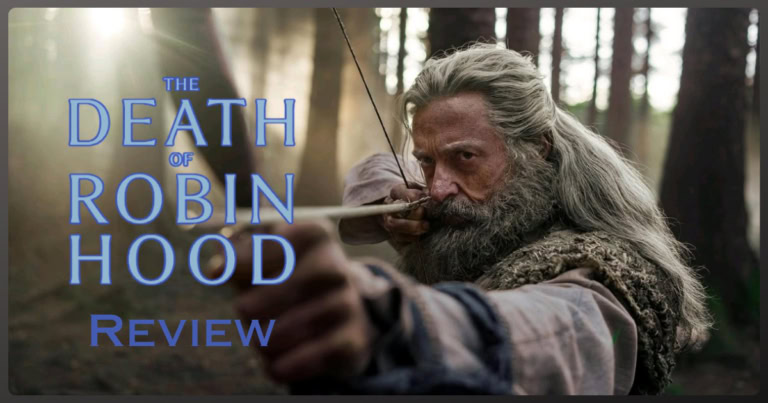
The Death of Robin Hood is a difficult pill to swallow. For most of us, the idea of Robin Hood evokes spectacle and adventure. He is the archery equivalent of King Arthur, supplying action, adventure, and a sense of nobleism. With a filmmaker like Michael Sarnoski, the director of Pig, one of the most sincere films about empathy, one might expect The Death of Robin Hood to have an uplifting tone, even in the face of a possible character death. Well, book an appointment with your therapist because The Death of Robin Hood is here to leave behind some scars.
Sarnoski’s film is relentlessly dark. And I do mean midnight during a lunar eclipse on the eve of Satan’s return, dark. It is unlike any Robin Hood portrayal we have seen, dismantling the familiar valiant ideas of the outlaw. But with Sarnoski, there are moments of reward if one survives the ruthlessly bleak opening.
What is The Death of Robin Hood about?
Written and directed by Sarnoski, the film centers on an old, withered Robin Hood (Hugh Jackman) who sports a majestic gray beard and quietly lives off-grid in the mountains. The alleged real-life legend says that Robin’s final days took place in West Yorkshire, England. But here, Robin appears to be in quiet isolation in the mountains of Ireland.
The film immediately sets the tone for how brutal it will become. A young drifter comes across Robin, who turns out to be a young girl. She tries to attack Robin while sleeping, and he defends himself by knifing her in the neck, with a ferocious finishing blow to the temple. And that is merely the opening sequence to Sarnoski’s vision of Robin Hood.
The film then introduces the viewer to an amazingly realized Bill Skarsgård as Little John, who has been secretly living as Edward with a wife named Margaret (Katie Breen) and their daughter, Little Margaret (Faith Delaney), for some time. Skarsgård‘s execution of Little John is not the towering, jolly persona we are accustomed to. Here, his voice is filled with a menacing, growling bass, and he almost comes off feral like an animal always ready to bite someone’s throat.
But a tragedy befalls the two men, leaving Robin intensely wounded and on the brink of death. He finds healing on an island priory, where Sister Brigid (Jodie Comer) tends to his wounds. And it’s in her care when Sarnoski’s film begins to find a voice.
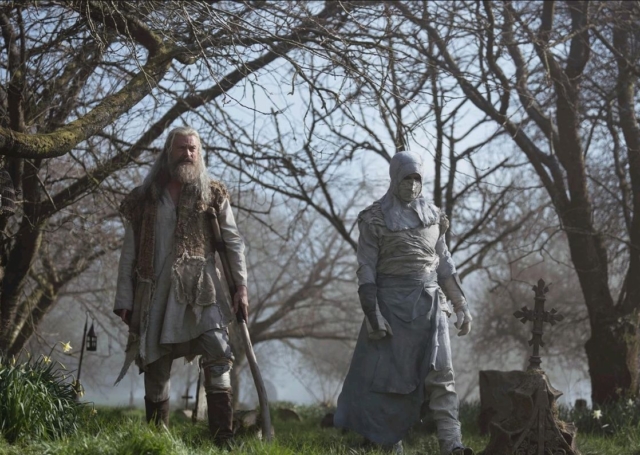
Michael Sarnoski and Hugh Jackman design an ill-tempered outlaw
Thematically, everything begins to come into focus as the story confronts the demons of an outlaw who made horrific choices for the greater good. As he lies there suffering in wounds, Sister Brigid refuses to let him find death. From this point, the film shifts from violence to a character study of a man who decides to stop running from his enemies and himself.
Robin is not only running from those who seek to slay him as a legend with a deadly bow; he is also running from the decades of lives he has taken. And the role could easily be one of Hugh Jackman’s best performances since possibly The Fountain. Unlike Logan, which resembles The Death of Robin Hood, Jackman’s portrayal of Robin is cold and unpleasant. One can see that he might have been charismatic in a past life, but what remains is a blistery personality. For any actor, being asked to play an “unlikable” main character is challenging, but Jackman succeeds.
Robin’s cold, grizzled aesthetic matches the film’s visual framework. Cinematographer Pat Scola (Pig, Sing Sing) gives the movie a hazy, grayed-out look that perfectly resembles Jackson’s overgrown, aged beard. There are long sweeping shots of Ireland’s mountains that feel wondrous to take in.
The breathtaking cinematography is only enhanced by the folk-inspired score from Jim Ghedi, which easily made the experience feel like a Ridley Scott period drama from the early 2000s. The movie itself almost feels like the movie Scott planned to make with Russell Crowe, where Robin was pitched as the villain, before Scott threw the concept away for a safer vision.
The Death of Robin Hood is a beautifully made and intentionally unpleasant

Like Sarnoski’s film Pig, his pacing in The Death of Robin Hood moves at its own rhythm, with little regard for whether the audience can handle a slow burn. With Pig, the careful pacing was more impactful because Nicolas Cage’s character has to slowly peel away the layers of a mystery surrounding his stolen pig. Furthermore, Pig’s pacing was rewarded with moments of surprising tenderness. With The Death of Robin Hood, the slowburn appeal often feels more like a bug than a feature.
The film does reward in sections during the back half. Still, the combination of mean-spirited violence and extremely dark themes made the first half challenging, especially with the unhurried narrative.
The experience inspires complex feelings, especially with how everything unfolds. The first section is patient, aggressively violent, and unsettling with its depiction of 13th-century violence. The added layer of misery Robin displays almost makes watching the opening feel like a game of Survivor for the viewer. Yet at the same time, the final 45 minutes are a deeply poetic, emotional, and beautifully realized vision of Robin’s last days.
Overall, The Death of Robin Hood is the bleakest and most brutal adaptation of the iconic character. Still, Sarnoski‘s vision is also a heartwrenching poetic interpretation of the ending of a legendary character. The film is beautifully made, but it’s not an easy recommendation.
Also check out: Carolina Caroline Coasts of Pure Vibes and Charisma