‘Saccharine’ Makes Attempts at Exercising and Exorcising
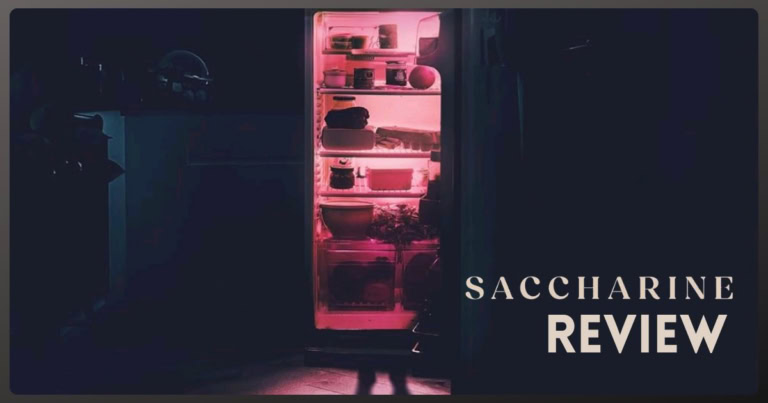
Following her filmmaking on Paramount Pictures’ Rosemary’s Baby prequel, Apartment 7A, with Christian White and Skylar James, writer-director Natalie Erika James returns with a new horror project. Independent Film Company and Shudder’s science fiction supernatural horror drama film, Saccharine, follows a young woman in medical school. She becomes terrorized by an apparition after experimenting with an unapproved weight-loss procedure—pill supplements apparently made from human ashes.
James has good intentions in spearheading a narrative about women’s means for comfort in the modern age. It’s important to emphasize body image and body positivity in opposition to the phenomenon of eating disorders, especially as fast food corporations and the junk food market manipulate the ease of access to hunger-satiation. However, as a horror film, the execution results in one of the more troubling feats that the genre has seen in a while.
Saccharine: A bittersweet production
As a feature film production, Saccharine shows promise for filmmaking. It’s presented similarly to Sasha Rainbow et al. Grafted, another horror movie distributed by Shudder last year. Primarily focused on women and their dynamics, I enjoy watching the degrees of acceptance of one another here.
As per Independent Film Company and Shudder’s production notes, Hana Hitching’s (Midori Francis) gym’s “candy-colored aesthetic[s]” stick out in comparison with the rest of the gloomy Australia-set environment. The workout space is unreal, with its shades of pink at times, and has minimal decoration.
Otherwise, the film is intended to be revolting, beginning with Hitching scarfing down a jelly donut as cinematographer Charlie Sarroff shoots the action in reverse. The life-sized human anatomy model in Hitching’s medical school department is uncanny. Perhaps it’s to allude to the disparity between the plastic view into weight loss and the realistic lens into “no pain, no gain”.
Sound editors Robert Mackenzie and Justin Spasevski‘s work on the character’s mastication and her stomach gurgling showcases the disquiet. The sounds also signal the arrival of the antagonist, nicknamed “Big Bertha” (Octavia Barron Martin, Anna Adams), a deceased woman with weight issues.
Gaffer Jesse Moyes provides skillful lighting, e.g., in the carnal red intimacy between the main character and another woman. Occasionally, a room can be so lit up that it appears inauthentic. Editor Sean Lahiff aids the narrative progression by cutting and assembling a few montages. He does so to exhibit the passage of time and demonstrate Hitching’s weight loss journey.
To its detriment, the middle act feels as if it drags on and on. Regardless, when she does lose weight, James never allows the character to sit with the achievements. It loses meaning and purpose, that is, in Hitching’s self-perception and what self-esteem is to be illustrated.
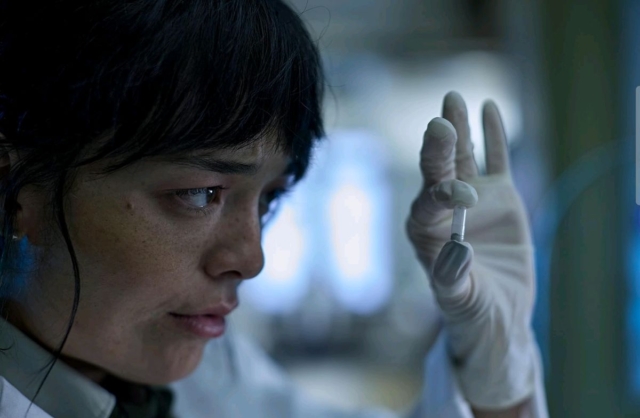
Natalie Erika James’s writing and directing
Sadly, James‘s screenwriting is inconsistent with the characters introduced, along with the smaller details brought into the fold. One noteworthy subplot is Hitching’s relationship to each of her parents, Travis (Robert Taylor) and Kimie (Showko Showfukutei). Asian parents and their views on their children’s physical appearances are very commonplace. Kimie represents this idea despite being on screen for a few, albeit remarkable scenes.
Next to that, the fictional family’s practice of Buddhism lends further to the supernatural aspect of horror. Buddhists are known for their vegetarian diets and proclivity for consuming simple, natural foods. Even then, the connection between the religion and the movie’s story is feeble.
Social media and the trendy “challenges” on display comprise another aspect of the dramatic conflict. However, it’s quite useless since Hitching is addicted to eating and not doomscrolling. Yet, the script interestingly utilizes language such as “hefty” and “fat” to describe the verbal harm that can be dealt between people.
In the production notes, James cites eating as “a source of shame, isolation, and powerlessness.” This rings true for Hitching in her personal sphere, her familial sphere, her romantic space, and in her friendship circles. Some people resort to eating sprees because of heartbreak. Others give in to their eating disorders because of the loss of a loved one.
She seems to do so because her father’s distancing himself from the family picture. Saccharine does a decent job of separating the protagonist from other people. Still, that doesn’t account for Travis’s own experiences and why he is left at home to be cared for by Kimie.
Unfortunately, Hitching informs neither the other characters nor the viewers what plagues her. That makes matters all the more difficult to gauge. The pervasive, reticent trauma harkens back to James and Christian White‘s Creswick and James‘s Drum Wave. These short films also center on adult women and their respective silent conflicts with family members.
The filmmaker never tries to resolve such conflicts. Instead, she highlights the ongoing troubles that women face alone. Hitching’s Japanese household and the Mandarin-speaking atmosphere of Drum Wave would be fun for juxtaposition’s sake. The foreign language layer, although thin, suggests that cultural differences between one country and another should not be ignored.
What subgenre(s) is Saccharine?
Moreover, Saccharine‘s concentration as a sci-fi supernatural story seems to steer clear of any solid stakes for the situation. It avoids a solid identity as a body horror or a psychological thriller, which could profoundly shift the tone if necessary.
Josie (Danielle MacDonald), Hitching’s college friend and peer, looks to be content with herself. As a supporting role, Josie contributes little, and her personality could have been merged with Hitching’s grade school acquaintance, Melissa (Annie Shapero). The concerns of cannibalism are swept under the rug until the finale, wherein it’s predictable, albeit somewhat inevitable, to watch unfold.
After her appearances in Gene Stupnitsky and Lee Eisenberg‘s Good Boys, Mindy Kaling and Justin Noble‘s The Sex Lives of College Girls, and Shonda Rhimes‘s Grey’s Anatomy, Francis‘s dramatic performance as the lead is pretty good. Hitching’s circumstances are mostly physiological, and her body remains intact.
It’s in the laughable third act that she has an out-of-body experience and any semblance of body horror. Ultimately, if this were the final cut, then it is as ridiculous as Stephen King‘s (as Richard Bachman) weight-loss horror concept for his novel (and Tom Holland and Michael McDowell‘s film adaptation of the same name), Thinner.
Additionally, love interest Alanya (Madeleine Madden) is a psychology student who runs the twelve-week weight-loss challenge at Hitching’s gym. Notably, her disappearance from the third act is indicative of the mindlessness that the story undergoes. In scenes involving her, Hitching fights with her cravings and desires for lust.
Overall, a psychological lens would have explained some reasoning behind much of what transpires. As a horror film in general, there is much greater weight in human choice and the struggle for balance found in both Julia Ducournau‘s Raw and Coralie Fargeat‘s The Substance. James‘s movie shares similarities with these two titles but tends to lose itself in certain areas.
Final thoughts on Saccharine

Unfortunately, Saccharine is another wasted potential of a feature following the divisive Apartment 7A. The narrative development and the character exploration thereof are nonexistent, stagnant even.
It’s ironic given that it shows Hitching always on the move, whether running up staircases, on stationary bikes, or on her feet. Arguably, there is commentary on the Sisyphean nature of gains and losses. With that said, the movie comes across as pointless and partially insincere about the hardships of heavy people. It never knows what message it hopes to send.
Fortunately for filmmaker Natalie Erika James, Saccharine hits theaters later this Friday. That means it won’t immediately head into streaming platforms. Movie-going audiences will have a chance at seeing it in the comfort of auditorium seats as well. With the help of ticket revenue, the movie will at least get some money back via the box office.
Also check out: Hokum Review: A Solid Spookhouse Throwback