‘Hokum’ Review: A Solid Spookhouse Throwback
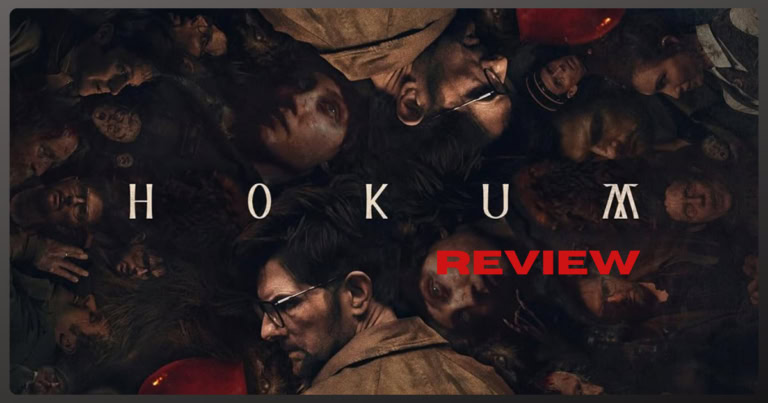
Hokum sees filmmaker Damian McCarthy return with another horror film that balances a mystery with supernatural creepiness. His previous effort, Oddity, made great use of the terror of inanimate objects moving. For almost 100 minutes, viewers would scan the background as characters talk in the foreground. And the same question would always arise: Did that giant mannequin-sized doll move? Hokum does not linger on the fear of sentient dolls or still objects. However, like Oddity, McCarthy’s new film understands the anxiety of dark spatial settings. The dead manifest over the shoulders of the main characters, voices faintly whisper underneath the sounds of an old hotel, and rumors of a witch are shared among visitors.
What is Hokum about?
The film centers on Ohm Bauman (Adam Scott), a novelist who writes about a family adventure with excessive cynicism. Our first introductions to Ohm are unsettling and bleak. He quietly sits at a laptop, drinking liquor, while writing a story about a father contemplating killing his son in the desert.
As he types, spiritual apparitions appear in his home. But Ohm is a skeptic and shuts himself off from the idea that these visions could be real. The film, however, suggests that Ohm’s past does haunt him, as we see him study a picture of a woman (his mother) who looks very similar to the mysterious figure in his home.
Ohm then decides to take a trip to visit an Irish inn where his mother and father spent their honeymoon years ago. It’s in the inn where we finally receive a glimpse of Ohm’s unpleasant personality. He comes across as annoyed and inconvenienced by the hotel staff, even going so far as to burn a bellboy named Alby (Will O’Connell) with a hot spoon when asking advice about being a writer. Ohm’s statement after burning Alby, “You will need thicker skin than that.”
His unpleasantness continues towards the inn bartender, Fiona (Florence Odesh). But Fiona is the only employee who can dull Ohm’s razor-sharp personality. The inn is also rumored to have strange occurrences, including a witch trapped on the top floor, where the honeymoon suite is located.
After a tragic occurrence that leaves Ohm hospitalized, he returns to find out Fiona has gone missing. And the last person to see Fiona claims that she may be on the top floor of the inn, where the alleged witch remains locked away.
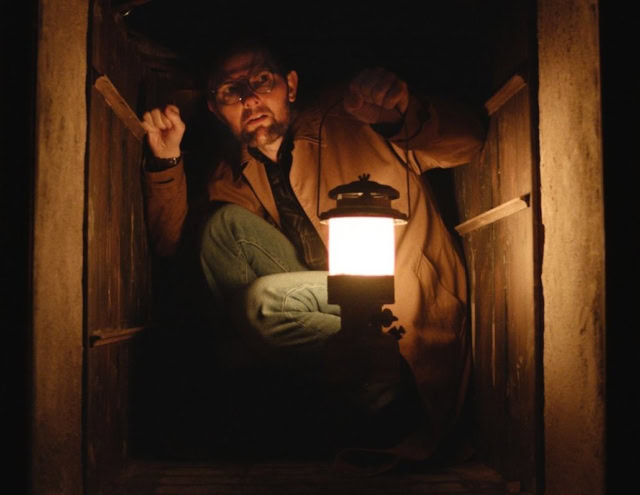
Damian McCarthy’s signature atmosphere
Once the film removes the upstairs barrier and allows the main character to enter forbidden territory, Hokum becomes quite the entertaining spookfest. It never becomes genuinely terrifying, leaning instead toward lighthearted horror in the vein of films like 2001’s Thirteen Ghosts (a highly misunderstood movie for its time). Like Oddity, the film leans into the atmosphere with great impact; the rooms are lit with strong Gothic textures.
The production design makes the honeymoon suite feel like a stage setting for an Edgar Allan Poe play. One can almost see the witch appearing and screaming, “Nevermore!” Small touches further enhance the production design. Cinematographer Colm Hogan gives brief shots of creepy shapes in the carpentry and wide over-the-shoulder shots that may or may not show something walking behind Ohm in the background.
The bed in the honeymoon suite is draped with white netting that makes one feel less secure about what lies behind it than about getting a peaceful night’s sleep. Then there is a magnificent use of a clock bell that has a startling quality for such a gentle sound.
Damian McCarthy’s signature is strongly felt throughout. Without revealing anything specific, a body is found in the honeymoon suite. And, similar to McCarthy’s film Oddity, each time the frame cuts to the body, it seems to have a different posture or facial expression. It’s the old-school horror technique where characters question whether the eyes in the painting are moving in the background.
Neon’s newest horror film has themes involving depression
At the heart of Hokum is a strong exploration of regret. Adam Scott plays Ohm with a quiet bitterness that lingers in every scene. It’s in the way he treats others and in the way he always has a drink in his hand to numb something within. And it all stems from a childhood event. There is a beautifully crafted depiction of Ohm’s pain, told through the novel he writes. The ending of Ohm’s story has a parent and child stranded in a desert, forced to make a choice that will change one of their lives. Either the parent kills the child to inherit the riches, or vice versa.
The choice seems to reflect Ohm’s guilt. He feels responsible for his mother’s death, and that lifetime of guilt might have made him a successful writer. For a horror movie, the way this subtext wraps up is surprisingly gripping. We rarely see horror with a strong emotional center, and given his background on the show Severance, it makes sense that Scott was chosen to carry the film’s emotional weight.
Final thoughts on Hokum

Overall, Hokum is another solid horror entry for Damian McCarthy. It’s not scary, nor is it trying to be. It’s simply a sharply written spookhouse feature with an intriguing mystery and well-crafted characters at its center. Even more impressive, it takes all these ideas and mostly executes them within a single setting.
There are some familiar ideas, such as the jaded skeptic who does not believe in the supernatural. But the emotional hook of a man confronting his pain by opening his mind up to a bigger spiritual world will always be a strong play in horror.
Also check out: Lee Cronin’s The Mummy is Squishy, Silly Horror with Less Edge