‘Silver Pines’ Game Review: A 2.5D Horror Detective Story with Survival Elements

Silver Pines is a game that combines survival horror, detective fiction, psychological mystery, and some Metroidvania exploration into a 2.5D adventure that is inspired by Twin Peaks, Silent Hill, Alan Wake, Widow’s Bay, The X-Files, and Resident Evil. What makes Silver Pines immediately interesting and different from other games of the genre is that it builds everything around atmosphere, creepy visuals, detective curiosity, creepy vibes, and the uncomfortable feeling that the truth is always slightly beyond reach.
Horror games that are set in a town that seems to have been abandoned without ever truly becoming empty are a classic trope of the genre. The streets may be deserted, the buildings may be falling apart, and the sounds of everyday life may have disappeared, yet every corner suggests that somebody was there recently and that you are not alone. And that’s exactly what Silver Pines is about.
[Warning: spoilers are discussed below! I played the PC version of this game. While I’m reviewing this game independently and honestly, it should be noted that it has been provided to me by Wych Elm Games & Team17 for the purpose of this review.]
The story in Silver Pines is creepy, scary, and fascinating
Silver Pines’ story focuses on Red Walker, a private investigator who arrives in a forgotten American town to investigate the disappearance of Eddie Velvet, a musician whose whereabouts have become unknown. Like a typical detective story, Walker follows leads that are starting to become one big, almost unsolvable puzzle.
But Silver Pines is not simply a location where a crime has taken place. It starts as a simple job, and the further we go, the more it turns into a nightmare that will take its toll on Walker’s mind and body. The mystery is deliberately constructed around uncertainty, fear, and horror to slowly reveal the truth through conversations, documents, environmental details, and climate.
A horror story can lose much of its effectiveness when every mystery is explained too fast or too poorly, and it seems the game developers at Wych Elm Games understand this. The narrative leaves a lot of room for interpretation to explore the relationship between Walker, Velvet, and the history surrounding the town. Nevertheless, the story’s strongest quality lies in its willingness to make uncertainty, fear, and spooky vibes an essential part of the journey.
Walker’s investigation leads to facts but also thoughts that finding Eddie Velvet will not necessarily resolve everything that has gone wrong in Silver Pines. The case slowly turns into a way of examining the relationship between memory, guilt, and personal responsibility.
The writing works best when it trusts us to figure things out by ourselves in the world rather than giving us every answer. Although some narrative choices could have benefited from more definitive conclusions, the combination of detective fiction, supernatural vibes, and multiple endings turns the story of Silver Pines into one of the game’s most important parts.
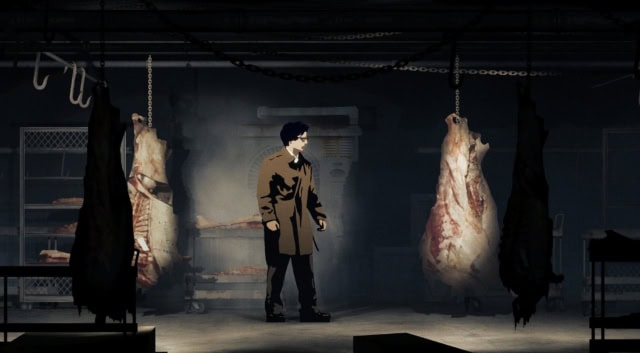
Gameplay uses elements of Metroidvania to create a unique 2.5D horror experience
Silver Pines uses a 2.5D perspective, showing its environments with a side-on visual composition while allowing the surrounding spaces to feel layered and interconnected. So it’s basically a 2D game with the use of 3D graphics to make it feel more structured. This structure creates an interesting balance between the understanding and exploring parts of the story, with the horror vibes of not knowing what’s to come.
We can easily understand the layout of a room, but that does not mean we know what awaits us at the next door or whether there is danger hiding in the shadows. Locked doors, concealed passages, environmental obstacles, and previously unreachable locations slowly change the town into an interconnected network of mysteries.
Searching a building may reveal a clue that you missed, a useful item, or a route that connects a section of the map that was unavailable an hour ago. Returning to a familiar location can become rewarding once we acquire the necessary equipment or solve some earlier puzzles. This creates the kind of satisfaction that Metroidvania games offer, where gaining knowledge becomes just as important as upgrading your gear or anything else.
At the same time, revisiting locations has a psychological benefit. An environment that we thought was safe can become dangerous when new enemies appear or when we realize that an unexplored part of the map has been hiding something we need.
Combat is designed around survival and nightmarish creatures and boss encounters that demand attention, careful positioning, and an awareness of the resources available at hand. We can fight the monsters in the town or avoid the encounters by deciding what is worth our time and what can defeat us easily. The limited availability of ammunition, healing items, and other supplies helps to pick the “better safe than sorry” option. Every confrontation becomes a small calculation.
One of the more distinctive features is the use of a camera system that encourages us to document clues and important environmental details to use in the future. It explores Walker’s identity as an investigator and gives observation a more expanded place in the gameplay.
Instead of using the protagonist as an excuse to become an ordinary character who happens to have a detective’s title, Silver Pines attempts to make his life and experience part of the game. That choice fits the game’s larger philosophy of making sure that every piece of information is a valuable resource, and understanding the environment can be as valuable as finding another box of ammunition.
The mechanics also make sure that the visual presentation encourages us to pay attention to details that might otherwise disappear into the background and hunt us in the future.
Silver Pines game rating and final thoughts

Silver Pines is a game that serves as a reminder to the industry that survival horror does not need to reinvent every established/known mechanic and story from the genre to deliver a memorable experience. From the start, we can see how serious, dark, scary, thrilling, and emotional this game gets.
By the end, you realize that you just played a survival horror game without a big budget that really felt like it was a part of the Silent Hill or Resident Evil universe because of how well it was done. But Silver Pines doesn’t lose sight of its identity as a detective mystery inspired by noir cinema and psychological horror projects from the past.
A 2.5D perspective, haunting climax soundtrack, horror vibes, thrilling vibes, and uncomfortable small-town setting give this game its unique personality. Ultimately, Silver Pines is best when it focuses on building and using the world’s atmosphere and interpretation rather than relentless, confusing, and unnecessary action. The story’s strength comes from the need to pay attention, remember details, and accept that not every mystery will be immediately explained.
Silver Pines is now available to play on PC, PlayStation 5, Xbox Series S/X, Nintendo Switch, and Nintendo Switch 2.