‘The Last House’ Review: Netflix’s Locked In Film Should Be A Last Resort
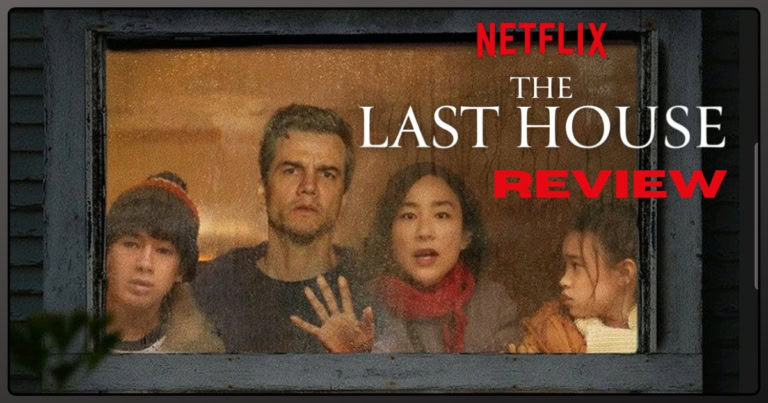
French producer and director Louis Leterrier and screenwriter Matthew Robinson’s The Last House is flawed in its storytelling. The problems don’t just lie in setting a narrative in Seattle, Washington, but in believing that its populace feels alone. I remember visiting the area in late July and seeing how a beautiful community can coexist. That is, until the shooting in Seattle Center during the Bite of Seattle that left three dead and four others wounded.
Yet, there is something remarkably Gothic about families being locked inside their homes. Dependent on the circumstances, the home is symbolic of these same family environments who should remain intact. Leterrier and Robinson’s movie follows the Delgado family and those in their vicinity as everyone is trapped inside their Washingtonian suburbia. Here, the premise is uncanny, blending partial voyeurism with post-COVID-19 pandemic familiarity.
The Last House story has some issues
The main characters are limited in resources. Seemingly, as part of Netflix’s prior movie rental service, they have only two DVDs available to watch at home. One is Wolfgang Petersen and Andrew W. Marlowe’s Air Force One. The other DVD is John Huston and Carol Sobieski’s Annie. The 1977 musical film adaptation centers on a young girl hoping to find a home for herself and her orphanage siblings.
This element speaks to the fact that physical media is crucial at times when the Wi-Fi is down. The idea is awkward, considering the streaming giant promotes watching at home and not in theaters. Netflix isn’t one for physical media anymore; therefore, it feels weird to present that concept in a film such as The Last House.
Additionally, I like the idea that patriarch Jason Delgado (Wagner Moura) communicates with his neighbor, Max Richardson (Sid Edwards). They do so by writing on a chalkboard and a whiteboard, respectively. Perhaps we don’t truly know each other unless a proper connection can be made.
The Delgados’ perspective of their neighbors through their front window is noteworthy. Director of photography Pål Ulvik Rolseth frames this aspect akin to how director of photography Robert Burks frames Alfred Hitchcock and John Michael Hayes’ film adaptation, Rear Window. Invisible lines are drawn to establish a network. Unfortunately for the narrative, this does not last long.
Of course, The Last House will not be for everyone. On the one hand, to an extent, I appreciate the tonal approach to being locked in. During the pandemic, it took days to loathe the lockdown. However, in this film, it takes a month to reach a pessimistic state of mind. It takes even longer to drive inhabitants mad. Needless to say, it doesn’t matter whether one knows how and why they are kept inside.
The horrible truth is that it’s more of a horror to see who people become. The otherwise treatment of staying in as any sort of nightmare is handled poorly. Take Stephen King’s novella, The Mist, or any page-to-screen adaptation of it, for example.
It would be more effective to showcase a stronger message about monstrosity. Leterrier and Robinson intentionally do not give viewers an antagonist or villain of any kind. Rather, the conflict is more concerned with survival and the means to go outside.
Netflix film has a “messy” message
The Last House doesn’t need to be too political, but it does start getting somewhere midway through. The “chimney fishing” montage leading into the five-year time jump demonstrates a development in ethos. All that we know of Jason Delgado is that he is an unemployed engineer. He learns to make do with what his family has in possession within the confines of their home.
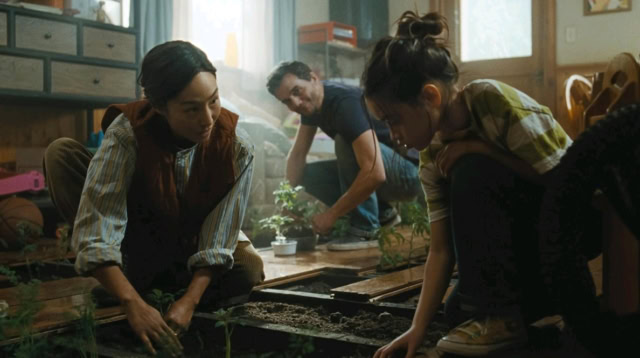
Failure after failure soon brings them to certain breakthroughs. They learn how to grow crops inside and to hunt for meat from outside. Robinson crafts intriguing inventions for everyone. It would all be logically sound if only they knew how to climb out of the rabbit hole. The family’s biggest narrative challenge is their aim to look beneath the surface.
The Delgados eventually learn to overcome their predicament, while other households have or haven’t. Even then, this progression makes sense for the melodrama of movies. It doesn’t quite work well on paper. There is voiceover narration in the opening, transitional, and closing moments between acts. Though, in my opinion, it’s odd to leave that in there.
Maybe the point of renaming the title The Last House from 11817 is that domestic atmospheres crumble. In modern America, we live in a time when obstacles constantly head our way with no absolute solution. We end up utterly helpless, and that is out of our control. Sometimes, that isn’t our fault. The metaphor of deterritorialization—or the restructuring or destruction of a specific environment—could have been made clearer.
The Last House movie rating and final thoughts

Moreover, I can’t speak much to the performances of the lead cast. Moura and co-star Greta Lee are award-winning stars that some cinephiles may want to see. Mainly, Jason Delgado struggles with keeping the family in balance. Ann Delgado (Lee) appears to be a stay-at-home wife. Regardless, Leterrier’s direction and Robinson’s material only offer her a good amount.
There is some wisdom and some stupidity to be had within the Delgado family. If you are one to root for a character, then this movie is not meant for you. Like its script, The Last House contains narrative structuring that is difficult to sit through. That isn’t to suggest that it’s totally a bad or pointless thing. Yet, the movie deserves fortification and growth, especially given that it’s just another addition to the Netflix catalog.
Also check out: TIFF 2026 Movie Review: Hope is Cinema at Its Purest