‘Avatar: Fire and Ash’ Review: More Like Fire and Rehash
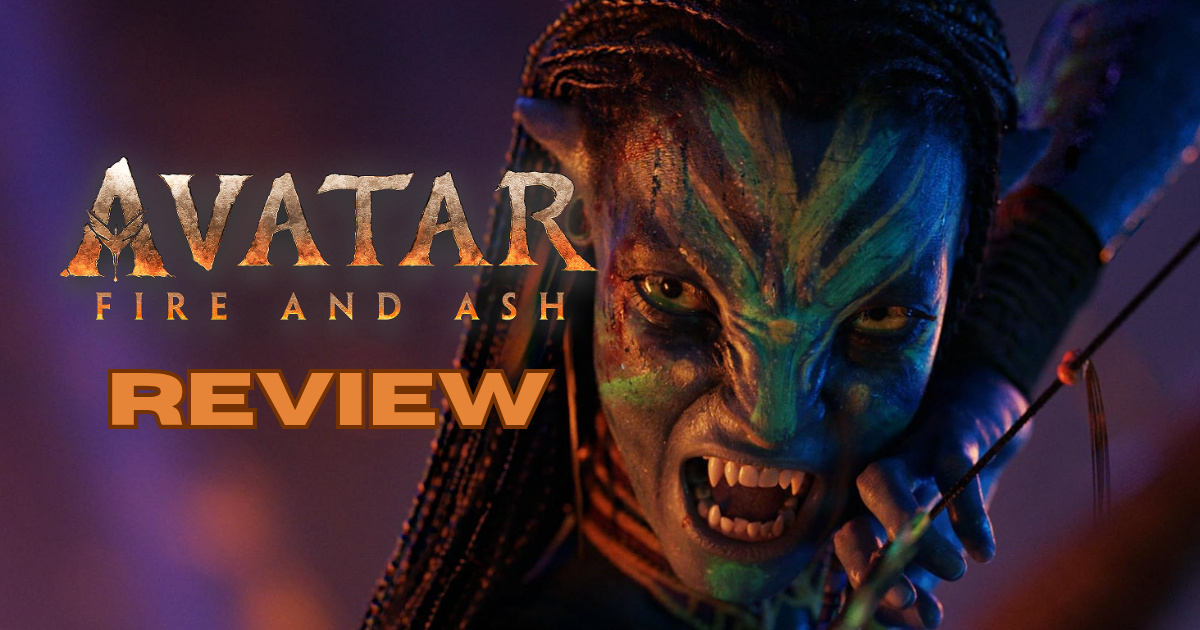
Avatar: Fire and Ash is a rare artifact from James Cameron. Throughout his career, the filmmaker behind the Terminator franchise has deliberately avoided trilogies. Even after Terminator 2 became an early ’90s phenomenon, he chose other creative endeavors, such as True Lies, and had a brief run developing Spider-Man before Sam Raimi. The question no one has ever considered is whether Cameron has the artistic stamina for three films.
The answer to the question is rather complicated. On one hand, Avatar: Fire and Ash holds the line on the technical mastery seen from the first two movies. On the other hand, Cameron‘s ability to bring something fresh, narratively and at times visually, is showing signs of vulnerability.
The third film certainly has action sequences that will rock the senses. One, in particular, kicks off in the first hour and genuinely dazzles the three-dimensional canvas. However, for a filmmaker who has made a career on showing the audience something new with each film, Avatar: Fire and Ash is more of the same.
The story in Avatar: Fire and Ash
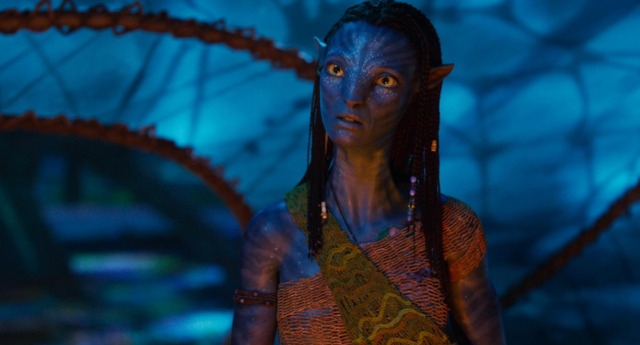
The film kicks off shortly after the events of Avatar: The Way of Water, as the Sully family maintains their safe harbor with the Metkayina Clan. The family group remains grief-stricken by the death of Neteyam, Neytiri (Zoe Saldana) most of all, who has become bitter toward the human species all around. Her building prejudice continually falls on Spider (Jack Champion), further driving a wedge in the family because of Kiri’s (Sigourney Weaver) affection for him.
Adding to the complications, Spider can only breathe on Pandora with a mask, and the supply to keep Spider breathing will eventually run out. Jake Sully (Sam Worthington) sees the inevitability of Spider’s situation and urges the family to transport Spider back to his own kind, where he has unlimited breathing resources.
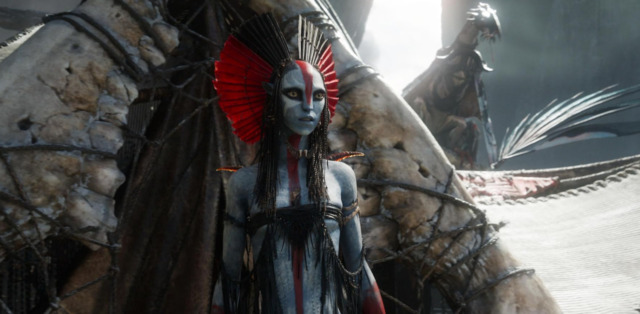
With the aid of other tribes, Jake and his family begin a transport for Spider, where unforeseen conflicts start to escalate. A vicious Na’vi tribe known as the Mangkwan Clan, or “Ash People,” ambushes the elaborate transport being pulled by strange floating air creatures. It is here that Cameron introduces a new antagonist, Varang (Oona Chaplin), an intimidating leader of the Ash People who has rejected Eywa’s teachings. Instead, she believes the most powerful god of all lies within fire.
Then there is Miles Quaritch (Stephen Lang), who remains persistent in bringing Jake Sully in for justice, as well as making every attempt to convince his son Spider to return home. But as formidable as Quaritch is in battle, even he and his men have challenges squaring off against Varang’s warriors. An extremely radical tribe capable of mimicking the actions of suicide bombers to achieve victory for the Ash People.
James Cameron’s otherworldly ambition
Visually, Avatar: Fire and Ash features much more action than previous entries. There are several moments of daring set pieces that resemble elaborate paintings full of detail. As mentioned, one of the best sequences in the film involves a sky ship being pulled by a giant jellyfish-like creature called the medusae, while a fierce banshee battle unfolds around it. It’s in these moments that Avatar: Fire and Ash becomes wonderfully frustrating. The level of detail is unlike anything seen before, and more can be discovered during multiple viewings.
But of all the Avatar movies released, the third film has the most confusing visual moments. To explain this, we need to talk about Michael Bay. When Transformers: Dark of the Moon hit theaters, the internet quickly caught on to a lazy decision by the creative team. A scene from an old Michael Bay movie, The Island, was reused with Decepticons added over the visuals, hoping no one would notice.
In various scenes from Avatar: Fire and Ash, the footage is nearly identical to that in Avatar: The Way of Water. For example, there is a scene in which one of the sea creatures, the Tulkun, jumps into the air and body-slams a ship, which looks very similar to a scene from the climax of the second film.
The core issue with most of Cameron‘s Avatar films is that the more realistic the world becomes, the more artificial the story feels. While there are some new ideas in Avatar: Fire and Ash, many of its plot points are frustratingly familiar, almost to the point of déjà vu.
In the middle part of the movie, we see another argument over the Tulkun outcast Payakan. The scene continues with an angry Lo’ak lashing out against the water clan. At this point, I honestly asked myself, “Did they accidentally switch films? Am I watching The Way of Water?” It doesn’t help that one of the earlier scenes involved another Tulkun hunting sequence that looks like a direct rehash of the second movie.
The doubling down of Jack Champion as Spider
Cameron has built a career around creating iconic characters that stand the test of time. Memorable characters like John and Sarah Connor, Jack and Rose, and, one could argue, Ripley was everlasting after Aliens. Avatar features some good characters, and admittedly, Jake Sully has grown on me over time.
But then there’s Jack Champion’s Spider, Cameron‘s version of Baby Tarzan with dreadlocks, who is Quaritch’s son and a possible romantic interest for Kiri. The character was controversial when it was released, mainly because the cultural appropriation undertones in Avatar stand out when Jack Champion appears with dreadlocks and a loincloth.
Despite mixed reactions to Spider, Avatar: Fire and Ash makes him a key part of the story. The Spider character has supporters who genuinely love his presence. However, others, including myself, see Spider as one of the weaker aspects of the series. The film picks up where The Way of Water left off, with Spider somewhat at odds with Neytiri after her son’s death. The situation escalates to the point that Neytiri views him as a threat to her people and wants him gone.
A story about a child forced to grow up on an alien planet that doesn’t want him could be compelling if performed by the right actor. But there’s something about Jack Champion‘s performance that doesn’t feel strong in these movies. He may be a good actor, but Champion struggles to perform in a movie set entirely in virtual environments, and he doesn’t give the character enough presence.
His performance feels messy, making it difficult to connect with him. Spider was created to provide a human presence on Pandora alongside the virtual creatures, demonstrating the CGI realism throughout the runtime. Instead, his existence in the story feels forced.
Oona Chaplin as villainous Varang continuously sidelined in Fire and Ash
Like the other two Avatar movies, some details work within the pedestrian storyline. The third installment introduces a unique threat to the planet itself: Varang, masterfully played by Oona Chaplin.
As the old saying goes, a movie is only as good as its villain. In another universe, Varang would have a more central, intense role against the Sully family, similar to Philip Seymour Hoffman‘s role in Mission: Impossible III. The problem lies in Cameron’s insistence on packing every idea into a third film. Cameron wants to bring back Quaritch, expand Spider’s story, revisit the same environmental themes involving the sea, make the sky people a threat again, and somehow give Varang room to breathe as a villain.
It’s frustrating because, on paper, Varang is an intriguing threat to the other natives on Pandora. She is bitter toward Pandora’s mother, Eywa, and views fire as the true “god” in her life. In this sense, she represents the opposite of characters like Neytiri. However, she is never given enough space to unleash her potential fully. When she is finally allowed to raise the stakes, Cameron falls back on a rehashed version of the Jake Sully story, this time from the villain’s perspective.
There is no argument against the beauty of the film, like Tron: Ares; for some, visuals will be more than enough to overcome narrative weaknesses. The third movie continues to improve the high frame rate 3D presentation. There are at least two sequences that would be worth revisiting in Dolby or IMAX if it weren’t for the exhaustive runtime.
Overall, Avatar: Fire and Ash is a technical marvel, showcasing vibrant images that invite viewers to linger over every frame. Yet, a sense of repetition begins to emerge by the third visit to Pandora. While the film remains a feast for the eyes, one can’t shake the feeling of déjà vu. As someone who genuinely defends The Way of Water, the third movie offers nothing new to say.
Also check out Review: Avatar: The Way of Water is Spectacular