‘Buddy’ Movie Review: A Twisted, Violent ‘Barney’ Satire
The 2026 horror film Buddy acknowledges a point about Barney the Dinosaur that we’ve all been quietly thinking about for the past thirty years: The purple behemoth is a low-key narcissist. The film by Casper Kelly cleverly unwraps the pop culture craziness of the time period when every child became fixated on a character that ended on a song about “loving” him at the end of each episode.
But while discussing those ideas, Kelly injects them with a Freddy Krueger-inspired zaniness that makes the television program feel like a hell someone cannot wake from. Instead of nightmares, it’s a TV dream world where Buddy brings in new kids to love him unconditionally, or the child will be m̶u̶r̶d̶e̶r̶e̶d̶ recast for a new kid to love Buddy in his ultra-colorful playhouse forever.
What is Buddy (2026) about?
The film, written by Kelly and Jaime King, begins like a television show, immediately throwing the viewer into this joyous universe where everyone learns childhood lessons and loves Buddy. Production design by Anna Kathleen (A Simple Man, Resurrection) and art direction by Vince Calabrese draw delightful inspiration from works like Pee-wee’s Playhouse, where the world feels vibrant and chaotically alive, with inanimate objects having facial features and mouths. For example, Patton Oswalt plays a sentient backpack named Strappy with a zipper for a mouth.
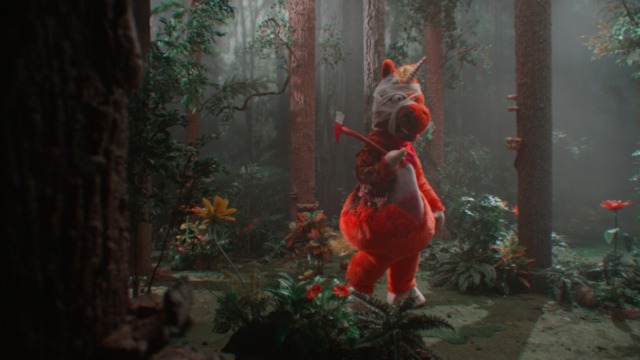
In this episode, we meet four kids: Freddy (Delaney Quinn), Wade (Caleb Williams), Oliver (Tristan Borders), and Josh (Luke Speakman). The episode (or whatever is occurring in this reality) plays out like a straightforward kids’ show, with simple, cheap, upbeat tones. The kids get invited to a dance party, but Freddy isn’t sure she is brave enough to dance. Wade calls their friend Buddy (Keegan-Michael Key), a large plush orange unicorn with a cheerful cadence in the style of a cartoon character like Goofy, to help them find courage.
At first Buddy seems upbeat, silly, and whimsical, until one of the kids doesn’t follow the narrative and refuses to dance for Buddy. After telling the kids to find another character, Betty Bunny (Jimmica Collins), Buddy confronts the kid alone, trying to get the moody kid back in the whimsical mood. When the child refuses, a skirmish is heard off-screen.
Buddy then tells Freddy and the others the kid left to pursue bigger things in a place called Diamond City. But when Freddy finds blood on one of her friend’s possessions, the simulation begins to unravel, and she begins to see Buddy for the monster he actually is.
Casper Kelly and Jaime King’s screenplay plays with expectations
For a while, Buddy as a film continues in this format, and it almost feels like a grotesque comedy sketch stretched into a movie runtime. But gratefully, the film finds an extra breath of life in its second act as the whole experience surprisingly switches gears.
The change is so surprising and jarring that it makes the viewer question for a moment whether they are watching the same movie. As the change unfolds, it stays magnetic as the writing slowly brings it back to Buddy’s nightmarish world.
Without spoiling anything specific, this new dynamic introduces us to characters played by Cristin Milioti and Topher Grace. The sequence builds on the lore and rules of Buddy’s world and what happens when he lures a child into his nightmarish, playful reality.
In a sense, it feels like a Zach Cregger (Weapons) script moment, purposely disorienting the viewer until it carefully guides us back into the main story. But as engaging as the change-up is, the final act of Buddy lacks the same punch as the first two. It keeps the horrific, bonkers energy flowing, but eventually it starts to feel repetitive.
Buddy is a twisted, albeit repetitive, television satire

By the time Buddy enters the third act, the gore and mayhem ramp up into comedic excess. Buddy is injured in nasty ways, and he inflicts violence on both humans and fantastical characters alike. If you ever wondered what it would be like to see Big Bird go on a killing spree on Sesame Street, this is the movie for you. The only issue is that most of the appeal has worn thin by this point, and it feels like a concept that runs out of ideas in the final stretch.
An upside is that the script adds one more world-building detail that serves as an exclamation point in the closing number. This detail makes it clear that Kelly and King’s script isn’t just satire; they likely believe Barney the Dinosaur was a genuine force of evil in 1990s pop culture. And as someone who grew up then and witnessed the addictive psychosis the purple dinosaur had on children, I’m inclined to agree with their assessment.
Overall, Buddy is pure twisted, satirical, and gory fun that pokes fun at the horrific media that was served to children decades ago. Sure, the character the film mocks isn’t a violent sociopath like the one seen here. But the experience of suffering through Barney and Friends gave the same sensation of being murdered psychologically over and over again. While there is no evidence that the purple narcissist caused long-term damage to children back then, there is no evidence that he didn’t either.