‘Doom Video Games: How A Doomed Space Marine Changed Gaming Forever’ by Mat Bradley-Tschirgi Book Review
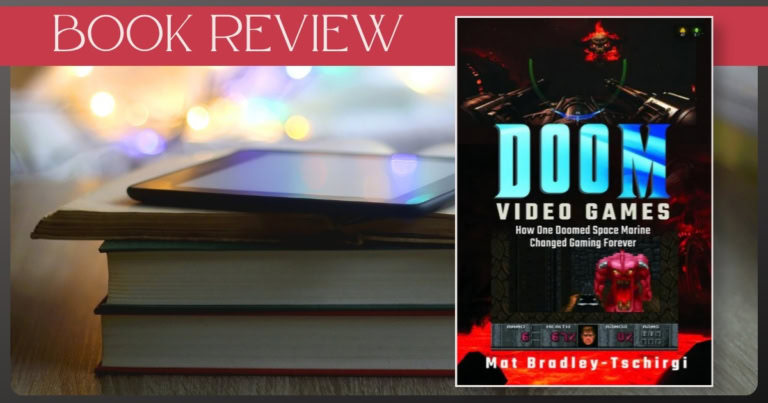
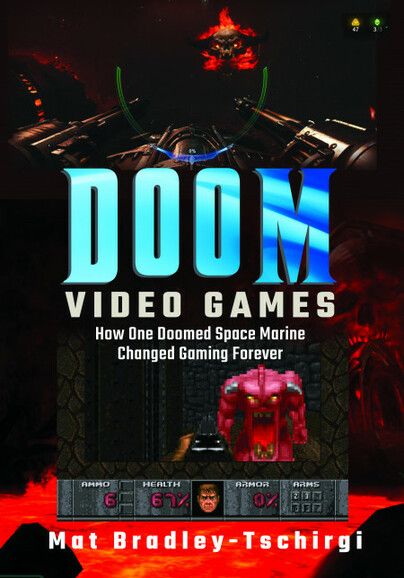
In 1993, Doom changed the entire landscape of what a first-person shooter PC game could be. While there has been a lot of history that happened before the iconic series debuted on home computers, it was not created in a vacuum. That is where Doom Video Games: How A Doomed Space Marine Changed Gaming Forever by Mat Bradley-Tschirgi comes in. This expansive compendium not only covers the titular game series, but it also tracks the development and release of other games that not only inspired Doom, but also directly led to its creation.
While the book’s primary content focuses on the history of a beloved video game franchise, Doom Video Games is still wildly informative, even if you’ve never picked up a video game in your life. Bradley-Tschirgi went through great lengths to carefully detail what the games are, how they play, and show their importance, leading up to the development of what eventually became a staple in PC and console gaming.
I by no means claim to be an expert on every game listed in this book; but I have personally played many of the games detailed, ranging from 1981’s Castle Wolfenstein through to 2020’s Doom Eternal. So when the author reached out to me about reviewing his newest gaming book, I immediately jumped at the opportunity.
The Doom games have always been very dear to my heart since I was a child. There have been so many long sessions playing Doom II where I would put the game down, close my eyes, and still see the “Pinky” demon in the darkness. This did not frighten or emotionally scar me for life, but instead it would reflect on how well designed these games are.
The book is split up into three main parts, with each of those parts being split up into multiple sections. After reading Doom Video Games, I have a greater appreciation for all the hard work that the developers put into each one of these games.
[Note: While I am reviewing this book independently and honestly, it should be noted that it has been provided to me by the book’s author, Mat Bradley-Tschirgi, and the publisher, White Owl Books, for the purpose of this review]
Doom Video Games and the genesis of greatness
The largest chunk of Doom Video Games is dedicated to the lead-up, the creation of, and the games that followed the original release of 1993’s Doom. I love how the first major section is split up into parts of “Before Doom” and “After Doom,” even if I was a little confused at first.
The majority of the “Before Doom” part details a lot of Wolfenstein games, both 3D and non-3D varieties. My personal standout being id Software’s Hovertank, released in 1991. This is important because Hovertank was id Software’s first foray into the genre we now commonly refer to as a first person shooter.
I remember playing this DOS game for the first time in 2020, and while it is very dated with its minimalist audio (and no music). This and their follow-up Catacomb 3-D are significant stepping stones that eventually led into the genesis of Doom, even if many of these games have been forgotten to time.
“After Doom” begins by chronicling how and what the first Doom video game came to be, along with its various sequels, expansions, and add-ons. This is the part I was excited for the most, and I strongly believe that this is what will make other readers gravitate towards this book.
Doom Video Games is jam packed full of terrific facts on everything you can imagine when it comes to covering the Doom series. This book is loaded with so much information that has been confirmed by the author through extensive research, his own personal experiences, and speaking to those involved in the industry. I could feel the author’s dedication come off the page.
Interspersed between 230 pages of Doom-y goodness, there are interviews with programmers, artists, contemporary video game critics, and other individuals that are important within the Doom community. These interviews provide insight into what people of different positions think of the Doom franchise.
There are two particular interviews that I found to be exceptional in this book: John Romero’s (lead programmer/designer of Doom) and Tony Giglio’s (film writer/director of 2019’s Doom: Annihilation.) Mr. Romero’s interview answers questions I have not seen asked anywhere else before, and it’s a highlight that deserves to be read.
This popular game franchise survives and thrives
Since the introduction of Doom II, there has been a contentious conversation about which is better: the original or the sequel? If you’ve played any of the Doom games under the light of the moon or are a complete newcomer to the series, opinions will be wildly varied.
Through my own escapades with the Doom series, I have always favored Doom II. While I still hold the game in high regard, reading more about the original in Doom Video Games, I now have more respect for the creatives behind the games.
With the explosive popularity of the first two Doom games, it was only natural to bring the games to other systems. There are accounts of attempting to directly port the first game to systems such as the SNES, Sega 32X, Atari Jaguar, and the ill-fated 3DO, all having mixed results, to put it lightly. Continuing further takes readers through the versions that appeared on the Nintendo Game Boy Advance handheld system, but to me the biggest standout is the completely original Doom 64 released for the Nintendo 64.
The Nintendo 64 version has original levels, music, and enemy sprites not seen prior to or since the release of this unique take on the game. It is more dark and disturbing than previous titles, and to this day it remains my favorite for those reasons.
Specifically, it is the music and sound design that stand out. I feel like Mat Bradley-Tschirgi’s book would have been improved if he were able to secure an interview with Aubrey Hodges, the man behind composing the score for Doom 64. It’s not a detriment to the book, but it would have been a nice inclusion. I am giddy that this gem gets more exposure by being featured in this book.
There are more sequels and expansions to Doom; most infamously is that of the case of Doom³. This game has a tumultuous reputation, especially upon release, but over time audiences have grown to be kinder towards it; especially with a special edition of the game being released years after its original release in 2004, all of which this book covers.
As noted in Doom Video Games, the next big follow-up to Doom³ took over 12 years to come to fruition. This is notable because fans of the Doom franchise considered it to be either dead or abandoned by the studio. When Bethesda and id Software decided on their big relaunch of the property, 2016’s (also titled) Doom became a massive hit and laid the groundwork for the future of this franchise.
The legacy and future of Doom
Now that Bethesda and id Software have been able to release a whole new modern trilogy made up of Doom (2016), Doom Eternal, and Doom: The Dark Ages, it shows that gaming fans still crave these experiences.
If Doom: The Dark Ages turns out to be the last Doom game to be released for some time, the book also goes into the unofficial games and fan mods. These are commonly referred to by the file format of .wad/WADs, which stands for “Where’s All The Data?”, which if you need help brushing up on terms, can be found along with other common terms that come up in the Doom community.
I am personally a huge fan of the greater modding community when it comes to classic Doom, and I could go on endlessly talking about my favorites. Thankfully, through his near encyclopedic covering of the topic, Bradley-Tschirgi has two of my top favorites already covered: Brutal Doom and MyHouse. These two specific topics are just briefly covered as they didn’t really have as much of an impact on the Doom scene as the mainline titles, but gosh, they are incredibly fun and inventive.
I also appreciate the short inclusion of the movies, and again, that interview with writer/director Tony Giglio of 2019’s Doom: Annihilation is fantastic.
DOOM Video Games book rating and final thoughts

This is an extremely fun and informative read for different levels of video game fans, ranging from hardcore players to casuals. Even if you’ve never touched a video game before, the entire story is fascinating, and you’ll be entertained. I thoroughly enjoyed this book so much that I’ve read it front to back three times over. I have so much admiration for an author who goes into the level of detail that was put into this volume.
I was slightly confused by the first part being split up into “Before Doom” and “After Doom.” From an author’s perspective, I can understand putting everything that literally came out before Doom as a before section, but as a reader, the “After Doom” section confused me. It might have been for simplicity’s sake, but this is such a small complaint, and I don’t want to deter anyone from picking up this book because of it.
I hope that after reading this book, it will bring in new fans and those who might have fallen off the series prior. I can safely say that this is a read that shouldn’t be missed!
DOOM Video Games: How A Doomed Space Marine Changed Gaming Forever by Mat Bradley-Tschirgi is available to purchase online for European readers, while American readers will need to wait until November 15th, 2026.
Also check out: Aliens: The Video Games By Mike Diver Book Review