‘Exit 8’ Gives Audiences A Good Video Game Adaptation
If you were disappointed by The Super Mario Galaxy Movie, look no further than Exit 8, a video game adaptation that actively respects fans of the original source material. Writer/director Genki Kawamura develops a visual language that’s very much in line with the atmospheric experience of playing Kotake Create’s mind-bending walking simulator. In fact, Kawamura is more concerned with the atmospheric experience of his film than with creating a compelling narrative, in which a Lost Man (Kazunari Ninomiya) is stuck in a perpetual loop inside a Japanese subway passageway.
Exit 8 provides an immersive experience fully reliant on the audience’s participation
It would be futile for me to explain the plot in this review, as the experience of playing the game (and watching the film) requires you to know absolutely nothing about it. What’s most fun about Kotake Create’s The Exit 8 is how you understand the rules while exploring the game’s liminal space, and the same applies to the movie. Kawamura’s camerawork is, at first, immersive through a smart employment of the first-person perspective before The Lost Man enters the loop. It puts us in his anxiety-riddled shoes after he receives a critical phone call from his girlfriend (Nana Komatsu), who reveals something that could change his life forever.
Whether he accepts this fate is up to you to discover during a movie that requires a great deal of participation from the audience. As soon as Kawamura and cinematographer Keisuke Imamura switch perspectives (from first to third person) the two have fun with how their camera moves and is blocked within the space. At first, it careens through the environment, just as The Lost Man is attempting to examine every aspect of the room. If he finds an anomaly within the loop, he must turn back immediately. If it all looks fine, he can continue up until the eighth exit, but he can’t overlook any anomalies, or else he’ll be forced to start again.
The Lost Man, The Walking Man, and The Boy
In a way, the camera acts a lot like someone who’s exploring the world and understanding the mechanics of the game before the ludonarrative truly begins. It’s an emotive way to get audiences engaged in the loop’s strange mechanics. Kawamura sadly fizzles it out near its conclusion by attempting to give texture and humanity to a nameless character whom audiences shouldn’t necessarily be attached to.
It is an admirable attempt to expand a game whose story is essentially “turn back if you see something weird,” but it doesn’t really gel with us. Kawamura continually switches points of view between The Lost Man (after we’ve formed a connection with), to The Walking Man (Yamato Kochi), and The Boy (Naru Asanuma) every time the film passes the half-hour mark.
We begin with The Lost Man, but switch at a crucial moment when the perspective should’ve remained the same. This ultimately dilutes the protagonist’s emotional journey within the loop because Kawamura doesn’t commit to a single perspective. It renders the high-stakes, tearjerking climax less impactful than it would’ve been had this movie stayed with one character throughout.
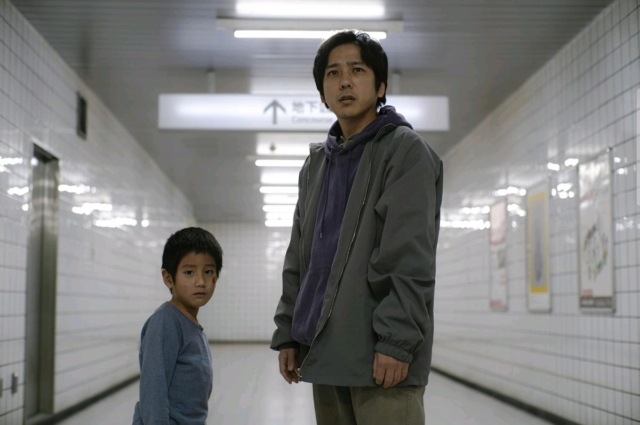
There is, of course, a desire to reinvent the tired structure of the “timeloop” movie, but it’s already done so with such a singular and playful visual language. It’s pretty remarkable to see Kawamura in complete control of his camera for the entirety of the movie’s 95-minute runtime, which often yields some surprisingly frightening (and occasionally very funny) bouts of visual tension.
Kochi, in particular, is excellent as The Walking Man, whose simple task of walking past The Lost Man throughout the timeloop grows even stranger as Kawamura switches points of view and the narrative gets freakier. But that’s the power of a filmmaker who knows exactly how to absorb the audience inside a space when he’s unable to give them a controller where they explore the passageway on their own. The movie has to evolve with the audience, so the visual style will always adapt to how The Lost Man (and the other characters) perceive the space they’re stuck in, hoping to immerse the audience in seeing the same location over and over.
Final thoughts on Exit 8

The movie is most effective when “anomalies” are small shifts in the space, or in the actors’ performances, rather than the most significant visual-effects-driven setpieces. One, in particular, falls especially flat because the VFX doesn’t look finished, and the biggest one doesn’t work.
Kawamura’s camera feels especially small in these sections because he doesn’t know where to place his device for maximum emotional impact. He knows how to move it when there are minimal effects in the hallway, but never when large-scale action is attempted. That said, each actor is effective at imbuing their respective stories with immense pain, which grows into something much larger when we realize how intertwined this environment is.
It’s a shame the movie begins to lose itself near its denouement, because it lures us with an intricate visual style that transcends mere recreations of video-game aesthetics. It is, however, a vastly superior adaptation than the money-making machine that is The Super Mario Galaxy Movie, because Kawamura questions the very essence of gaming through his interpretation of the source material.
In that regard, Exit 8 is worthy of our attention, even if it may not be a perfect transposition, and its flaws stick out like a sore thumb. However, you’ll be much more compelled to play the game if you didn’t already, than the incessant commercial for Nintendo-adjacent products playing in cinemas right now…
Also check out: The Super Mario Galaxy Movie is a Cosmic Mess