‘La Bola Negra’ Review: A Sprawling Generational Epic Hampered by Its Own Sense of Indulgence

Javier Calvo and Javier Ambrossi’s La Bola Negra is a lot to take in. The decade-spanning epic tracks three queer characters at distinct moments in history. The film often feels grand and emotive, simply by looking at the succession of visual (and thematic) juxtapositions thrillingly brought to life by cinematographer Gris Jordana’s eye for painterly, almost God-like, compositions. It can also feel like the directorial duo known as Los Javis are trying to do far too much in an overlong, excessively indulgent movie that might have been more effective if it were simply less heavy-handed.
Either way, La Bola Negra remains an unforgettable experience that is worthy of the big screen treatment. Netflix is giving the film a 45-day exclusive theatrical release, the first of (hopefully) many for the streamer’s change of heart after failing to acquire Warner Bros. earlier this year.
What is the story in La Bola Negra about?
What better way to finally make the biggest statement that theatrical is not only profitable but necessary than a 160-minute-long Spanish queer drama that shows you a succession of sweeping, grandiose images you’ve likely never seen before? The way La Bola Negra thrillingly wrestles with theology and sexuality might be the movie’s biggest strength. Religious iconography is omnipresent and also inferred, as the duo was primarily inspired by Caravaggio to frame pure evocative beauty.
The film does this less so in its section set in 2017, where Alberto (Carlos González) has his life upended when he learns of a grandfather he never met, or knew he existed. However, it is on full display when the film cuts to 1932 and 1937. These sections, so close together, will soon make sense when Los Javis reveal what connects Carlos (Milo Quifes) and Sebastián (Guitarricadelafuente), but this critic won’t reveal it. You’ll have to see it for yourself.
What I can say is that Alberto gets closer to his grandfather by learning who he is and what he protected following the death of the man he loved, Rafael Rodríguez Rapún (Miguel Bernardeau), during the Spanish Civil War. This, of course, occurs at a time when being homosexual was considered taboo.
Carlos longs to become a member of his father’s casino and might not get the approval needed from the board due to rumors surrounding his sexuality. He is “blackballed” (where the term “La bola negra” comes from), and the rest opens up in ways so unexpectedly moving it would feel criminal to ruin the experience of discovering this generational tapestry for the first time.
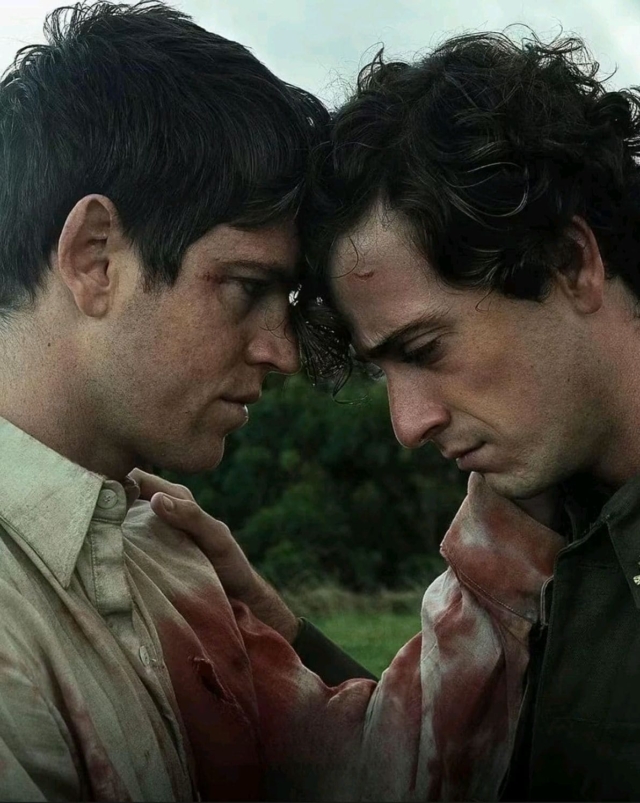
Los Javis presents an imperfect but deeply moving lesson in image-making
Alberto learns of his mysterious grandfather’s existence as if his life made no sense before. He begins to understand why his mother deeply resents her son and has lived in misery ever since her father unexpectedly left the house without a word. Los Javis don’t need to explain why that is. We know why (the images are so potent on their own), but the necessity to handhold the audience at almost every turn of La Bola Negra’s story is the primary reason why it failed to fully grab my emotional senses.
Sometimes, letting the film’s sweeping, bold visual language speak for itself is more than enough. Unfortunately, some of the dialogue in La Bola Negra is so ridiculously heavy-handed, so unnecessarily expository, and so unconfident in its own image-making that it honestly feels as if the directors don’t know what they want to say.
This is exemplified in a 2017 scene when Alberto meets author and historian Isabelle Durand (Glenn Close), who has written a book about Federico García Lorca, one of the most important figures in Spanish literature. Without revealing the context, as it is essential for the character’s journey of self-discovery and in our understanding of the film’s multiple timelines, some of the dialogue is clunky as it desperately tries to explain what the movie is about.
It’s easy to figure out what it’s about by looking at it. We don’t need Close’s presence to tell the audience what to pay attention to. Although her delivery of “La bola negra” has inspired a thousand memes and is even funnier in the context of the film, given her long pause before she pronounces these words.
The adage in all of moviemaking is to “show, don’t tell.” Showing is for cinema. Telling is for television. Whenever La Bola Negra stops talking and repeating the plot to the audience, it’s the year’s most astonishing film. Whenever Los Javis becomes a tad indulgent and repeatedly bludgeons viewers with the same emotional registers, trying to make us feel one way instead of letting their visual storytelling speak and have some subtlety, the film doesn’t work. Thankfully, whenever the film tries to bathe in self-importance, none of these moments last long and immediately revert to some of the year’s most arresting, jaw-dropping images.
La Bola Negra film rating and final thoughts

Late in La Bola Negra, one scene offers a breathtaking distillation of Los Javis’ conception of images. It blends otherworldly (read: spiritual) textures with a metaphor so powerful it almost brought me to tears. The way the duo attempts to reach the Holy Spirit as its essence is challenged yields genuinely emotive sequences that will pierce your retina forever and renew your faith in cinema as the ultimate visual medium.
It helps that both Guitarricadelafuente and Miguel Bernardeau are so powerful in their yearning for one another that we believe in their love. Los Javis aestheticizes a relatively harrowing part of Spanish history, where fascism took root due to the likes of Francisco Franco, Benito Mussolini, and Adolf Hitler. This leads to the film culminating in one of the darkest periods in world history.
That part is barely explored. Even though it isn’t necessarily what the movie is about, the excessive slow-motion shots of the male form as they bond inside a fascist army seem like an extremely questionable choice the filmmakers refuse to engage in. And yet, the film’s generational story is still so profoundly moving that we ultimately embark on this cinematic tapestry, as unwieldy and imperfect as it is.
If Netflix wants to make a statement that they will invest in theatrical releases and that some of their movies are worth the trip to the cinema, you can’t make a better case for the format’s perennity than with La Bola Negra. These are images you need to witness on the biggest screen possible, not on a television. And if it’s playing near you, this is a film you need to see with an audience, or the emotional experience won’t be the same. Whether or not you like it won’t necessarily matter, because you’ve never seen anything quite like La Bola Negra.
You can experience La Bola Negra in theaters now, with a streaming release on Netflix scheduled for December 2, 2026.
Also check out: Animol Review: A Hard Hitting, Impressive Prison Drama Which Offers Hope