‘The Boys’ Series Finale Brings Tragedy, Gore, and Emotional Closure
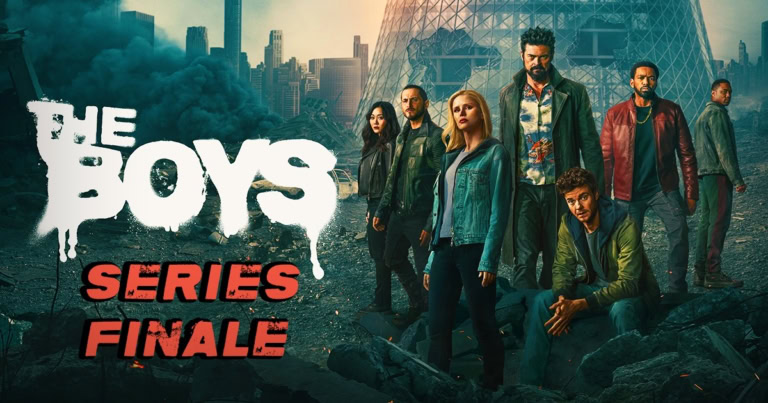
For years, Prime Video’s The Boys built its reputation as a superhero satire and often crossed lines that most superhero stories would never even consider. Heads exploded, politicians became puppets, and corporations weaponized celebrity culture. With each season, superheroes slowly transformed into terrifying symbols of unchecked power and terror. What started as a violent, funny parody of comicbook universes eventually evolved into something much heavier and more uncomfortable.
The final season of The Boys carried enormous pressure. The show had already spent four years driving itself into chaos, trying to actually deliver a satisfying ending without collapsing under its weight. We expected one final blood-soaked episode filled with nonstop insanity and brutal action. But the truth is that the finale attempts to do everything all at once. Closing story arcs, giving brutal action, having “awe” moments, etc.
The series finale is surprisingly reflective and aware of itself, which is always surprising for a show known mostly for exploding bodies, superhero parodies, and dark comedy. There is still violence. We have brutal moments, and it’s so full of absurdity that only this series could pull them off. The Boys series finale feels aware that these characters have destroyed themselves piece by piece for years and that no clean victory was ever possible. Even when the story delivers peace and satisfaction, it does so with scars attached.
[Warning: Spoilers from the final season of The Boys are below!]
The overall story in The Boys season 5
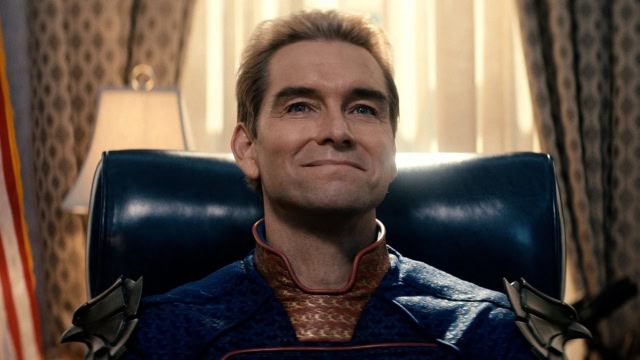
Season 5 pushes the world of The Boys into full societal and sociopathic collapse. Earlier seasons showed a slow growth of authoritarianism, but the final season stops being subtle altogether. Homelander (Antony Starr) is no longer hiding behind smiles and fake patriotism. He has effectively become a living god and a messiah, surrounded by followers who worship him as much as they fear him. That political and psychological tension becomes the season’s strongest quality.
At the center of everything is Billy Butcher (Karl Urban), and the show cannot end without forcing him to face the monster he has become. Karl Urban gives one of his strongest performances because Butcher spends most of the season balancing between revenge and self-destruction. The virus capable of killing all Supes becomes the ultimate moral dilemma for him. It represents the exact thing Butcher has always struggled with: wondering whether saving the world justifies becoming evil himself. But for quite some time, he is the villain of his own story, and it shows even in the finale.
What makes the season very interesting and appealing is that it refuses to show Butcher as heroic and good in a traditional sense. He is desperate, exhausted, paranoid, and increasingly isolated. Even the people closest to him no longer trust him. There are several moments where the series practically asks whether Butcher and Homelander are simply two different versions of the same obsession with control and fear of losing what makes them, them.
Meanwhile, Homelander’s storyline becomes increasingly horrifying. This season portrays Homelander as desperate, trying to force love from a world incapable of loving him. Underneath the rage and narcissism sits an emotionally broken child who never learned empathy and never knew what it means to be human.
Hughie (Jack Quaid) is exhausted by trauma and by trying to be the only sane person in the team. Whatever he does, he tries to keep his head cool and be the brain of the entire operation. Especially when no one else can. Annie (Erin Moriarty) struggles with what heroism even means anymore. She slowly stops setting out to even fight for justice and for everything. She’s almost done, but by the finale, it all starts to slowly come back.
Interestingly, the final season becomes less obsessed with shocking twists and more interested in the consequences of one’s actions. Season 5 tries to slow down enough to examine grief and emotional fatigue, but doesn’t attempt to use it to do another weird turn with the story. Still, the season succeeds because it understands something important. That the true horror of this universe is not the gore. It is the normalization of corruption and showing how certain events are far too similar to what’s going on in the real world.
Powerful entities murder civilians, corporations manipulate democracies using fake AI photos or videos, and public outrage fades almost instantly. By the final episode, society itself feels emotionally numb. That atmosphere gives the finale enormous thematic weight because the story is no longer simply about defeating Homelander. It is about whether humanity can recover from years of fear and manipulation at all and take control to make sure there won’t be a second Homelander.
The story in the The Boys series finale
The Boys’ finale itself is surprisingly emotional from its opening moments. Rather than immediately rushing into thrilling action sequences, the episode begins with grief. The funeral establishes the tone perfectly. The show still uses dark humor and jokes to stay true to what they established about characters, but underneath it sits genuine sadness.
From there, it starts to build toward the inevitable confrontation between Butcher and Homelander. Homelander spends much of the episode having moments that show how sick he is and how brutal he becomes with each second. The actual showdown delivers the brutality fans expected, but it is intentionally weird and was written to prove one thing. That Homelander without powers is just a man with the mentality of a child.
Homelander’s death itself feels fitting because it strips away the myth surrounding him and finally makes the five-season chase after the main goal is reached. Once his powers vanished, he was no longer an untouchable god. He became terrified, vulnerable, and human. Butcher killing him with a crowbar is brutal, messy, and deeply personal. But also iconic for the character.
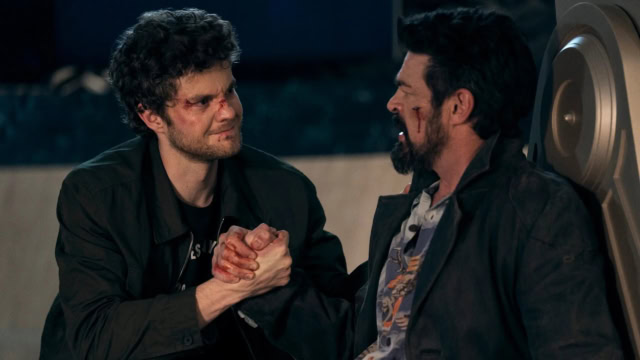
But the finale refuses to let Butcher walk away as a savior. His decision to unleash the Supe-killing virus pushes him too far. Hughie ultimately stopping him becomes one of the episode’s most emotionally powerful moments because it reflects how much Hughie has changed since the first season and how their relationship has evolved. The nervous, traumatized young man who once depended entirely on Butcher finally realizes that revenge without limits only creates more suffering.
Character development and closing story arcs for Hughie, Butcher, and the gang
The finale episode succeeds mostly because it gives emotional closure to characters who have suffered continuously for five seasons. Butcher’s ending is tragic but appropriate. Throughout the entire series, he convinced himself that hatred was his strength. In reality, it slowly ate him up until revenge became the only thing keeping him alive. The series finally forces him to confront the fact that his obsession was destroying innocent people, too.
Hughie arguably receives the healthiest conclusion in the entire show. Across five seasons, he transformed from a powerless victim into someone capable of making impossible moral choices. The finale rewards him not with glory, but with peace and love. His relationship with Annie finally feels stable because both characters have stopped chasing impossible fantasies about heroism. They both started a family, which for them serves as a sort of therapy to work through everything that happened in the last few years.
Kimiko (Karen Fukuhara) receives one of the most bittersweet endings. Her connection to Frenchie (Tomer Capone) remained emotionally messy throughout the series, but the finale gives her space to finally exist outside endless violence. Her final scenes carry sadness because she has lost so much, yet there is also a quiet sense of liberation.
Mother’s Milk (Laz Alonso) perhaps represents the moral center of the show more than anyone else by the end. While others became consumed by revenge or power, MM consistently tried to protect people and maintain perspective. His final storyline involving Ryan (Cameron Crovetti) becoming his adoptive son feels especially meaningful because it suggests the next generation might actually escape the damage created by people like Butcher and Homelander.
Final thoughts on the final season of The Boys

The ending of The Boys is not as messy as one would think. It’s violent, emotional, and occasionally uneven, but it also feels honest to everything the show always was. It does not suddenly transform into a hopeful superhero story at the last second, nor does it drown entirely in nihilism. Instead, the finale chooses to go in a much more complicated way. It acknowledges that people are capable of terrible things while still leaving room for healing and redemption.
Not every storyline lands perfectly. Some supporting characters deserved more screen time, and certain emotional moments probably could have benefited from another episode of buildup. Yet despite those flaws, the series finale succeeds. It actually ends. It commits to consequences. Furthermore, it finishes some character arcs and doesn’t turn the viewer into an idiot.
Most importantly, the series finale remembers that beneath all the satire and gore, The Boys was always about damaged people trying to survive systems larger and crueler than themselves. That is why the ending is still great. Not because of the violence, gore, parodies, comedy moments, etc. And that’s good. Because the show finally asks whether broken people can stop passing their pain onto others and using it to burn everything to the ground.
Also check out: The Boys Season 5 Mid-Season Review