‘Avatar: Seven Havens’ Season 1 Premiere Review: An Ambitious Beginning

Avatar: Seven Havens tells the story of Pavi, a young Earthbender who discovers that she is the next Avatar in a world that no longer trusts people who have this title or associate with it. The first three episodes introduce us to this now destroyed and unbalanced world. In it we see a new mythology, an introduction to new characters, and a civilization that struggles to survive the consequences of a mysterious catastrophe that was seemingly caused by Korra.
Avatar: The Last Airbender gave audiences one of the most beloved coming-of-age animated adventures. In it, we followed Aang as he learned to master all four elements and bring an end to a devastating war. The sequel, The Legend of Korra, expanded that universe through a more complicated protagonist, a much more modern take on the story, and a rapidly modernizing, slightly steampunk world. It also asked difficult questions about spirituality, politics, and the meaning of balance in every person’s life. More than a decade after Korra’s story ended, Avatar: Seven Havens is being released to begin a new story.
[Warning: Spoilers from the season 1 premiere are below!]
The story involves a mystery in Avatar: Seven Havens
The strangest decision in Seven Havens‘ premiere is to completely drop a bomb and reshape this world from peaceful nations into dangerous, disconnected places. Set about 225 years after The Legend of Korra, it shows a civilization reshaped by a catastrophic event blamed on Korra herself.
The old nations and their familiar cities have become isolated settlements known as the Seven Havens, where survivors seek protection from violent storms and the dangerous wilderness beyond their walls. The opening episodes concentrate on Ellora, a fortified desert city whose citizens have built their lives around the belief that Korra destroyed this world.
Seven Haven‘s season 1 premiere shows this conflict between society and an Avatar institution through a festival celebrating the Avatar’s demise. What might once have been a celebration of balance and spiritual renewal has now become an expression of fear and resentment.
Pavi’s introduction as a new Avatar provides a different look at this society. Unlike Aang, whose identity becomes inseparable from the fate of the world almost immediately, Pavi begins as a young outsider trying to survive without attracting attention to herself.
Pavi’s personality is different from Korra’s more confrontational temperament and Aang’s playful optimism. She has a strange curiosity about the world because she does not know anything about it and has to start to behave like someone destined to unite humanity.
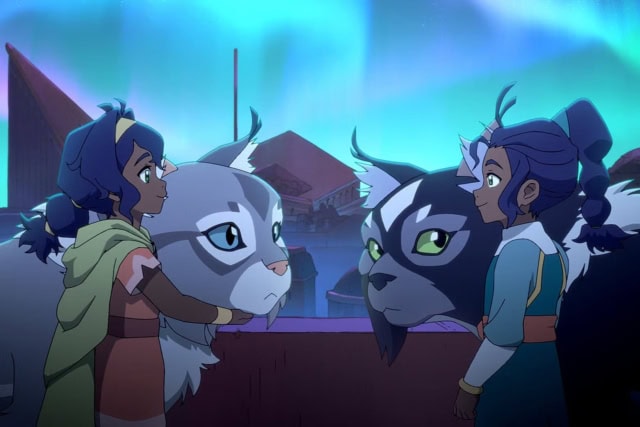
The first three episodes of Avatar: Seven Havens build their plot around Pavi’s discovery of her identity, her encounter with the airbender Jae, and her reunion with her long-lost twin sister, Nisha. These chapters introduce additional questions about the twins’ origins, their missing memories, and the true nature of the catastrophe supposedly caused by Korra.
That approach makes the world feel larger from the start. Although it is not as good as I’d expect, it doesn’t look for a “villain of this season” from the start. Korra’s supposed responsibility for an apocalypse is a provocative flashback to her. But not revealing everything all at once is allowing Korra’s legacy to function as a genuine part of the plot and not as a simple Easter egg.
Evolution of The Last Airbender’s world and meeting the new protagonists
Pavi’s relationship with Nisha is this series’ emotional center because they are sisters who were separated by circumstances they do not yet understand. Pavi is eccentric, instinctive, and comfortable living outside conventional society, while Nisha presents a more guarded and composed exterior.
This shows they are two different people, but their dynamic has the potential to provide the kind of relationship that works in The Last Airbender so effectively. Their shared history is intriguing, but mystery alone cannot substitute for the small interactions through which we can understand why these two matter to each other.
Jae is equally important because he serves as a bridge between Pavi and the society that fears her. As an airbender serving in Ellora’s Brigade, he has grown up within the structures that define his community’s understanding of safety and authority.
His meeting with Pavi forces him to reconsider the ideals he was taught. This is an effective use of the Avatar mythology, because each time we’ve had a new hero significant to the Avatar, we had to learn important things from them. And his place within the Brigade means that protecting Pavi could require him to question the very institution he has been trained to serve.
When it comes to animation, Avatar: Seven Havens is less detailed than the franchise’s previous projects. Movement sections feel simplified, character designs lack the fine details, and action scenes are missing details that were beloved in two previous projects.
Equally essential is the preservation of the franchise’s humor. The apocalyptic setting could easily make the series feel serious, dark, and tight. Especially when its protagonist is hated and hunted by people who should traditionally welcome her with open arms. Fortunately, the premiere episodes keep the awkward moments, playful character interactions, and occasional absurdity that have always been a part of the Avatar series.
Avatar: Seven Havens premiere rating and final thoughts

The premiere of Avatar: Seven Havens is an ambitious beginning to the new chapter in this universe that understands the value of being another chapter in the beloved world. Its main idea is not simply that another Avatar has arrived, but that the world she must protect has lost faith in the institution she represents. The mystery surrounding Korra’s supposed role in the catastrophe provides a reasonable connection to the earlier series that does not simply make it a fanservice.
Ultimately, Seven Havens feels more like an attempt to discover what the franchise can become in a very different world and how far the creators can go with their ideas. It has the iconic interest of the series in balance, identity, and the consequences of fear. But as a whole three-episode premiere, it is uneven, chaotic, too weird, and not as visually appealing as previous shows.
Avatar: Seven Havens is now available to watch on Paramount+, with three episodes being released each week. It was recently revealed at New York Comic-Con 2026 that the animated series has been renewed through season 4 on the streaming service.
Also check out: Avatar Aang: The Last Airbender Review