‘The Social Reckoning’ Review: Sorkin’s Inept Follow-up to ‘The Social Network’
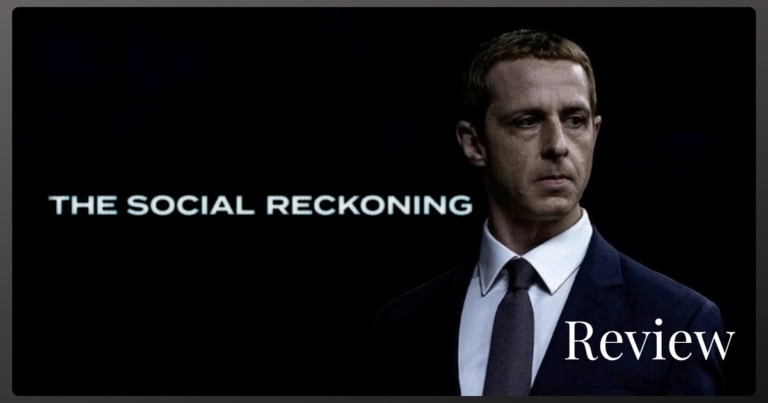
Anyone who thinks image-making matters less than “the story” (whatever that means) should watch David Fincher’s The Social Network and Aaron Sorkin’s The Social Reckoning side by side. Shot by the same cinematographer, Jeff Cronenweth, it won’t be long before you realize why Fincher’s film stands the test of time as one of the most impactful masterpieces of the 2010s. But Sorkin’s follow-up will be quickly forgotten as an example of poor Oscar-bait that accomplishes virtually nothing of interest and wastes a cast of highly talented (and Oscar-nominated) A-listers.
Fincher understands that images are the story. Each choice he makes—from the lighting, to the way the camera is placed, to how the film is cut—responds with the emotional distance the audience should have in looking at the rise of an era that will likely define the rest of our lives.
In The Social Reckoning, Sorkin makes zero formal choices that enhance the “story” he wants to tell, which is essentially a cautionary tale about the evils of social media that has arrived perhaps a decade or so too late. It feels like we’re watching a made-for-TV sequel to a masterpiece no one will remember, and it’ll be available for cheap as a DVD in the Walmart bargain bin a month from now.
The plot of The Social Reckoning
Divided into four parts (a prologue plus three chapters), The Social Reckoning attempts to reckon with Facebook’s rise as a social network that has maximized profits and engagement over safety. It begins with a segment revolving around a wasted white girl (this is how the prologue is called, “White Girl Wasted”) taunting the police with racist and inflammatory language, a person who, according to whistleblower Frances Haugen (Mikey Madison), was once progressive and carried left-leaning political views.
No politician is ever mentioned by name (one of the most cowardly decisions of the decade, as America is currently subjected to total autocracy from an administration that has completely flaunted the rule of law), but it’s pretty clear which presidential candidate they are talking about.
In any event, this moment prompts Frances to research what happened to her, and it turns out that Facebook’s own algorithm not only radicalized her but recommended the woman join groups related to QAnon conspiracy theories where (criminal) hate speech abounds.
Worse, Facebook knew what its algorithm was doing, through a change in its “Meaningful Social Interactions” (MSI) approach that amplified political divisions and conspiracy theories. Fact-checking was no longer the norm because more and more people believed what they saw online instead of thinking critically.
This alarms Frances, who first alerts Facebook management, but they don’t seem to care. She then contacts Wall Street Journal investigative reporter Jeff Horwitz (Jeremy Allen White), who has been researching Facebook’s role in shaping political discourse and comes forward with data that will be damning for CEO Mark Zuckerberg (Jeremy Strong).
In the film, Zuckerberg is preparing to testify in front of Congress with crisis PR agents Raya (Wunmi Mosaku) and Charlie Garrigan (Bill Burr) in the hours leading up to the January 6th insurrection. The association is clearer-than-clear: Facebook played a critical role in facilitating the spread of misinformation that radicalized its users and prompted a harrowing event like this one.
Aaron Sorkin’s film reckons with nothing meaningful
Even if we engage with them meaningfully, they might never see the light at the end of the tunnel. They still waste their days doomscrolling on social media to find the next conspiracy theory that further isolates them from the real world. None of the CEOs at the top care about fact-checking or telling users that what they’re doing will harm their health and worldview. As long as they make money off real people’s vulnerabilities, why bother safeguarding the platform?
The fundamental problem with The Social Reckoning is simple: Sorkin treats this as new information that “reveals” what Facebook is currently doing to its users and tries to make the film a bigger indictment than the articles that revealed what kind of company Zuckerberg actually runs.
Sorkin isn’t saying anything new, but he’s also not saying anything at all. The only thing he knows how to do is to create closed-room dialogue exchanges (read: shouting matches) between characters to heighten a perceived sense of tension. However, since we don’t know what this film is building toward until later in the runtime, when insurrectionists march toward the United States Capitol, all that built-up tension seems nonexistent.

He also uses a non-linear approach, alternating between Horwitz investigating the story with Haugen in 2019-2020 and Zuckerberg preparing for his hearing right before the insurrection on January 6th, 2021 (the date never appears on screen until we realize what day it is).
This lets Sorkin cross-cut between Horwitz’s information-gathering and the way the crisis management team wants to shape Zuckerberg as a “free speech absolutist,” but this approach makes very few (if any) meaningful associations.
It tries to be Sorkin’s answer to Christopher Nolan’s Oppenheimer, especially during black-and-white flashbacks that show Zuckerberg deliberately ignoring his own studies on teen mental health and radicalization to further fill his pockets. But the Academy Award-winning screenwriter doesn’t know how his (lack of) visual choices should enhance the story.
Cronenweth’s compositions are flat and televisual (always the same medium-shot set-ups of shot-reverse-shot exchanges), while the film handholds us in its various timelines by always telling us where we are, instead of actively trying to create the same distance Fincher did in his original.
Some have argued it is unfair to compare apples to oranges, but The Social Reckoning directly follows in the footsteps of The Social Network. While they were written by the same person, one fails because the person behind the camera has no business being there. Sorkin has tried to direct movies, and it hasn’t worked, but he’s still going at it for reasons that don’t seem motivated by any desire to create something for the big screen.
The fact that he has the ideas in place for a story like this proves that he knows exactly what he should focus on. Unfortunately, the way he executes it betrays all the actors on screen, most of all Strong, whose caricatural performance as Zuckerberg borders on parody and lacks the emotional complexity of Jesse Eisenberg’s turn in The Social Network.
In The Social Reckoning, he’s essentially portrayed as a mustache-twirling, antipathetic cartoon villain, with no regard for the human cost of the radicalization that his company is creating. While that may be true, the way Strong delivers his line is so comical that any desire to further villainize Zuck falls flat.
Instead of focusing on the deliberate withholding of data by Facebook itself, Sorkin takes the All the President’s Men approach and shifts attention to the journalist trying to expose what the company is doing to people. That wouldn’t be so bad if the film didn’t sexualize Haugen on almost every occasion, making her wear elaborate outfits during scenes where she shares critical data with Horwitz. It doesn’t help that Madison, while decent in the role, looks nothing like the person she’s playing and is much younger than she was when Haugen exposed Facebook in 2021.
There’s something painfully uncomfortable about seeing the character hide on the hotel room balcony, almost undressed, as she’s here to meet Jeff to share data; it almost feels like we’re watching a Wattpad fanfiction account of what happened instead of the serious indictment Sorkin so desperately wants to portray.
When he eventually reveals the film was leading up to January 6th all along, the cinematic recreations of the event (quite daring, given that it just happened) should feel like a massive gut punch. This was preventable. Facebook didn’t implement guardrails or do its job as a platform to combat the proliferation of misinformation that helped create an event like this while its president stokes the fires of division.
But it doesn’t, because Sorkin has never drawn anything about the company that should be meaningfully excavated, apart from the white girl reappearing as she prepares to enter the Capitol. What does this image mean in the context of his film? What does Sorkin want to say about the effects of MSI in our daily lives and how our subjective perception of the world around us is now shaped by scrolling on our technological devices?
The Social Reckoning movie rating and final thoughts

What was the point of cross-cutting January 6th with Frances’ testimony? His images fail to tell a story, and his fast-paced dialogue exchanges feel more insipid than ever. If anything, The Social Reckoning will reckon with Sorkin’s own ineptitudes as a writer and director. He was only effective when he collaborated with other better filmmakers who fundamentally understood the power of images and how they tell a story.
Images don’t “matter less” than the story; they are the story. They are the primary driving force behind every good (or great) movie. To say otherwise discredits the very function of cinema, and Sorkin might be one of the biggest perpetrators of the made-for-TV aesthetics that sadly plagues our screens.
With a stronger filmmaker at the helm, perhaps The Social Reckoning could’ve been as memorable as The Social Network, but Aaron Sorkin’s writing has considerably worsened over the past decade. What we’re ultimately left with is nothing more than an “Old Man Yells at Cloud” excavation of Facebook that is neither damning nor thought-provoking.
Also check out: Verity Movie Review