‘Scarlet’ is Mamoru Hosoda’s Most Ambitious Film

Mamoru Hosoda’s Scarlet, a derivative adaptation of William Shakespeare’s Hamlet. The film begins with the most spiritually charged image of the Japanese animator’s career as the titular character (voiced by Mana Ashida) arrives in the “Otherworld,” a purgatory that stands between life and “nothingness.” Scarlet attempts to fight her internal (and external) demons and prove to the forces that be that she still wants to live. In the real world, she was poisoned by her uncle Claudius (Kōji Yakusho), who publicly executed her father, the King, and is aiming to take over the Kingdom of Denmark.
Scarlet as a twist on Shakespeare’s Hamlet
While some aspects of Hamlet are retained in Hosoda’s revision of the source material, the title primes the audience to expect something drastically different from Shakespeare’s initial text. Instead, the Mirai director embarks us on a quasi-spiritual journey of self-actualization where the protagonist embarks on a revenge-fueled quest to kill the perpetrator who assassinated her father and herself.
Inside the Otherworld is a form-blurring environment where the past blends with the present and could perhaps alter the course of the future. There may or may not be a reference to Silent Hill when a strong image from Silent Hill 2 appears out of nowhere to envelop us in the protagonist’s tormented psyche, which dissociates itself from her living self.
The audience, quickly entranced by Hosoda’s painterly sense of imagery, including a dragon who oversees events occurring in a plane of existence that teeters between life and total death, could check out of the picture at that point. For reasons that still feel perplexing, Scarlet meets Hijiri (Masaki Okada), a present-day paramedic who was stabbed in the real world and now finds himself in the same purgatory as a 16th-century Danish princess. Why did Hosoda choose to pair the two together? I have no idea, and it quickly becomes the film’s weakest and most rudimentary link.
An expository flashback that gives audiences the broad strokes of what happened before she landed in the Otherworld is par for the course. The story begins in media res, and fills in the gaps as the film progresses. But such a telegraphed character, whose emotional progression is predictable and who isn’t as interesting a three-dimensional human being as Scarlet is, considerably brings the movie down. Especially considering how easy it is to figure out how he will factor into the larger portrait of Hosoda’s vision.
There is but one sequence that paints him as a character worth exploring. That’s when Scarlet travels to an alternate timeline where she envisions herself in the present, in a world that knows no wars or legitimate global challenges. The power of song unites everyone who lives in this idealized world, and Hijiri is an entirely different human being from the one we’ve seen him be throughout the picture.
This scene, while isolated from the rest of the film, could’ve been the engine that meaningfully propelled their relationship forward. But Hosoda chooses to ignore it entirely, even during its emotive climax, where Scarlet comes face-to-face with the person who killed her and her father.
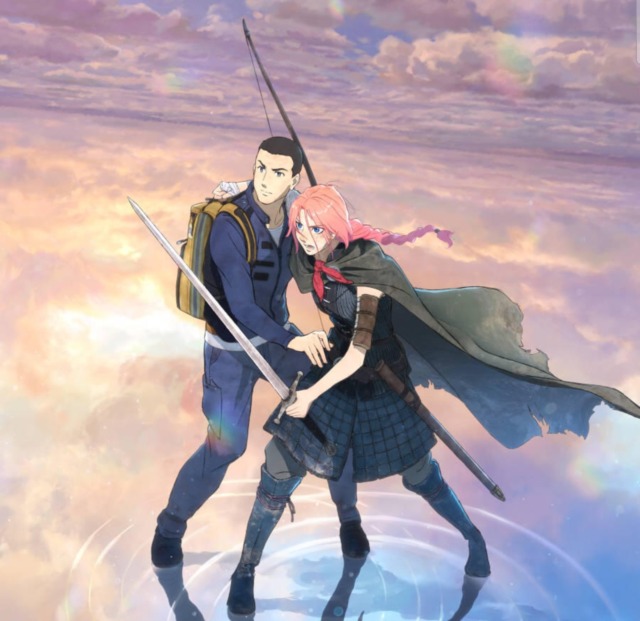
Mamoru Hosoda’s most thematically and visually daring feature
That being said, it still isn’t difficult to appreciate what’s on screen. Everything in the picture is completely earnest, both from a visual and thematic perspective. Scarlet may not be as rock-solid as Belle, but Hosoda’s latest work of art is filled with so many evocative, jaw-dropping images (which look utterly astonishing on an IMAX screen). These images either reframe the character’s plight in a world that consistently communicates between the past and present or imbue the film with a tangible spiritual dimension to discuss humanity’s place on a planet that has (historically) consumed itself in greed-driven conquests (as expressed in Lav Diaz’s Magellan).
Scarlet also contains a bevy of unwieldy ideas that are haphazardly developed, but its attempts to grapple with unsolvable questions about our ultimate fates are what ultimately make the movie so sincere. Hosoda deliberately creates a messy, mythopoetic tapestry of complex images that constantly depict a world at war with itself, filled with inhabitants who don’t know what they’re fighting for.
It’s as far removed from Hamlet as you could think. Yet, it still works. Because the protagonists wrestle with their own mortality in the face of almost certain death in ways that are cogently in line with Shakespeare’s visions of death and the ambivalent nature of what awaits all of us once we’ve crossed that line.
Unlike a certain adaptation of a popular literary classic coming out in a week, Scarlet signals to audiences that it won’t stick to the text by titling the film away from Hamlet. The film already promises something drastically different from what we’re usually accustomed to in transpositions of Shakespeare’s text. In fact, it may not even be related to Hamlet at all if it weren’t for one of the characters being named so.
Even still, Hosoda’s animation style is so staggering and emotionally driven that it won’t be long before you ultimately get swept away (and perhaps even moved) by what’s on screen. The trip through time, which starts as a rip-off of the Stargate sequence from Stanley Kubrick’s 2001: A Space Odyssey and morphs into a musical sequence that feels plucked from a vibrant Jacques Demy picture, is worth the price of admission alone.
In an era where Hollywood blockbuster innovation seems to be at an all-time low, a film like Scarlet might stand the test of time by the end of the year and be remembered as one of 2026’s most stunning animated achievements.
Also check out All You Need Is Kill: A Beautifully Animated, but Tired Timeloop Film