‘Undertone’ Review: An Audio Masterclass in Psychological Horror
Undertone digs at the unnerving fear of emptiness. Not in the sense of space, but the way noise occupies a room. For instance, when some of us need sound to fall asleep or the way we need a television on in the background to get chores done. It’s the anticipated nervousness that if everything becomes silent, something unexpected might fill the space.
The horror film, directed by Ian Tuason, plays with the anxiety of quietness to its full potential. For 93 minutes, Tuason beautifully demonstrates how much tension can be generated in a single setting. The main character mostly stays at a table recording a podcast throughout the film, yet the situation is more thrilling than most higher-budget productions.
What is Undertone about?
The film centers on Evy (Nina Kiri), who co-hosts a podcast about the supernatural with her co-host, Justin (Adam DiMarco). The film offers a simple introduction to Evy; we see that her personal life consists of caring for her dying mother (Michèle Duquet). Evy’s mother has entered the last stages of life, where she is mostly catatonic, and a nurse explains that her breathing will begin to rattle when it’s time.
Evy’s only means of escape is the podcast, where she can confide in Justin before every recording. And once the show begins, we see the dynamic between them. Justin is the supernatural optimist, and Evy is the skeptic.
For their latest episode, Justin says he got a mysterious batch of audio clips from an unknown sender. The clips feature a couple, Mike and Jessa, who, with each new clip, experience increasingly bizarre noises. Jessa also begins speaking in her sleep, repeating an unsettling phrase. And as Evy and Justin dive further into the clips, Evy’s house starts exhibiting the same noises.
Ian Tuason leans on the technical side for terror
From here, Tuason makes great use of every film trick in the book. His cinematic language conveys the dread more than any jump scare or act of violence ever could. One example of this is the choice of cinematography, which intentionally maintains an over-the-shoulder fixed position throughout.
Cinematographer Graham Beasley designs every shot with paranoia. The camera constantly tells us to look behind Evy rather than pay attention to her. The shallow depth of field is blurry enough to obscure what lingers in the distance; at the same time, it makes the viewer concerned about what might be lurking beneath the haze.
The film might cause anxiety for people who wear noise-canceling headphones. For most of us, these types of headphones help us focus on the task at hand. The same is true of Evy in the film. The minute she puts them over her ears, everything drowns out.
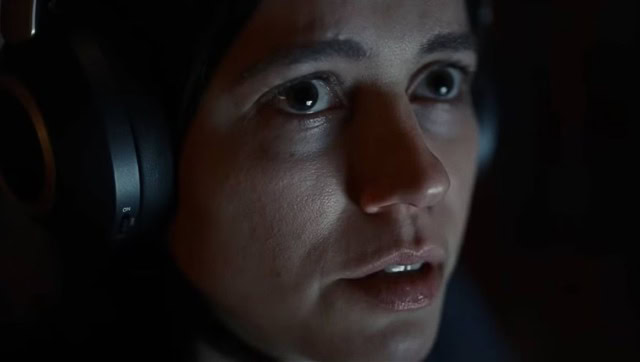
As viewers, we feel everything is unsafe because we know danger might be present beneath the cancellation. The method brilliantly demonstrates how effectively the movie plays with sound design. Even when she is listening to the audio files, it’s unclear because of the cleverness of the audio structure, whether the sounds are also coming from her house. And we won’t give it away, but anyone who has required guided meditation might find Undertone ruins it for them.
The remarkable thing about Undetone is how minimal its execution is. For this reason, some will call the film boring because it doesn’t offer conventional scares. The majority of the film takes place at a dining room table.
Like Paranormal Activity and The Invisible Man, the horror is not about what you see; it’s about what you can’t see. For example, when the audio plays during their podcast, the scenarios are more terrifying because we can only imagine what’s happening to Mike and Jessa. Our imaginations carry more weight than actual footage.
Undertone is a cinematic pressure cooker
The movie also plays with the fear of hidden messages. The narrative delves into nursery rhymes. For instance, the actual lyrics to “Rock-a-bye Baby” are genuinely creepy when you break them down. Undertone explores these ideas and how they sound at different stages of playback. It’s another eerie way the film approaches horror through audio.
The only issue with Undertone is that the ending does feel rather abrupt. It builds to an incredibly chilling climax. The soundscape becomes off-the-charts disturbing. The movie then offers a jaw-dropping, visually unsettling scenario. And once it reaches the intended ramifications, the movie ends. Overall, it does not devalue the experience, but it left this reviewer wanting.
Still, as a horror film, Undertone is an atmospheric pressure cooker. A horror movie that never uses gore or jump scares to qualify itself. Instead, it gets under your skin, plays with your senses, and creatively uses film techniques to push the dread. It is truly a phenomenal piece of work and must be seen in a theater with amazing sound.
Also check out: The Bride! Movie Review with John & Vin | Cosmic Circus Reviews