‘You Can See Everything’ Review: A Groundbreaking Documentary
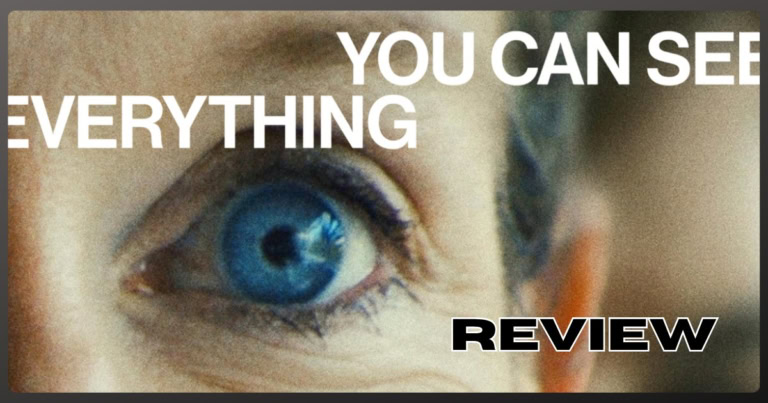
You Can See Everything shows Nathan Fielder asking Elizabeth Holmes one simple question: “Are you being real right now?” It’s a question that drove the marketing to popularity, as the scene shows Holmes radiating big puppy eyes, innocently tilting her head, and responding, “I’m always being real.” Without context, it looks like Fielder is in psychological warfare with one of the world’s biggest fraudsters. In broader context, Fielder examines her as if she were an alien who doesn’t realize she’s from another planet.
That question of “real” drives the documentary’s core themes. The news, courtrooms, and Hulu have covered Holmes and her story extensively. But filmmakers Fielder and Lance Oppenheim seem fascinated by the nuances of “real” vs. “exaggeration.” Surprisingly, that exploration makes for one of the best films of the year.
What is You Can See Everything about?
The documentary follows filmmakers Fielder and Oppenheim as they are invited to cover Elizabeth Holmes during her last month of freedom. From the first moments, Fielder expresses suspicion, asking directly whether his lack of scientific knowledge is why he was chosen, which impedes his ability to challenge her on the basic facts of the fraud conviction. A notion both she and her partner, Billy Evans, outright deny.
But it becomes clear right away that Fielder is the perfect person to interview personalities like Holmes and Evans because he questions with a child’s hilarious curiosity. For instance, a more polished interview might focus on broad follow-up questions that more or less confront the issue. With Nathan Fielder, the subject can say, “The sky isn’t blue.” And he will respond, “But it is.” When they respond, “No, it isn’t,” he hilariously drills down on what “blue” means to them until they define it.
The footage covers over 30 days of these interactions. Holmes tries to be transparent about her life and problematic history while insisting she never did anything wrong. Fielder also makes subtle attempts to understand why she believes the sky isn’t blue. But it’s the nuances in these exchanges that are wildly entertaining.
Was Elizabeth Holmes possibly a victim of sensationalist reporting and exaggerated depictions on dramatic programs made for Hulu? Or is she as manipulative as she seems? And if she is guilty of deception, does exaggerating details in the media also amount to some level of fraud? Exploring the different levels of agency over truth is what makes You Can See Everything feel so compelling.

Lance Oppenheim’s heightened vision
You Can See Everything continues the dreamlike surrealism often felt in Oppenheim’s Primetime, where everything feels strangely stylish and flashy while showing real-life events. The camerawork is so flashy that, at times, it almost feels like the big reveal will be that it’s all staged.
Cinematographer David Bolen captures the most intricate shots that have the essence of being storyboarded. As an example, there’s a close-up of a single tear sliding from Holmes’ eyelashes down her cheek as the room cascades light across her face in just the right way.
Not to mention, Ari Balouzian’s score feels like it belongs in a gripping David Fincher thriller. The presentation adds to the insecurity of “What is real?”
Bolen also incorporates extreme facial close-ups during interviews and conversations, and the choice is incredibly revealing at different moments. When Fielder asks Evans how he could be in a relationship with someone known for being deceitful, we see every little behavioral tick and response on his face. If Fielder asks whether Evans is hiding something, his face fills the frame for the viewer to analyze.
You Can See Everything film rating and final thoughts

As the three-hour experience makes its final lap, Fielder and Oppenheim take it to an extra layer of dissection. We have to be extremely vague about the details, but what we can say is that it is absolutely brilliant.
Moreover, the choice could make You Can See Everything qualify for award categories a documentary has never been considered for. During these moments, audience members and attendees could be seen visibly covering their mouths as the element unfolded.
Overall, You Can See Everything is spectacular and possibly one of the best documentaries ever made. It’s a gripping exploration of manipulation within social dynamics and art. Nathan Fielder, at the helm of conversational sparring, is fearless.
You Can See Everything releases in theaters in the U.S. on October 16, 2026.