Boots Riley Loves Movies with ‘I Love Boosters’
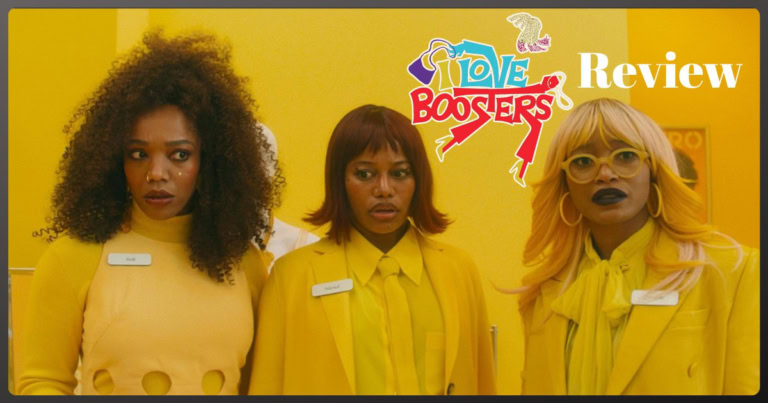
It would be futile for me to give you a succinct plot summary of Boots Riley’s I Love Boosters. The movie is the rapper-turned-filmmaker’s sophomore effort in the world of cinema following Sorry to Bother You and, most recently, a digression inside the world of television with the limited series I’m a Virgo. It would also be futile for me to say that this film is better than his wild, hypermaximalist feature directorial debut. There was no way he would ever be able to top something like this. Riley recognizes that it would be practically impossible to do this, which is why he throws everything on the screen in his latest motion picture. This film acts as the most potent expression of his love of cinema and visual art you may see on the big screen all year.
No, really. I couldn’t tell you what it was about, but I didn’t care either. There’s so much creativity brimming in this 114-minute crime comedy. You eventually begin to suspend your disbelief and surrender to Riley’s dream-like logic as he focuses on a group of shoplifters, led by Keke Palmer’s Corvette. Alongside friends Sade (Naomi Ackie) and Mariah (Taylour Paige), Corvette’s booster gang targets the powerful fashion brand of Christie Smith (Demi Moore), a designer who has stolen multiple ideas from Corvette and branded them as her own.
A late arrival from a teleporting Jinhu (Poppy Liu) also repurposes the gang’s boosting operation in a smart and engaging way that refreshes our modern conception of cinema in a world convinced that fully digitized environments are the way to go. We’ve lost our sense of creativity if we churn out everything from a computer. Some artists can accomplish this feat well (read: James Cameron), but it’s impossible for fully virtual worlds to feel impressive if every single film coming out of Hollywood uses the same digital techniques.
A film like I Love Boosters raises the bar for what cinema can accomplish in our era of hyper (perhaps over) stimulation and shortening attention spans. Riley is a maximalist first before a formalist, which makes him a hot commodity at a time when films, as a visual and aural medium, have lost their artistic essence.
I Love Boosters is an explosion of colors and filmmaking techniques
In the first minute of I Love Boosters, Riley dazzles us with exaggerated color schemes, even designing Christie’s flagship Metro Design stores with primary (bright) colors, such as vivid greens and yellows worthy of Jacques Demy. To say these colors pop on the screen would be the understatement of a generation. Natasha Braier’s photography is so textured and dynamic that it doesn’t take long for anyone to be immediately enticed by Riley’s artistic intent. His convoluted narrative slowly begins to make sense when all the pieces are laid out. The thing is, even if we don’t understand all of it, we can still feel the expressions at the heart of the movie, which, in turn, creates its own sense of logic.
It’s a film that’s always on the precipice of dreams and reality, as if we’re always in the protagonist’s shoes. The metaphorical boulder of debt and overdue bills that continually follow Corvette throughout the film serves as the main anchor between our fantasies and nightmares. Appropriating Spike Lee’s signature double dolly also exacerbates the feeling that we’re never looking at the harsh conditions of reality but rather a heightened vision of the hell the protagonist feels stuck in.
Why is Christie Smith’s building crooked, like the Leaning Tower of Pisa, if not to represent the corrupt nature that most CEOs inhabit? Exploiting their corporate workers for meager wages and, even worse, treating the factory employees as disposable and purposefully exposing them to unhealthy conditions.
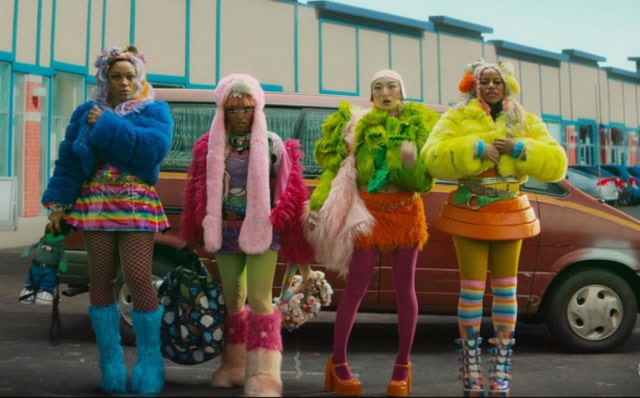
The ones at the top will always benefit from the people they exploit, either at the corporate or manufacturing level, because they don’t care about anyone but themselves. You didn’t need a film to tell you this, sure, but Riley’s messaging still feels increasingly urgent at a time when simply getting by is becoming increasingly difficult and getting even stable employment almost seems impossible.
CEOs never value the people who work for them and always treat them as numbers, ready to be rid of whenever they no longer contribute to the company’s bottom line. Moore’s turn may be caricatural, but it’s also based on such truth that we immediately recognize that her soulless nature is part of a system that benefits only the 1% and leaves everyone else behind.
Of course, Riley will bathe in Jacques Tati-esque slapstick with Shields’ strange building (lord knows he lingers on this, but it’s very funny). However, this type of visual information that astute viewers will immediately pick up on is only slightly inferred (even though Riley’s style is anything but subtle) before he clears it all up in the movie’s exciting climax. There’s a clash of creative expressions that, while primitive, show the makers of the alleged Dream Machine what they’ve been missing. Again, today’s American cinema is unimpressively stale. The grandeur of digital images no longer holds weight because audiences are accustomed to seeing the same things over and over again.
A pure expression of Boots Riley’s unwieldy imagination with something to say at its core

In I Love Boosters, Riley employs miniatures to visualize a large-scale car chase between Corvette’s gang and the police, which feels refreshingly simple, even as most filmmakers have given up on creativity. There’s something so deeply human in seeing a director essentially play with toys and give them tangible scale when this could’ve easily been done in camera as a Fast & Furious-inspired setpiece.
The miniatures, however, keep Riley’s artistic essence intact as he flows between genres and smashes together filmmaking figures, creating his own approach to overstimulation. I couldn’t describe the sheer sense of euphoria I had watching the film’s denouement, which sees stop-motion figures fight inside Corvette’s miniaturized imagination in words. The awe-inspiring nature of such a sequence must be seen with your own eyes to be believed.
The movie does get occasionally overstuffed with far too many ideas and thematic threads, especially when it adds Jinhu to the mix, but it’s more of a feature than a bug. The proposition at the heart of I Love Boosters is so effervescently creative that none of us care if Riley indulges a bit too much in excess.
Better a movie that has too many things going on at the same time and excites our senses than one that accomplishes one goal but has little to say in return. That’s the most impressive aspect about Riley’s latest. As much as it fills the screen with as many unwieldy pop-art images as it can, it’s also extremely cogent in its messaging and never strays away from the filmmaker’s personal anti-capitalist parables.
The acting also helps hammer the message home, with Keke Palmer and Naomi Ackie being massive standouts from a star-studded ensemble. Eiza González’s Violeta serves as the conduit for large chunks of exposition as her character is blazed out of her mind. Somehow, it works because Riley’s stylistic inspirations are so invigorating that it won’t take long for any of you to get swept up into this chaotic cinematic explosion that is I Love Boosters.
Sometimes, all that’s needed to enjoy a movie is for you to surrender to the filmmaker’s logic and let their imagination run wild in your mind. I don’t let many directors into my brain like this (I actually don’t let them in at all), but I’ll give Boots Riley a pass. His mind is fun.
Also check out: The Substance Movie Review with John & Vin